


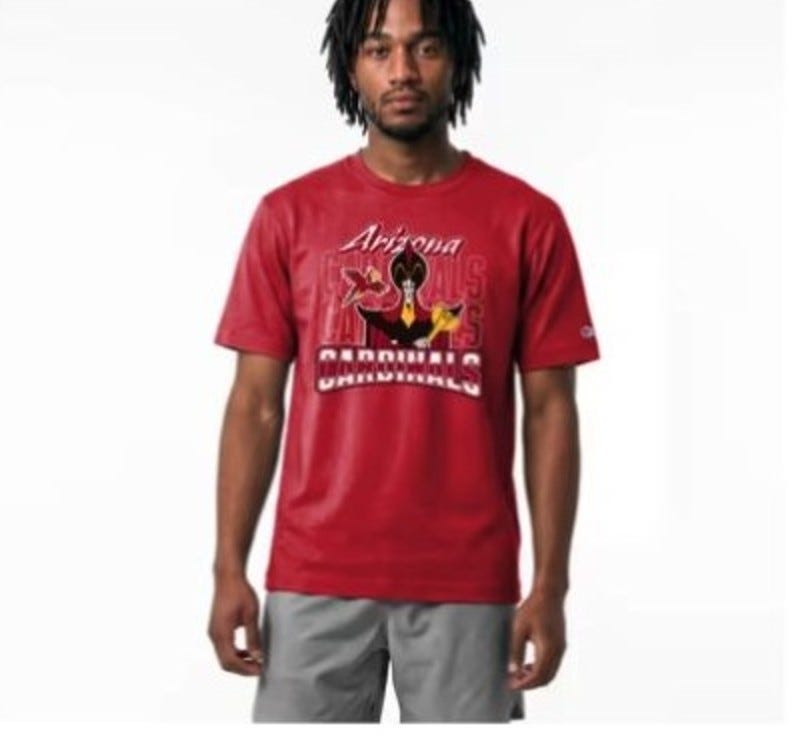
An Arizona Cardinals T-shirt has an unexpected new bird.
Iago, the red parrot from Disney's Aladdin, appears alongside the villain Jafar against a backdrop of Cardinals lettering. The design is part of a new merchandise collection pairing NFL teams with characters from Disney, Pixar, Marvel and Star Wars. Fanatics lists the shirt at a regular price of $39.99.
The novelty apparel is one piece of a much larger business relationship between Disney and the NFL, encompassing merchandise licensing, television rights, streaming and an ownership stake in ESPN.
In January, the NFL acquired 10% of ESPN in exchange for media assets in a transaction Disney valued at approximately $3 billion. ESPN is preparing to produce its first Super Bowl in February 2027, with the game airing on ABC, ESPN and Disney+. Meanwhile, Disney is bringing its characters into football through merchandise, animated broadcasts and a yearlong promotional campaign.
The arrangements give the companies more ways to reach consumers and generate revenue from audiences they already share. How much additional business they produce remains largely undisclosed.
The Business Behind a Disney Football Shirt
The Disney-Champion NFL collection debuted July 16 at Fanatics Fest in New York, where NFL Commissioner Roger Goodell and broadcaster Taylor Rooks hosted a staged character draft. The first eight team-character pairings were revealed there, with the remaining 24 announced Aug. 24.
Some selections draw on the teams' identities. The Dallas Cowboys get Woody from Toy Story, the New England Patriots get Captain America and the Las Vegas Raiders get Darth Vader.
Others require more specialized football knowledge. The Washington Commanders were paired with Hamm, the Toy Story piggy bank, a reference to the Washington franchise's celebrated 1980s offensive line, known as the Hogs.
Bret Healey, director of graphic design at Disney Consumer Products, told the entertainment website Laughing Place that the idea grew out of seeing visitors wear their hometown teams' apparel at Disney parks.
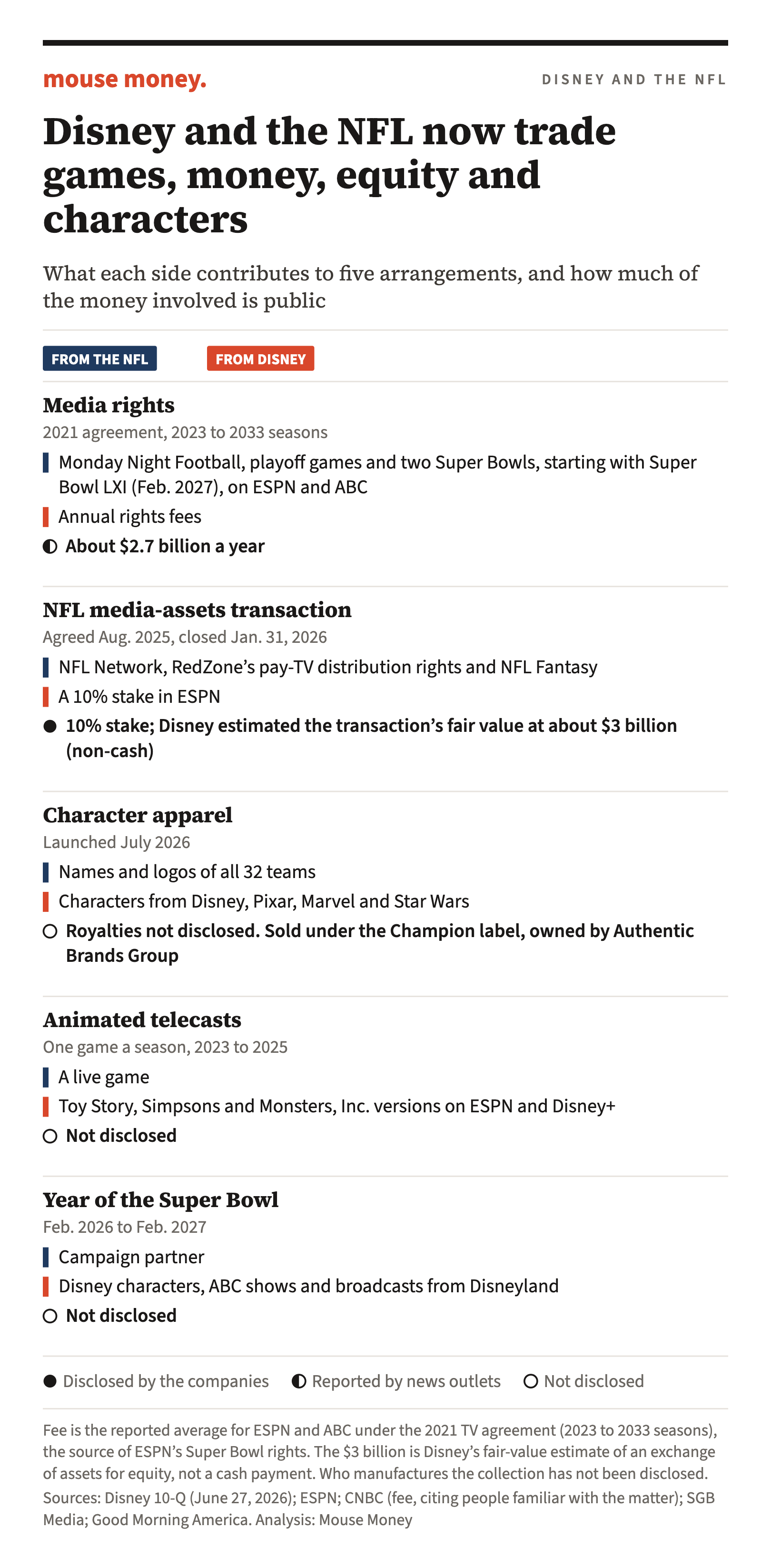
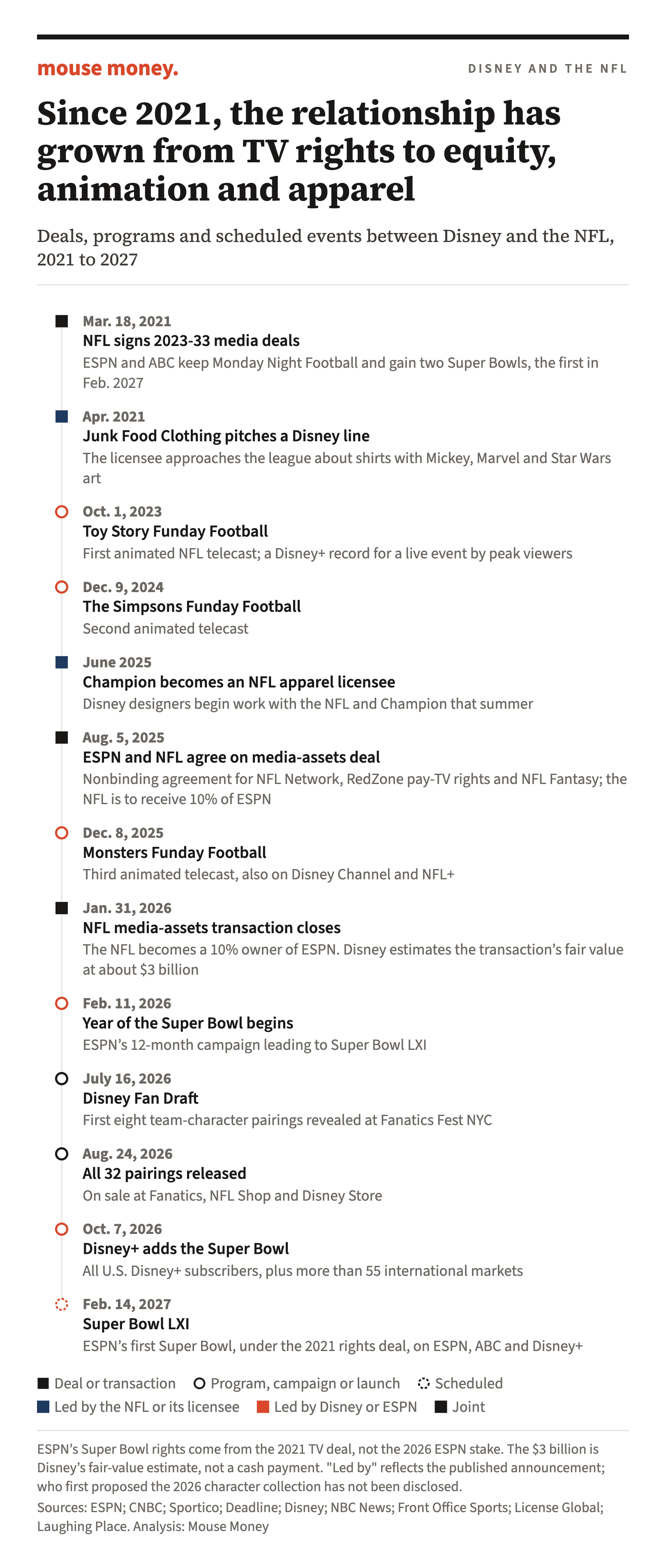
Disney characters have appeared on NFL clothing before. In 2021, a licensee called Junk Food Clothing approached the league about a line combining team logos with Mickey Mouse, Marvel and Star Wars imagery.
The latest collection is broader, with pairings for all 32 teams, and ESPN is promoting it as part of its buildup to the 2027 Super Bowl.
Several companies have a financial interest in the clothing.
Disney owns the characters, while the NFL controls the licensing of its team identities. The apparel carries the Champion label, which Authentic Brands Group acquired in 2024. Champion's U.S. teamwear business is managed by Ames Watson, which also has an investment relationship with Lids. Fanatics, another major retail partner, identifies itself as Lids' majority owner.
Licensed merchandise typically generates royalties for the owners of the intellectual property involved. But the companies haven't publicly disclosed the royalty rates, revenue shares or minimum guarantees for this collection.
That makes the $39.99 regular retail price a poor guide to what Disney receives, how much goes to the NFL or what remains for the companies making and selling the clothes.
Disney's broader licensing business illustrates the potential scale. In fiscal 2025, the company reported $3.879 billion in merchandise-licensing revenue.
Separately, the trade publication License Global estimated in its 2026 rankings that Disney-licensed products generated $63 billion in worldwide retail sales during 2025, more than those of any other company it tracks.
The measures aren't interchangeable. Disney's reported figure represents revenue it recognized. The industry estimate measures consumer spending on licensed products, much of which goes to manufacturers and retailers.
Disney also participates in retail sales directly. It sells the NFL collection through DisneyStore.com, while Good Morning America, part of Disney-owned ABC News, published shopping coverage featuring links to the clothing. A disclosure accompanying that coverage says ABC receives commissions on purchases made through those links.
The NFL has another financial connection to the retail business. In 2022, it invested $320 million in Fanatics as part of a $1.5 billion financing round. That investment gave the league an equity interest in Fanatics, separate from its role as a merchandise licensor.
It doesn't establish that the league receives any additional payment on an individual shirt sale.
The result is a network of commercial relationships surrounding a single product. What remains unavailable is a breakdown of how much each participant earns.
The Much Bigger ESPN Deal
The more consequential financial connection between Disney and the NFL was completed Jan. 31.
ESPN acquired NFL Network, the pay-TV distribution rights to NFL RedZone and the league's fantasy football business. The NFL retained ownership and production of RedZone, along with its digital-distribution rights.
In exchange, the league received a 10% noncontrolling interest in ESPN. Disney now holds an effective 72% stake in the sports network, Hearst owns 18% and the NFL owns 10%.
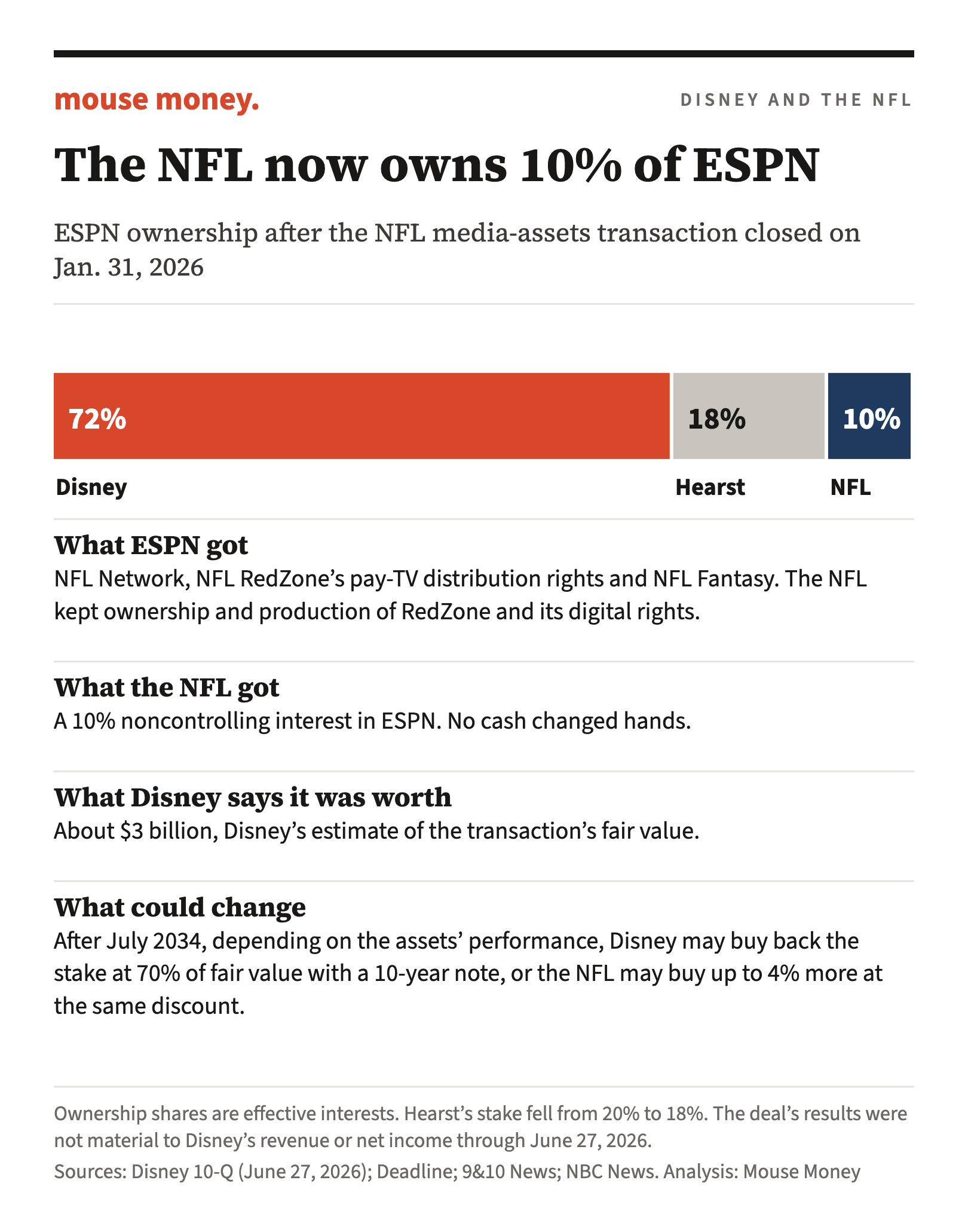
Disney valued the noncash transaction at approximately $3 billion, according to its securities filing.
The ownership arrangement need not be permanent. After July 2034, depending on the performance of the acquired assets, Disney may gain the right to repurchase the NFL's stake at 70% of its then-current fair market value, using a 10-year note. Alternatively, the NFL may gain the right to acquire up to an additional 4% of ESPN at a similar discount.
The acquired assets haven't materially affected Disney's consolidated results. The company said their contribution to revenue and net income wasn't material for the quarter and nine months ended June 27, 2026.
Disney's financial relationship with the NFL extends well beyond the assets it acquired in January.
ESPN's television-rights agreement with the league was negotiated in 2021, years before the NFL became an ESPN shareholder. The agreement extended Monday Night Football rights through the 2033 season and awarded ESPN and ABC two Super Bowls.
CNBC reported at the time, citing people familiar with the negotiations, that Disney would pay approximately $2.7 billion annually. The companies haven't publicly confirmed the figure.
The first Super Bowl under that agreement is scheduled for Feb. 14, 2027, at SoFi Stadium in Inglewood, Calif.
Disney has since expanded its distribution plans. On Oct. 7, ESPN announced that all U.S. Disney+ subscribers would be able to stream the game, with the service also carrying it in more than 55 international markets.
Advertising demand has been strong. Disney said in August that it had sold out its commercial inventory for the game, with 58 brands securing advertising time across 34 categories.
The Super Bowl is also the centerpiece of a 12-month marketing campaign spanning Disney's entertainment businesses. One advertisement reworks the company's familiar “I'm going to Disney World!” Super Bowl tradition with more than 60 Disney characters. The NFL apparel collection is another part of that promotional effort.
The connections are commercial, but they shouldn't be confused with the terms of the January media transaction.
Disney and ESPN secured the 2027 Super Bowl rights years before the NFL received its ownership stake. Neither company has publicly established that the apparel agreement was negotiated as part of the January deal.
What has changed is the financial relationship: The NFL now owns part of ESPN, the network that broadcasts Monday Night Football and will televise the 2027 Super Bowl.
Can Disney Bring New Viewers to Football?
The collaboration also extends to animated broadcasts intended to reach audiences beyond conventional sports television.
In October 2023, ESPN and Disney transformed a live Atlanta Falcons-Jacksonville Jaguars game into Toy Story Funday Football. A December 2024 broadcast put the Cincinnati Bengals and Dallas Cowboys into the world of The Simpsons. In December 2025, the Philadelphia Eagles and Los Angeles Chargers played inside an animated version of the factory from Pixar's Monsters, Inc.
The broadcasts use player-tracking data from Sony's Hawk-Eye system and animation technology from Beyond Sports to recreate the action in real time.
ESPN has been explicit about its ambitions. Before the Simpsons broadcast, Rosalyn Durant, an ESPN executive vice president who oversees league programming, described audience expansion as a top priority for the network.
The format gives viewers another way to experience football, potentially attracting people more familiar with Disney characters than NFL players. It also provides Disney's streaming services with programming built around franchises the company already owns.
But drawing someone to an animated broadcast doesn't necessarily make that person a regular football viewer. The companies haven't released sufficiently detailed data to establish how many occasional viewers subsequently became regular NFL viewers.
The merchandise presents a related question, although its immediate commercial purpose is simpler.
A Simba shirt bought by a longtime Detroit Lions supporter generates retail sales and potential licensing revenue. The same shirt bought by a Disney fan who doesn't follow football could introduce the NFL to a new customer.
Both purchases can be commercially valuable. Neither requires the buyer to become a regular football viewer for the sale to generate revenue.
Beyond the Merchandise
The financial scale of the Disney-NFL relationship is clearest in television rights, licensing and ESPN ownership. The economics of individual merchandise and promotional collaborations are considerably less transparent.
That distinction matters. A merchandise sale doesn't necessarily demonstrate growth in the NFL's audience, just as viewership of a special animated broadcast doesn't establish a lasting increase in football fandom.
What the arrangements do demonstrate is how Disney and the NFL can use familiar assets across multiple businesses.
Disney characters appear on football merchandise, in television promotions and in animated broadcasts. NFL games reach viewers through ESPN, ABC and Disney+, while licensed clothing is sold through Fanatics, the league's retail channels and Disney's own stores.
The Jafar shirt is an unlikely symbol of that relationship. What looks like an amusing pairing of a cartoon villain and a football team reflects a broader effort to generate business from audiences the companies already command.
Neither Disney nor the NFL needs to create a new football fan with every collaboration to benefit commercially. They can also seek additional spending and engagement from existing customers.
Whether these arrangements produce substantial additional profits remains unknown. What is clear is that Disney and the NFL have created more opportunities to generate revenue from audiences they already share.
Sources
Fanatics: Arizona Cardinals Disney x Champion Jafar and Iago All-Star T-Shirt
Disney, Jul 2026: Disney x Champion NFL Collection debuts at Fanatics Fest
ESPN, Aug 2026: All 32 Disney x Champion NFL team pairings revealed
Laughing Place: Interview with Bret Healey, Disney Consumer Products
Sportico, 2021: NFL and Disney apparel deal with Junk Food Clothing
License Global, Aug 2026: Disney maintains licensing dominance with $63B in retail sales
Good Morning America, Aug 2026: Shop the Disney x NFL collection
Sportico, 2022: NFL leads Fanatics funding round with $320 million
Disney 10-Q for the quarter ended June 27, 2026 (Note 4, NFL media assets)
9&10 News, Feb 2026: ESPN to distribute NFL RedZone, NFL retains ownership
ESPN, Mar 2021: Disney, ESPN and NFL reach long-term agreement
Disney Advertising, Aug 2026: Super Bowl LXI inventory sells out
Awful Announcing, Dec 2024: ESPN executives on The Simpsons Funday Football