


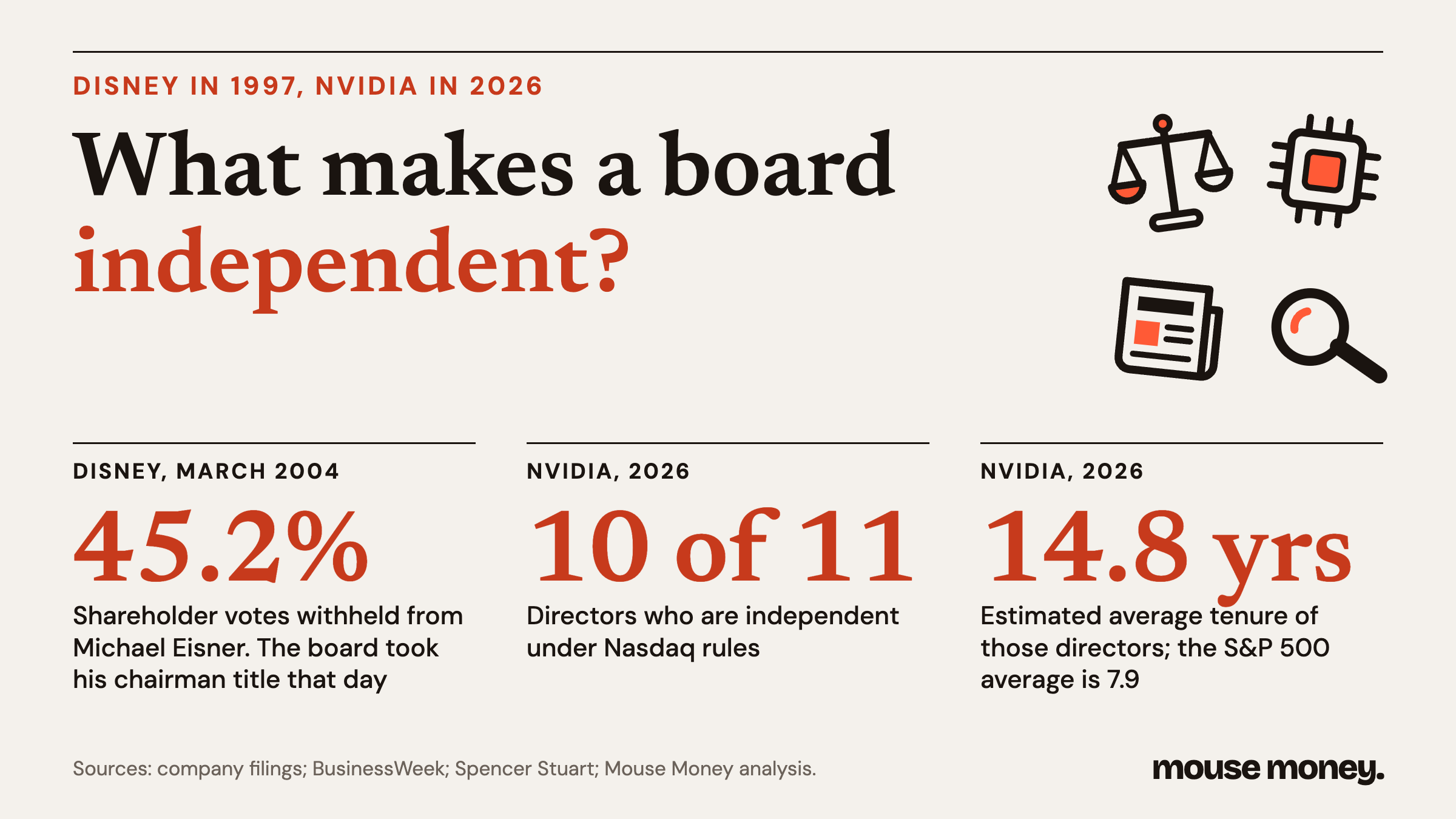
In December 1997, BusinessWeek ranked Disney’s directors the worst board in America. Michael Eisner, the chairman and chief executive, had an answer. Disney’s shares had returned more than 20% a year for a decade, and he said he had a fantastic board.
Nvidia’s directors are hearing a version of that question this month, and their defenders are giving a version of that answer. On Nov. 8 the board opened an investigation into reports involving its founder and chief executive, Jensen Huang. On Nov. 17, the same day Disney reports its results, Nvidia holds its first earnings call since then, and analysts get their first chance to question management.
The two cases are not the same, and the difference matters. Disney’s boardroom failures are documented in a court record. Nothing in the public record shows that Nvidia’s board has failed in the matters now under investigation. It is facing a major public test.
Our view: Disney’s history shows what the test is. A board shows its independence by how it handles evidence that could be unwelcome, and Nvidia’s directors added to their burden with their first statement.
What Nvidia’s board has done so far
News reports citing U.S. officials say an intelligence memo alleged that Alice Huang, a former executive at Nvidia customer Megaspeed, was recruited by China to gather information on Jensen Huang. The two are not related. China calls the claim groundless, and no charge has been brought.
On Nov. 8, Huang told employees he had been unfaithful to his wife. He did not name anyone.
The same day, the board said a committee of independent directors would oversee an investigation. In the same statement it said it had “confidence in Jensen and his leadership team.”
On Nov. 10, the independent directors said they had retained Joon H. Kim, a former acting U.S. attorney in Manhattan, and his firm, Wachtell, Lipton, Rosen & Katz.
Hiring a former federal prosecutor is a serious step. But the board has not said which directors sit on the committee, whom the lawyers report to, or whether the findings will be made public.
The board also expressed confidence in Huang as it opened the inquiry. There is a sound reason to do that. A company of Nvidia’s size cannot leave employees, customers and investors guessing about who is running it, and confidence in someone’s leadership during an inquiry is not a judgment on what the inquiry will find. But the statement raises the bar. Whatever the committee concludes, the directors will need to show their work for the conclusion to be believed.
The public record does not say what the directors knew about any of this, or when they learned it. The company described Huang’s dealings with Megaspeed as routine as recently as Oct. 29 and Nov. 6. A proposed shareholder class action filed Nov. 9 centers on those statements.
Reasons to look closely, and the other side
By the formal measure, the board is independent. Ten of 11 directors qualify under Nasdaq rules, and Huang owns 3.58% of a single class of stock, so he does not control the vote.
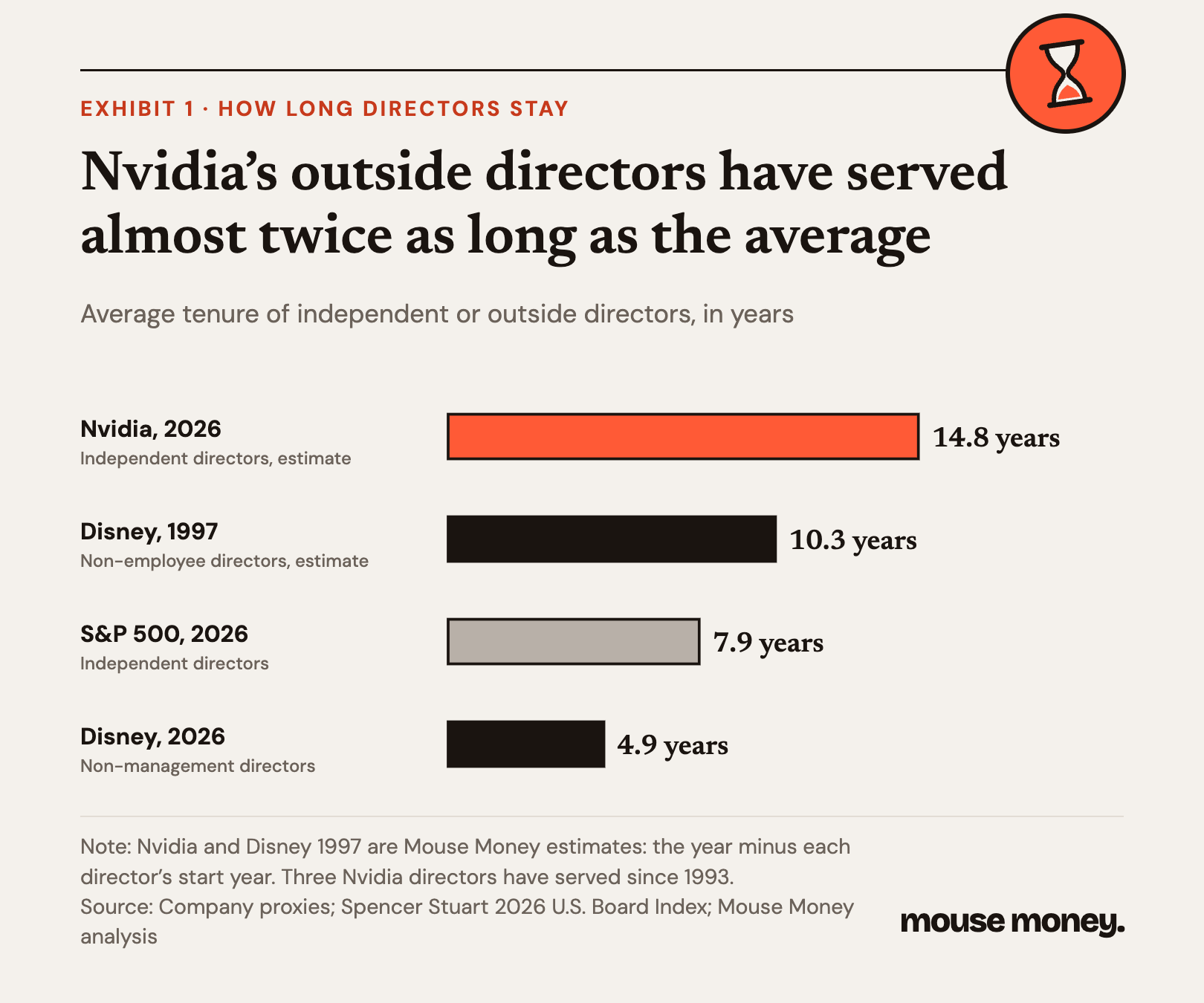
Critics point to features the rules do not measure. Three directors have served since 1993, the year Nvidia was founded. Independent directors have served an estimated 14.8 years on average, against 7.9 for the S&P 500. Three are billionaires from their Nvidia shares, by Bloomberg’s count. The lead independent director, Stephen Neal, is chairman emeritus of Cooley, a law firm that does legal work for the company. ISS, the proxy adviser, recommended all of Nvidia’s nominees this spring but gave its board structure its riskiest rating, The Wall Street Journal reports.
None of that proves deference. Large shareholdings tie directors’ wealth to the outcome other shareholders want. Long service brings knowledge of the business and, sometimes, the standing to say no.
Nvidia has no chairman, but its proxy gives the lead director real powers. He schedules board meetings, works with Huang on the agendas, can require that risk matters be added, and runs quarterly sessions of the independent directors without Huang in the room.
The question is whether those powers work when it counts. Jill Fisch of Penn Carey Law told Semafor the board’s makeup suggests a chief executive with effective control. Director Mark Stevens told Forbes in 2024 that he thought it might be the best board in America. The investigation is a chance to find out which is closer.
What a deferential board looked like at Disney
Disney’s record is not a matter of inference. In December 1996, a year before the BusinessWeek ranking, Disney paid Michael Ovitz about $130 million to leave after 14 months as president. Eisner had recruited him.
The board included Eisner’s personal lawyer, his architect and the principal of the school his children attended. By BusinessWeek’s count, seven of 16 directors were current or former Disney executives.
Shareholders sued over the payout. In 2005 a Delaware judge cleared the directors of liability, but he wrote that Eisner had stacked the board with friends, and he put the phrases “imperial CEO” and “supine or passive board” on the record.
When Disney’s board showed it was independent
Disney’s directors did eventually act against a chief executive. Two decisions stand out, and they are not equally strong evidence.
March 2004. Roy E. Disney had resigned from the board on Nov. 30, 2003, and campaigned against Eisner through the winter. At the annual meeting, shareholders withheld 45.2% of their votes from Eisner, by the certified count. The same day, the board took the chairman title from him and gave it to George Mitchell, a director and former U.S. senator. Eisner left in 2005.
November 2022. The board removed Bob Chapek as chief executive five months after extending his contract, and brought back Bob Iger.
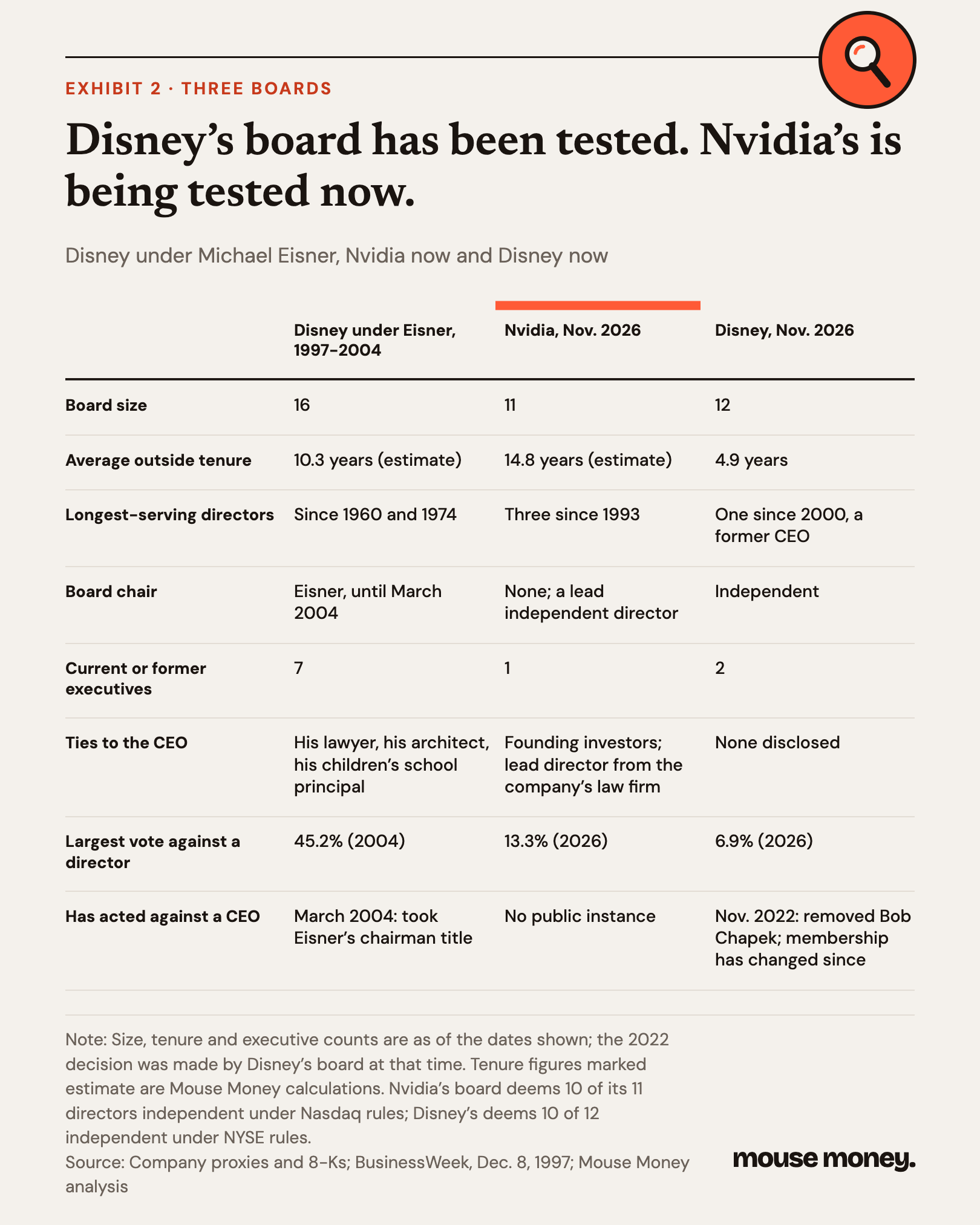
The 2004 decision came only after an extraordinary shareholder vote. It still counts. The directors reached a conclusion their chief executive did not want, and acted on it.
The 2022 decision is weaker evidence. Removing Chapek showed the board could dismiss a chief executive, though it was reversing its own choice of successor. Bringing back Iger, who had run the company for 15 years, showed how much it still leaned on one dominant leader. Being able to remove a chief executive is not the same as being able to build a succession that lasts. In between, in 2012, the board had given Iger the chairman title as well.
Disney has since rebuilt the structure. James Gorman, who ran succession at Morgan Stanley, became independent chairman in January 2025. The board unanimously named Josh D’Amaro chief executive in February, and outside directors now average 4.9 years of service. It is too early to call that succession a success. What Disney’s record does show is that a board once ranked the worst in America later reached a conclusion its chief executive did not want.
What returns can and cannot tell you
Eisner’s defense was his stock price. Nvidia’s is stronger. By the company’s proxy, $100 invested at the end of fiscal 2021 was worth $1,445.67 five years later.
Returns reflect many things: the product, the market, the chief executive, luck. They cannot isolate the quality of oversight. Disney’s shares returned more than 20% a year in the decade that ended with the Ovitz payout. And Disney’s shares trailed its peers over the five fiscal years through 2025, a period that included the Chapek decision and a rebuilt board. Good governance does not guarantee good returns, and good returns do not show that anyone is watching.
They can make watching harder. Directors who have seen a chief executive create that much wealth, including their own, have every reason to give him the benefit of the doubt.
What would show independence
On the Nov. 17 call, listen for whether Huang takes questions on the investigation and whether any director speaks. Disney reports that morning, in Josh D’Amaro’s first full-year call as chief executive.
After that, the tests are about conduct. Independence does not mean opposing the chief executive. It means being free to reach an unwelcome conclusion if the evidence leads there. A board could investigate thoroughly and reasonably keep Huang in place. It could also appoint a chairman and change nothing.
Access to evidence. Whether Kim and Wachtell get the documents and the people they ask for.
Freedom from interference. Whether the committee’s members are named, and whether the lawyers report to the committee alone and not to management.
Credible findings. Whether shareholders see what was examined and what was found, or only a conclusion.
Action that fits the findings. Whether what the board does next follows from the evidence, whichever way it points.
No single item would settle the matter. Together they would be evidence.
More than six years passed between the worst-board ranking and the day Disney’s directors took Eisner’s title. Nvidia’s directors face the same question on a much shorter clock: are they free to reach a conclusion their celebrated chief executive would not welcome, if that is where the evidence leads?
A board can look independent on paper and still lack the will to challenge its chief executive. Disney’s experience shows how costly that deference can be for a company and its shareholders. Whether Nvidia’s board proves independent in practice remains to be seen.
A note on the numbers
Tenure averages for Nvidia and for Eisner’s board are our estimates from proxy data.
The 2004 withhold vote was announced as about 43% and certified at 45.2%.
The Ovitz severance is the Delaware Supreme Court’s figure.
Return figures come from each company’s own proxy. The periods and peer groups differ, so we do not compare the two companies directly. Disney’s proxy shows $100 becoming $94.13 over fiscal 2021 to 2025, against $224.99 for its peers.
The intelligence claims are allegations from news reports citing officials. Nothing here shows wrongdoing by any Nvidia director.
Sources
In re The Walt Disney Co. Derivative Litigation, Delaware Court of Chancery, Aug. 9, 2005
The Wall Street Journal, Nov. 10, 2026; Spencer Stuart 2026 U.S. Board Index; Disney 10-Q, May 13, 2004; Disney and Nvidia 8-Ks