


I have gone to Disney World almost every year since 1982, the year Disney started selling an annual pass there. The Annual World Passport cost $100 for an adult and covered a year of admission to two parks, Magic Kingdom and EPCOT, which was about to open. Disney's 1982 employee bulletin
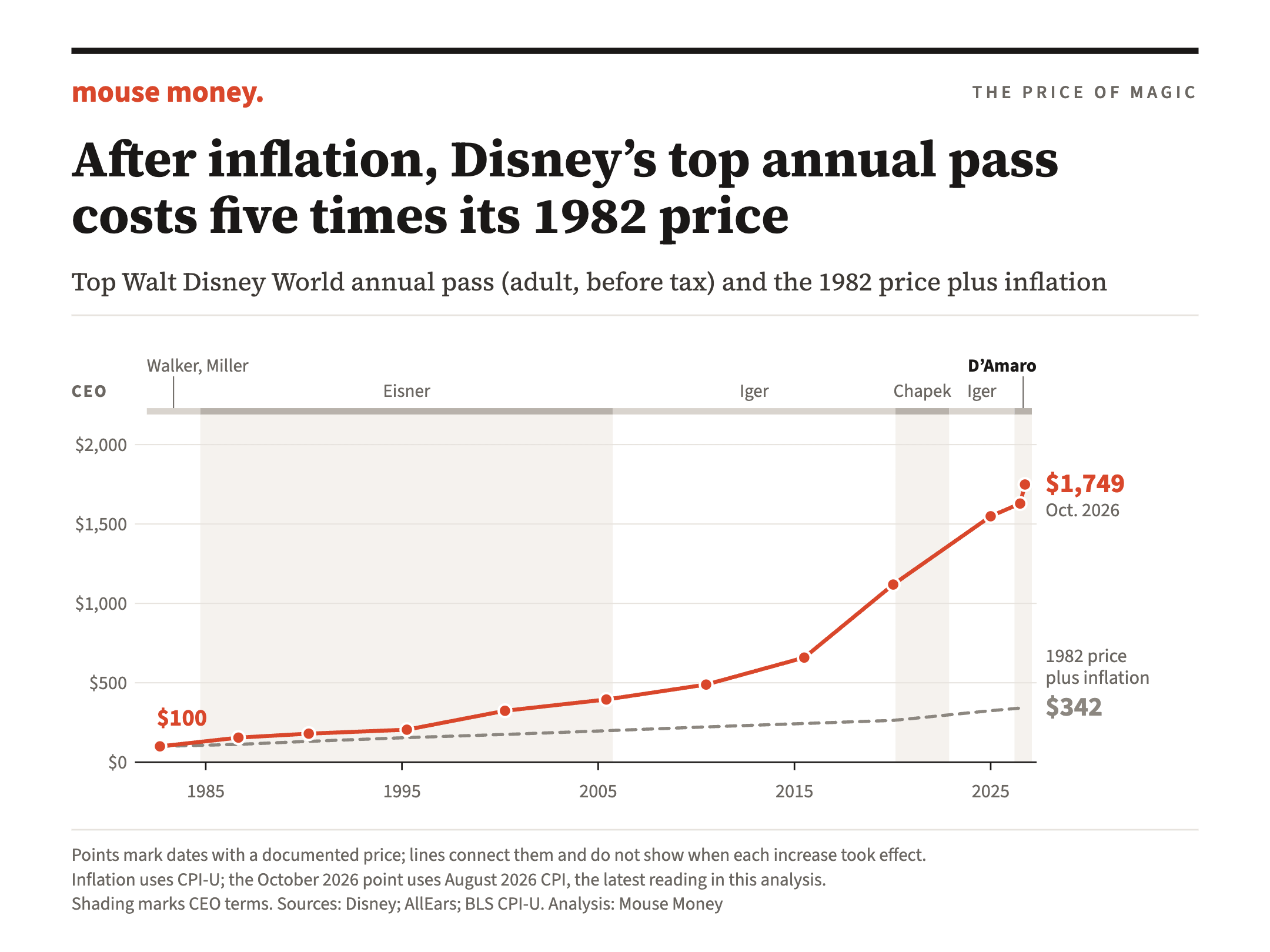
Today the Incredi-Pass, the only Disney World annual pass sold to the general public without Florida residency or a Disney Vacation Club membership, costs $1,749 before tax. It has no blockout dates, though visits are still subject to Disney's pass terms, including park reservations where required. Disney's current pass prices
Adjusted for inflation ($100 in 1982 is worth about $342 today), that is roughly five times the original price, although today's pass covers four parks rather than two and operates under different rules. CPI-U
At its year-end 2025 price of $1,629, one pass cost about 1.86% of median U.S. household income, compared with 0.60% in 1984. Pass price history, Census income data
Disney has raised the price of belonging much faster than inflation, and it has also taken more control over when that belonging gets you in.
The latest increase, and a former CEO's account
In October, Disney raised the Incredi-Pass by $120, from $1,629 to $1,749. That is the largest dollar increase since the pass launched in 2021. At 7.4%, it is smaller in percentage terms than the 7.7% increase in 2022. 2026 increase
On September 29, Bob Chapek published Behind the Castle Walls, a memoir that includes his account of annual-pass pricing during his time as CEO. Publisher
According to BlogMickey's coverage of the book, Chapek writes that Michael Colglazier and Josh D'Amaro, who was then running Walt Disney World and is now Disney's CEO, studied the annual-pass business with him and recommended changes to shift demand and spread out crowds. They told him, he writes, that the pass was a fantastic deal for passholders and a terrible one for Disney. In BlogMickey's telling, Chapek describes D'Amaro as a "key ally" and as the "tip of my spear" in rolling out park reservations. BlogMickey on the memoir
Chapek's account, as reported by BlogMickey, describes D'Amaro's involvement but does not establish responsibility for individual price increases.
The leadership record is simpler:
May 2020: D'Amaro becomes parks chairman, reporting to Chapek.
November 2022: Disney announces a pass increase on November 15, while Chapek is CEO. Robert Iger returns as CEO on November 20, before it takes effect.
2023 to 2025: Further increases follow under Iger, with D'Amaro still running the parks.
March 18, 2026: D'Amaro becomes CEO, and Thomas Mazloum succeeds him as parks chairman.
2020 appointment, 2022 announcement, Iger's return, 2026 succession, Mazloum appointment
D'Amaro ran the parks business through every pass increase from May 2020 until he became CEO, under two chief executives.
What the pass does for Disney
An annual pass commits the customer to a year of admission and gives the holder a reason to return. For Disney, that means cash committed early and more chances to sell food, merchandise and tickets for friends. On a slow Tuesday, a passholder fills space that would otherwise sit empty.
On a packed Saturday, the math flips. A park has only so many ride seats, restaurant tables and places to stand. A passholder who comes that day pays nothing more to get in. A guest buying a one-day ticket does.
Disney’s recent changes give it tools to manage that tension. When Disney resumed new pass sales in 2023, it said quantities would be limited and a pass type could sell out, even as it eased some reservation rules. Disney's announcement Tiers, blockout calendars, reservations and sales caps give the company several levers at once: it can earn more from each passholder, keep passholders away on the busiest days and steer some guests toward dated tickets. Disney doesn't publish the customer-level figures, such as visit frequency, in-park spending and hotel stays, that would show which lever matters most or whether passholders are more or less profitable than other guests.
Cheaper passes, different terms
Florida residents can buy the Pixie Dust Pass for $499. Measured against the $100 pass of 1982, that is only about 46% more after inflation. The catch is the calendar: it is good on eligible weekdays, with peak and holiday blockouts. Disney's Florida resident passes
A working parent who can mostly go on weekends faces a different choice from a retiree who can go on a Tuesday. Both may live in Florida, but the cheaper pass means something very different to each of them.
Disneyland follows the same pattern. Its Magic Key runs from $599 for the Imagine Key, sold only to Southern California residents, to $1,899 for the Inspire Key, and even the top tier has blockout dates and requires reservations. Disneyland's Magic Key comparison
The annual pass has always been more than a ticket. Disney now prices it more precisely, by who you are and when you want to come.
How the price compares
I compared the pass with 15 government price indexes for household costs, from September 1982 to August 2026. Over that period the pass rose from $100 to $1,629, more than sixteenfold, before October's increase. None of the 15 indexes rose as fast. The closest were hospital services, up about thirteenfold, and tuition, school fees and childcare, up almost tenfold. Rent rose less than fivefold. Hospital services, tuition and childcare, rent
Those are price indexes, not spending. A slower increase in a necessity can strain a family budget far more than a faster one in a vacation.
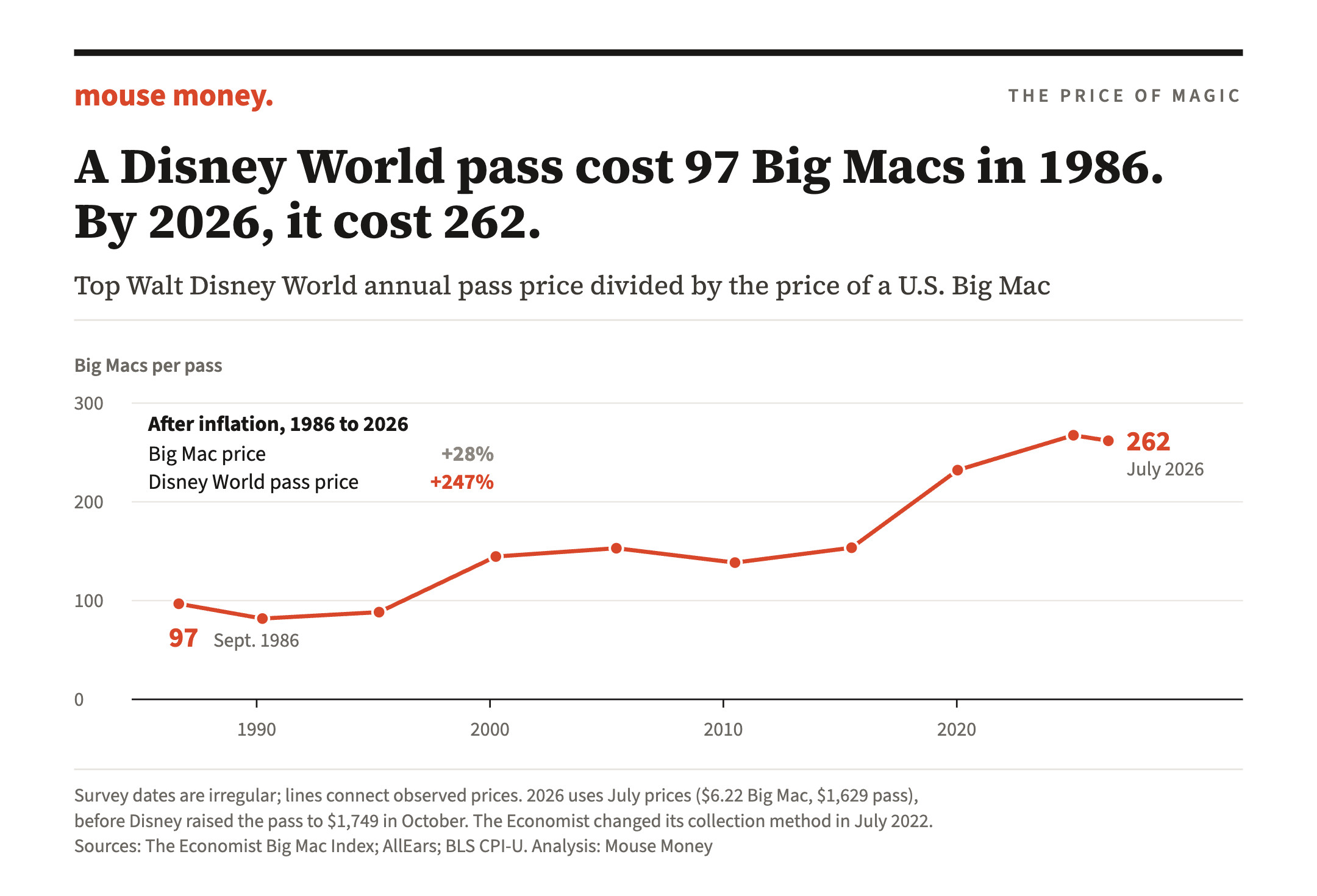
For a price you can picture: in September 1986, a U.S. Big Mac cost $1.60 and the pass cost $155, about 97 Big Macs. By July 2026, the burger cost $6.22 and the pass cost $1,629, or 262 Big Macs. After inflation, the Big Mac rose 28% and the pass rose 247%. The Economist's Big Mac data, pass price history
The math of belonging
Disney's strongest defense is everything it has built. The 1982 pass covered two theme parks, and today's covers four, along with entire new lands and attractions. Value and affordability are different questions, though. A family pays for a bigger bundle with cash, not with an estimate of how much better the bundle is.
For a frequent visitor, the pass still works. At $1,749, admission works out to about $175 a visit for someone who goes ten times and about $35 for someone who goes fifty, before travel, food or anything else. The effective price falls with every visit, which is why the pass rewards the people who come most.
So, has Disney gone too far?
On price, the record is clear. The pass has risen faster than inflation, faster than every household price index I checked and faster than median household income.
Whether that is too far depends on who is asking. For a customer, the question is affordability, and the pass now takes about three times the share of a median household's income that it did in 1984. For Disney, the question is commercial: whether higher prices and tighter access bring in more revenue and more manageable crowds than a cheaper, busier pass would. A pass can fail the first test and still pass the second.
Outsiders can't see where Disney's commercial limit is. Disney doesn't publish how many passes it sells, how often holders visit or how many renew, so neither continued sales nor a sold-out tier would settle whether the price is right for Disney, let alone for its customers.
That is the business of the annual pass. It makes coming back cheap once you've paid to belong. Over four decades, Disney has raised the price of belonging far faster than inflation and gained more control over when belonging gets you in. A customer can reasonably decide that is too far, even if Disney keeps selling every pass it offers.
Methodology: Inflation figures use monthly, unadjusted CPI-U for the U.S. city average. August 2026 is the latest CPI reading used, so comparisons with October 2026 pass prices carry a two-month lag. Comparisons with household price indexes run from September 1982 to August 2026, comparing the $100 pass of September 1982 with the $1,629 price in effect in August 2026. Income shares use year-end pass prices and median U.S. household income: $135 against $22,420 in 1984, and $1,629 against $87,460 in 2025. The Big Mac comparison runs from September 1986 to July 2026. Prices exclude tax and optional add-ons, and no dollar value is assigned to changes in attractions or benefits. Memoir material is attributed to BlogMickey's published coverage.