


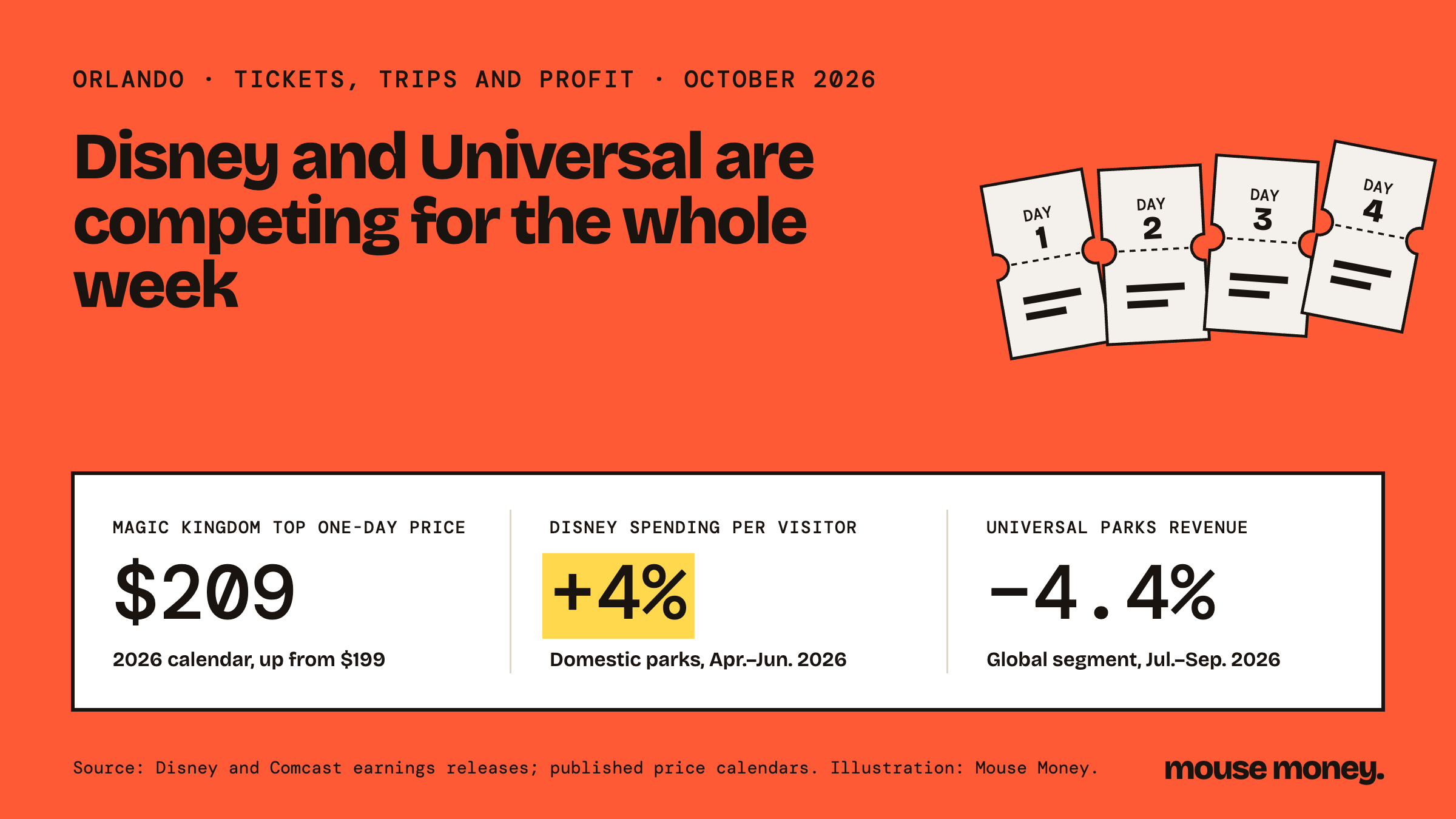
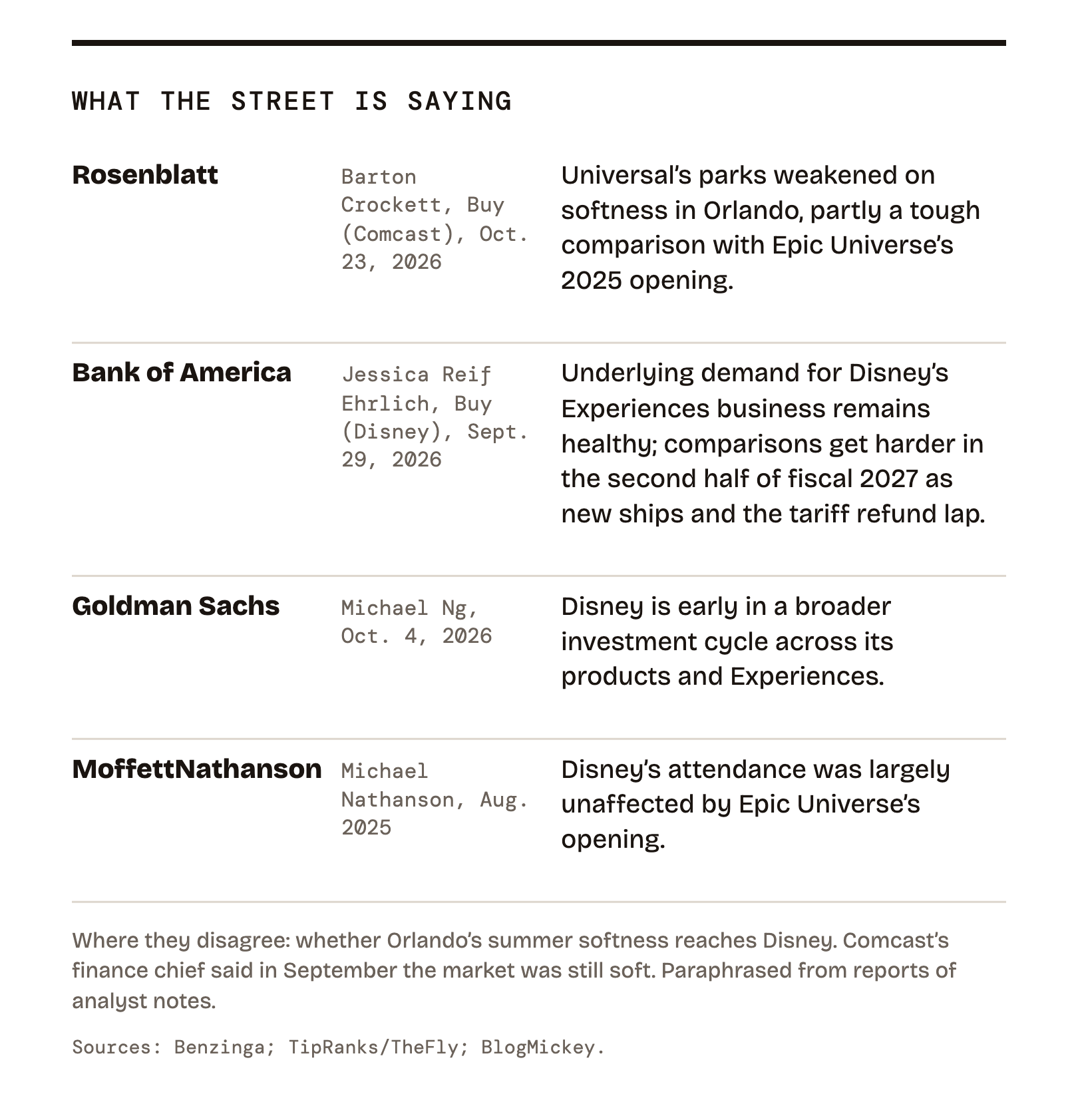
Universal's theme parks revenue fell 4.4% in the quarter ended Sept. 30, its first decline since Epic Universe opened. On the Oct. 22 earnings call, Comcast President Mike Cavanagh said competitors were quicker to recognize softening demand and adapt their marketing, and that Universal will answer with promotional packages, three-park passes and more media spending aimed at its Orlando parks. It has also hired a new head of marketing and pricing from an airline loyalty program.
Those moves matter because the real contest in Orlando is over a family's vacation days, not the price of one. Multiday tickets and hotel packages give visitors a reason to stay at one resort, which makes each additional day harder for the rival to win. On the evidence so far, Disney has played that game better, pairing targeted discounts with rising spending per visitor through June.
One limit applies throughout. Neither company publishes an Orlando income statement: Disney's domestic parks business includes Disneyland and its cruise line, and Comcast's parks segment includes Hollywood and Japan. Their results show the direction of each business, not which resort is winning days in Florida.
Universal's new commercial push
Luc Bondar, formerly chief operating officer and president of United Airlines' MileagePlus program, started Oct. 19 as chief brand and commercial officer of Universal Destinations & Experiences, succeeding Alice Norsworthy, who retires at the end of the year after more than 18 years with the company. He oversees marketing, sales, pricing and revenue management, a combination that puts the levers for packaging extra days under one executive.
At United he ran a business built on getting customers to come back. Universal's announcement says it wants to use technology and data to build more personalized guest relationships and loyalty. Cavanagh did not give terms for the new passes. Universal already sells three-day, three-park deals introduced in September, starting at $99 a day, or $85 for Florida residents. The direction is clear: sell the whole resort as a destination, not just a new park.
The ceiling moved, the floor didn't
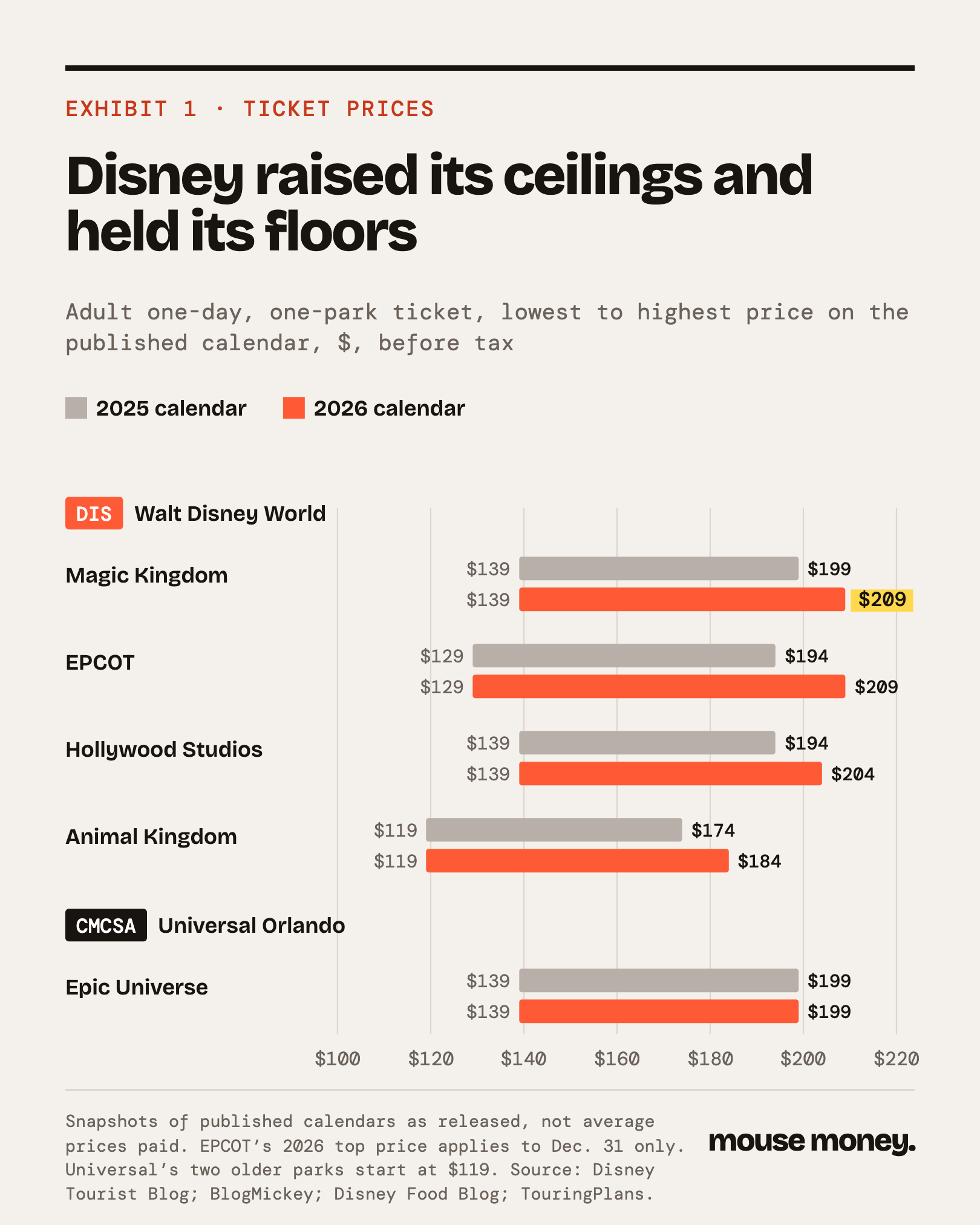
Disney's published price calendars show its approach. When it released 2026 prices in October 2025, a one-day Magic Kingdom ticket ranged from $139 to $209 before tax, up from $139 to $199. The floor held and the ceiling rose 5%. EPCOT, Hollywood Studios and Animal Kingdom followed the same pattern, with top prices up 5% to 8%.
Epic Universe's one-day prices ranged from $139 to $199 at both its 2025 launch and for 2026, overlapping Magic Kingdom's. Universal's two older parks start at $119. Epic was priced as an alternative to Disney's flagship, not a cheaper one.
The floor is a poor guide to what families pay. TouringPlans counted two days at Magic Kingdom's $139 minimum on the 2026 calendar. And the $229 peaks reported this month apply to holiday dates in 2027, so they say nothing about what this year's visitors paid.
What another day costs
The more revealing prices sit inside multiday tickets, where each added day gets cheaper. On Disney's calendar as of Oct. 26, a four-day ticket starting Sunday, Nov. 15, costs about $700 before tax for a guest 10 or older, or $175 a day. A five-day ticket for the same start costs about $785. The fifth day adds about $85.
A family weighing a day at Epic Universe on Thursday, Nov. 19, faces a different number. Epic's published one-day price for that date was $159 when Universal released its 2026 calendar. A family can rearrange its days or skip the extra one, but a day across town costs nearly twice as much as one more day at the resort it already chose. That gap is what multiday tickets are designed to create, and what Universal's three-park passes are meant to answer.
The offers differ in what they include. Universal's 2026 multiday tickets allow repeat visits to Epic and, on eligible tickets, park-to-park access. Disney's fall offer for eligible Disney+ members combines up to 25% off selected rooms with Park Hopper access on qualifying packages, which lowers the cost of a trip for one group without cutting published prices for everyone.
Universal's parks revenue turns down
Universal's parks revenue was up 24.2% in January through March, measured against a quarter before Epic opened. Growth slowed to 2.7% in April through June, the quarter of Epic's first anniversary, and adjusted EBITDA fell even as revenue rose. In July through September, with Epic open in both years, revenue fell 4.4%.
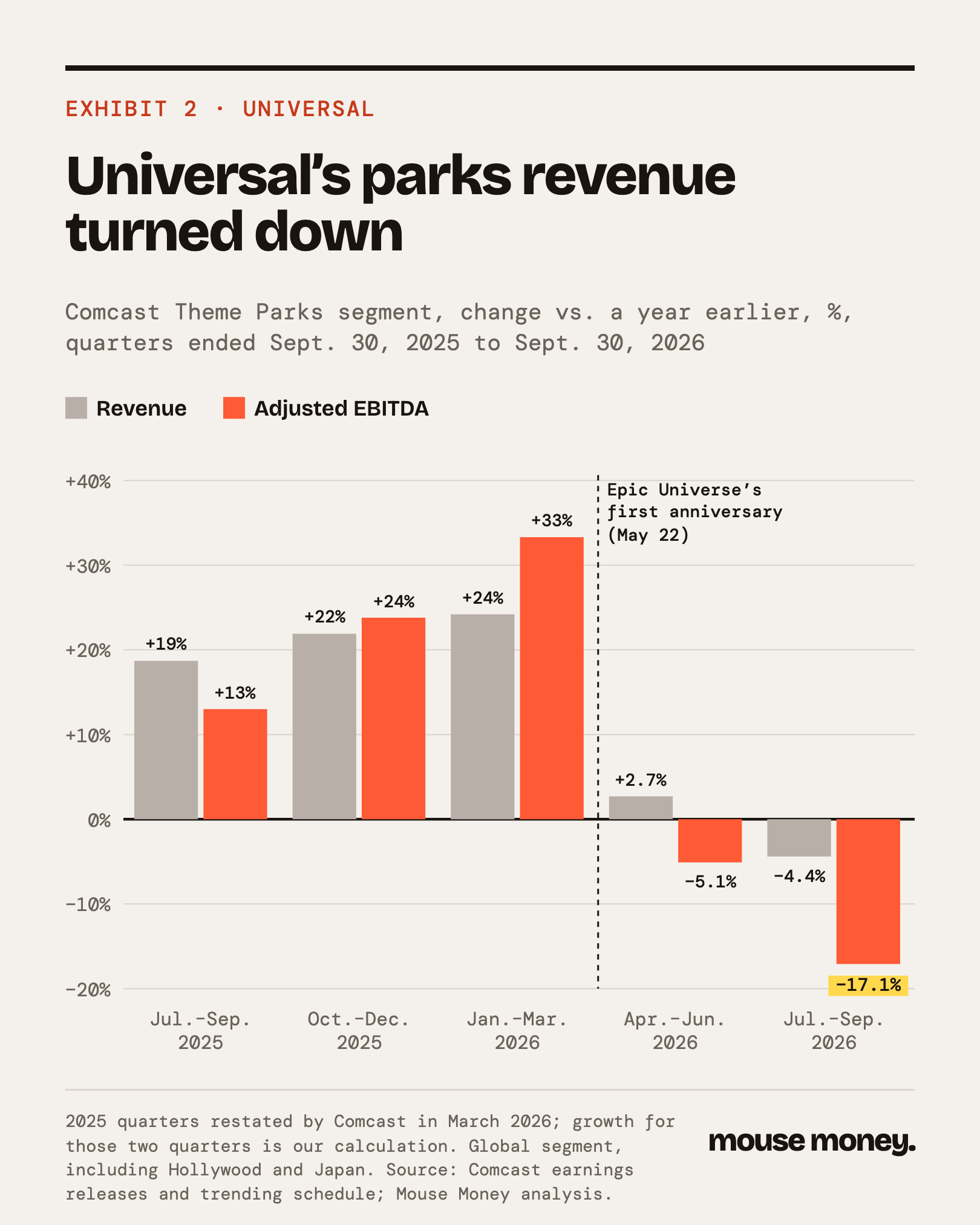
In July, management attributed softer attendance that began in June to consumer sentiment and travel costs, and said Epic was delivering the guest response it expected. In October, Cavanagh added two causes of Universal's own making: rivals adjusted their marketing faster, and Epic still has limits on ride capacity and throughput. Chief Financial Officer Jason Armstrong said the pressure was concentrated in Orlando and Japan.
Capacity limits complicate any commercial fix. Discounts can bring visitors in; they cannot increase the number a ride carries each hour. Comcast has not quantified the cost.
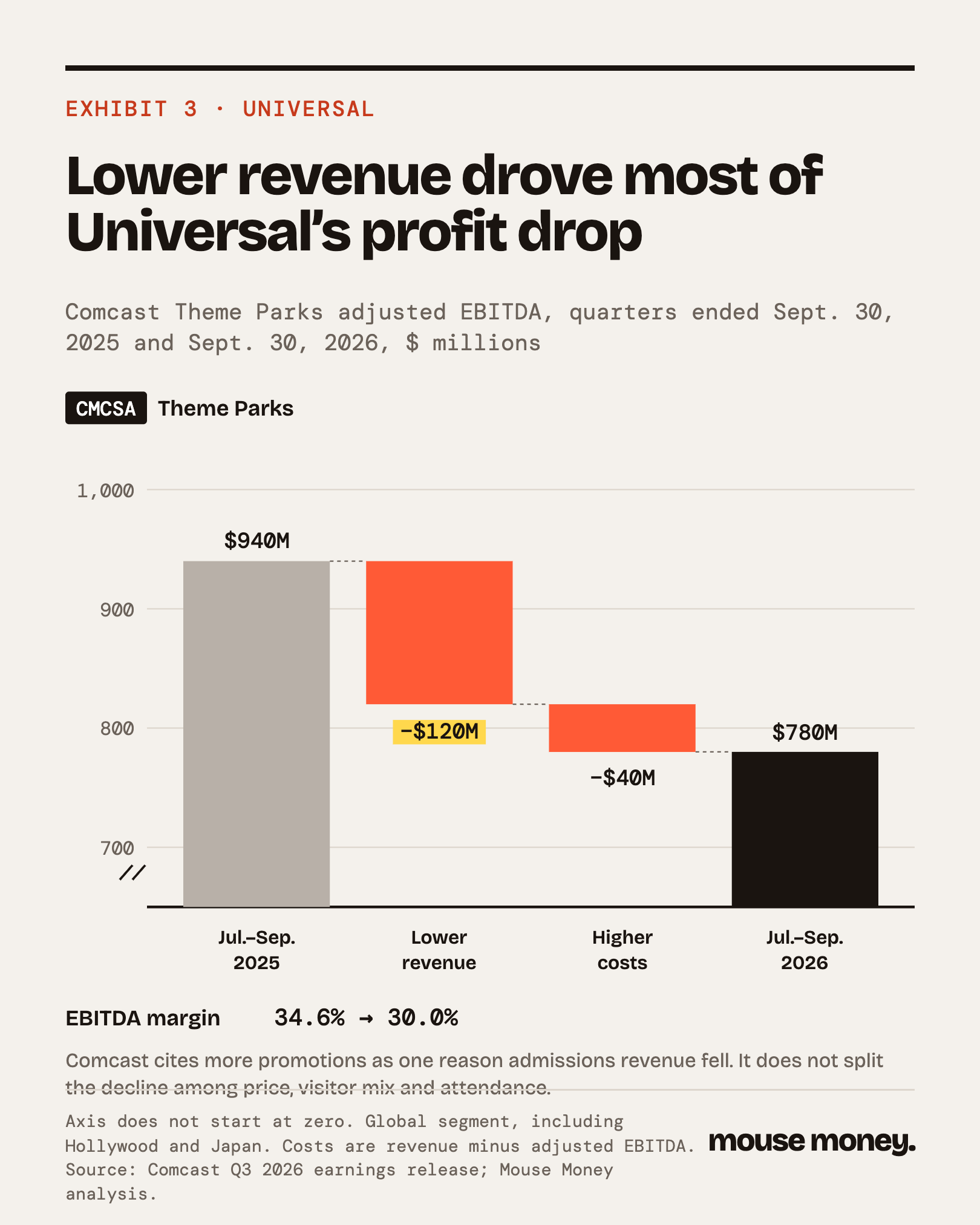
The September quarter shows how fast lower revenue squeezes earnings. Revenue fell $120 million and operating costs rose $40 million, cutting adjusted EBITDA by $160 million to $780 million and the margin to about 30.0% from 34.6%. Comcast cited increased promotions as one reason admissions revenue fell, but did not separate price, visitor mix and attendance.
Cavanagh said results in the theme parks segment should strengthen through 2027, with a return to growth in the second half, and that Orlando attendance, spending and profit remain well above where they were two years ago.
Disney's guests kept spending more
Disney's domestic parks reported a 1% attendance decline and a 5% increase in spending per visitor in the quarter ended March 28. In the quarter ended June 27, attendance rose 3% and spending per visitor 4%. Disney credited summer promotions, domestic tourists and annual passholders for Walt Disney World's performance, so discounts and higher average spending went together.
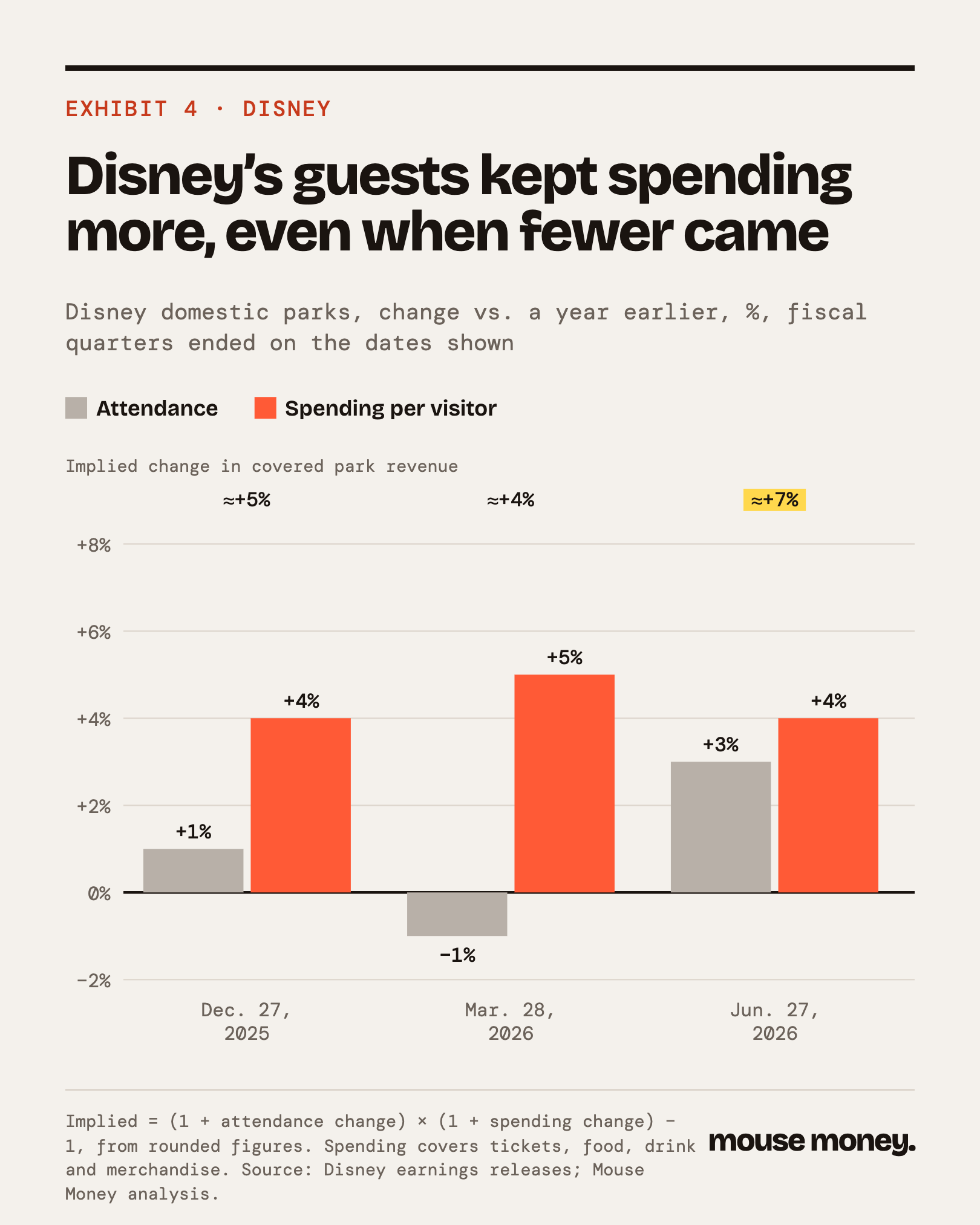
Spending per visitor is not a ticket-price measure. It includes food, drink and merchandise, and Disney's admissions line includes paid Lightning Lane access. Disney's hotels give a separate read: domestic occupancy reached 91% in the June quarter, up from 86%, and spending per occupied room rose 3%.
Two items flatter Disney's profit growth. A roughly $100 million tariff refund contributed about four percentage points of the Experiences segment's 20% operating-income increase in the June quarter; without it, growth was about 16%. And new cruise ships lift the domestic category: Disney attributed its July-September 2025 profit growth to the cruise line, not the parks.
Universal grew faster; Disney expanded its margin
Over the four quarters to late June, Universal's parks revenue grew 16.5% to $10.35 billion, against 7.8% to $26.8 billion for Disney's domestic parks and experiences business. Universal's adjusted EBITDA grew 15.1% and Disney's domestic operating income 12.1%. Universal's margin slipped to about 30.1% from 30.5%, while Disney's rose to about 26.4% from 25.4%. These are our calculations, summing the four quarters reported in each company's quarterly results and comparing them with the prior four.
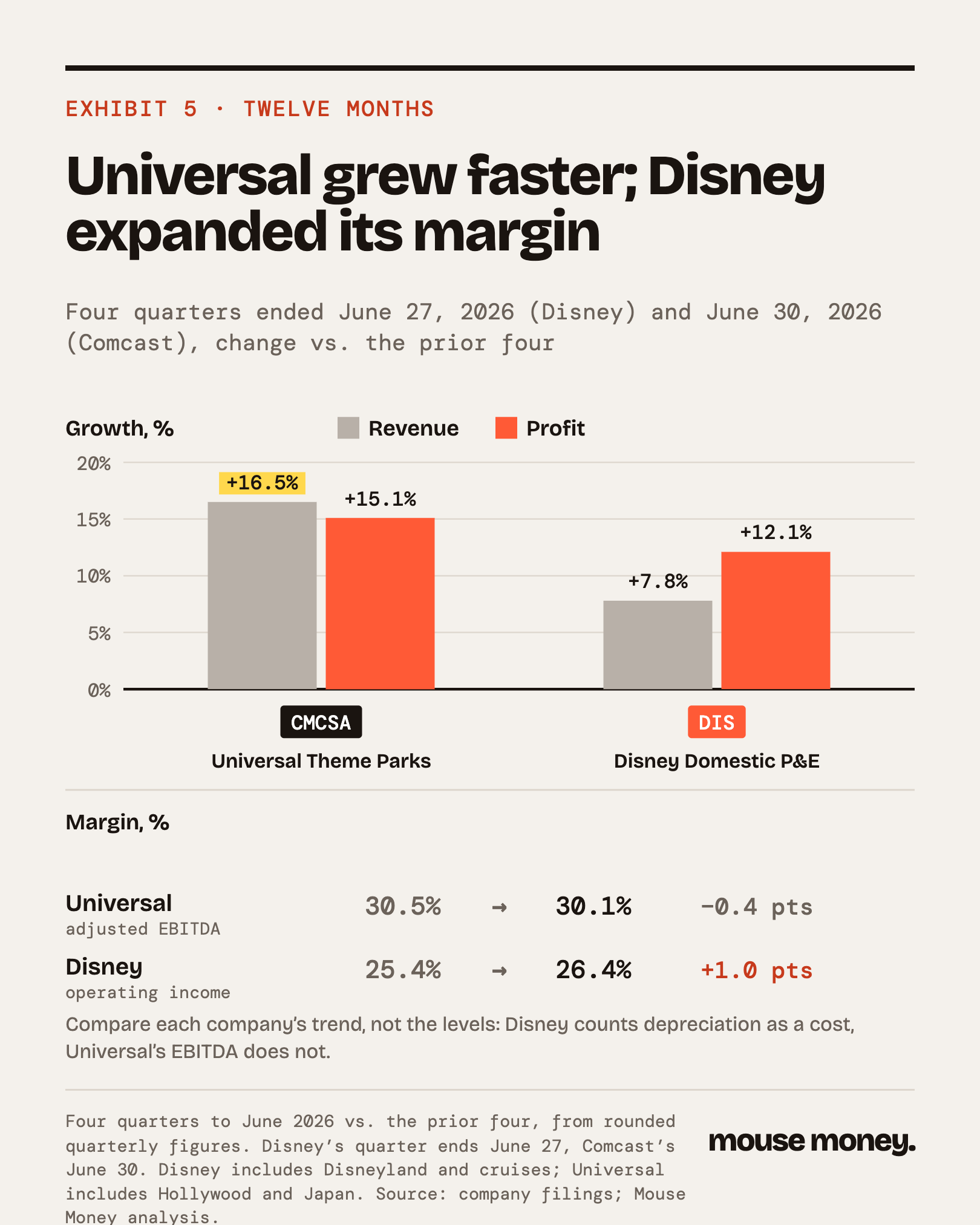
The two profit measures differ: Disney's operating income is after depreciation and Universal's adjusted EBITDA is before it. Each company's trend is meaningful; the margin levels cannot be compared directly.
The wider market points the same way as Universal's account. Orlando International Airport's passenger traffic was down 6.9% in August from a year earlier, after a record 76.7 million visitors to the region in 2025. Airport traffic is not park attendance, but it is a reason not to assume Disney's spring strength carried into the summer.
The next test
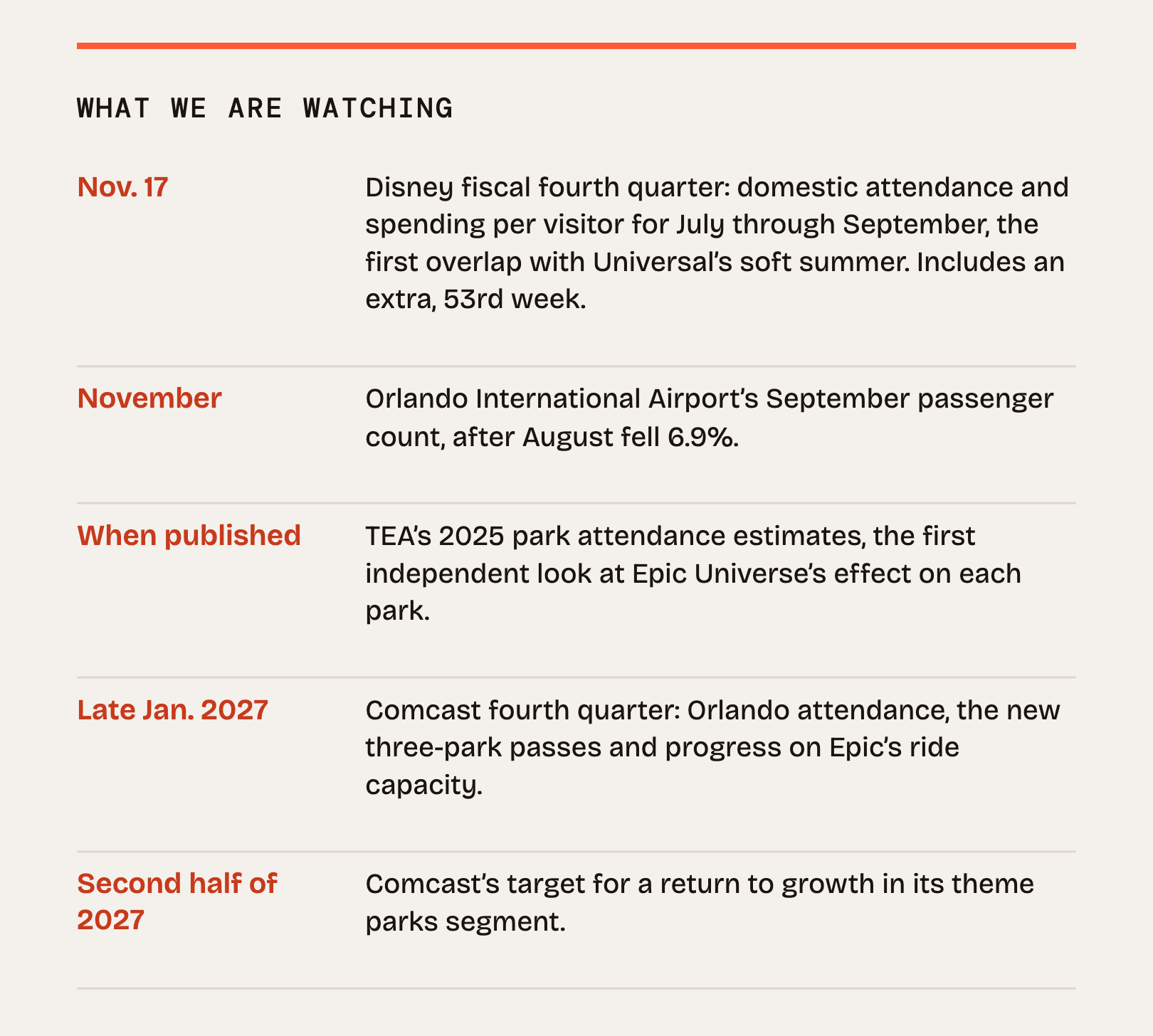
Disney reports its fiscal fourth quarter, July through September, on Nov. 17. It is the first period that overlaps Universal's soft summer. The quarter also has an extra week, because Disney's fiscal 2026 runs 53 weeks; its outlook calls for adjusted earnings per share to grow about 16% including that week and about 12% without it. Growth in the parks should be read with that week removed.
If domestic attendance and spending per visitor both fall, the case that Disney is winning the contest for the whole week is wrong. If growth comes mostly from cruises, it says little about the parks. At Universal, the test is whether the new passes and better ride capacity turn Epic's added capacity into more visits and higher earnings.
For a family that has already paid for tomorrow, the rival's most important price is the cost of changing plans.
Sources
Comcast, Mar 2026: Trending schedule, as revised (SEC filing)
Disney Tourist Blog, Oct 2025: Disney World raises 2025-2026 ticket prices
TouringPlans: Every regular Disney World ticket price in 2026
BlogMickey, Oct 2026: Record ticket prices for 2027 peak holiday dates
BlogMickey, Mar 2025: Epic Universe single-day tickets on sale
Disney Food Blog, Oct 2025: Epic Universe 2026 ticket prices
ClickOrlando, Oct 2025: Universal 2026 tickets add park-to-park access including Epic Universe
Disney Tourist Blog: 25% off resorts with Park Hopper upgrade, fall 2026
Disney Tourist Blog: Disney World's stand-out quarter and resort occupancy
Visit Orlando, May 2026: Orlando welcomed a record 76.7 million visitors in 2025
Benzinga, Sep 2026: Bank of America on Disney's fourth quarter
TipRanks/TheFly, Aug 2025: What Wall Street is saying about Disney
BlogMickey, Sep 2026: Comcast CFO says Universal Orlando softness continues
Universal Destinations & Experiences, Oct 2026: Luc Bondar named chief brand and commercial officer
Disney Tourist Blog, Sep 2026: Universal launches new three-park ticket deals
Walt Disney World: theme park ticket price calendar (checked Oct 26, 2026)
Disney Food Blog, Dec 2025: The cheapest days to go to Epic Universe in 2026