


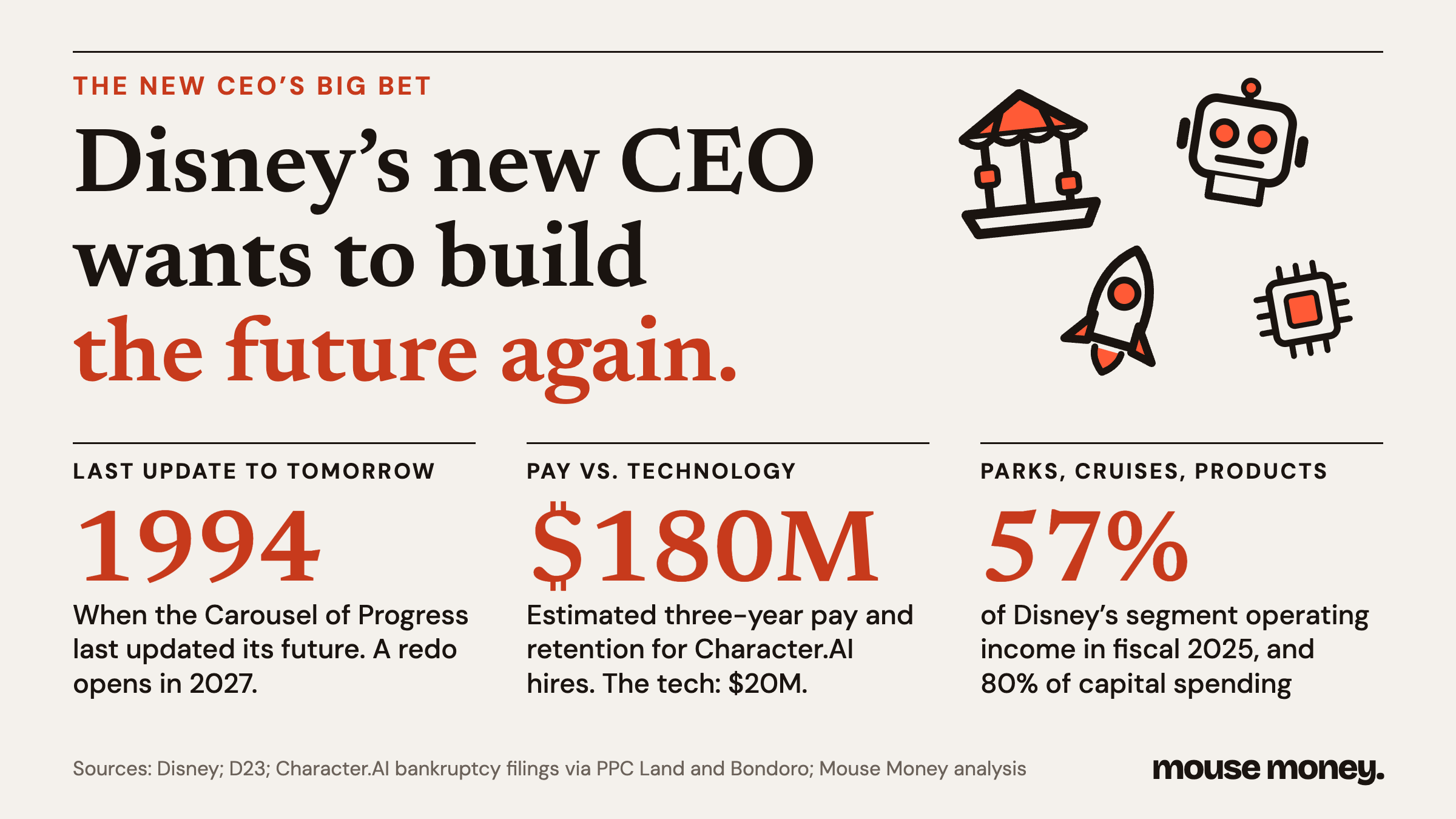
For more than 30 years, the future at Walt Disney World’s Carousel of Progress looked like the early 1990s. In the show’s final scene, the father of the family promises that his new voice-activated oven won’t burn the turkey, then accidentally tells it to heat to 975 degrees.
In July, Disney closed the show for its biggest overhaul since 1994. When it reopens late next spring, the last act will be called “The Possible Future,” set in an “out-of-this-world home” with a robot helper, and a new opening scene will bring back Walt Disney as an Audio-Animatronics figure.
Disney’s new chief executive is betting the company can build the future again, not just stage it. Josh D’Amaro, who took over in March after 28 years in Disney’s parks business, has made technology one of his three priorities and hired the head of the chatbot startup Character.AI as Disney’s first company-wide chief technology officer. Court filings show Disney expects to spend about $180 million over three years to pay and keep the startup staff it hired, nine times its bid for the startup’s technology.
A parks CEO without an executive chairman
The last parks chief to get the top job, Bob Chapek, was named chief executive in February 2020, while Bob Iger stayed on as executive chairman to “direct the Company’s creative endeavors” through 2021. Within three weeks, the pandemic had closed Disney’s U.S. parks. Chapek ran Disney without an executive chairman above him for less than a year, from January 2022 until the board replaced him with Iger that November. This time, Iger has stepped back to senior adviser and board member until he retires on Dec. 31. D’Amaro has run the company without an executive chairman from his first day.
The expectation was that the parks would be his stage. In February, Orlando’s WKMG wrote in its newsletter that it was “safe to expect D’Amaro to lead the big announcements at D23,” Disney’s fan convention, in August. Instead, his successor as parks chairman, Thomas Mazloum, and a team of Imagineers presented them, with Neil Patrick Harris as host, at a showcase Disney called “Horizons,” the name of an Epcot ride about the future that Disney closed in 1999. D’Amaro has kept the roughly $60 billion, 10-year parks and cruise plan Disney announced under Iger in 2023. He has also cut jobs in four rounds this year, including 159 at Walt Disney Imagineering, the unit that designs the parks.
Disney’s two longest-serving recent chief executives each had a defining bet. For Michael Eisner, who had been president of Paramount Pictures, it was the animation revival that began with The Little Mermaid in 1989. For Iger, who rose through ABC television, it was buying Pixar, Marvel, Lucasfilm and most of 21st Century Fox, then launching Disney+. D’Amaro hasn’t named his. His own words point to technology.
His answer is technology
In his first memo as chief executive, on March 18, D’Amaro named three priorities: storytelling, technology and operating as “One Disney.” The parks, which he had run for nearly six years, were not on the list. “Innovation has always been part of Disney’s DNA,” he wrote.
He has returned to the theme since. On his first earnings call as CEO, in May, he said Disney would “embrace technology more aggressively” and wanted to “remain a leader in the use of technology to enhance creativity,” going “all the way back to when Walt was pioneering synchronized sound and Steamboat Willie.” In August he told investors, “Our company was founded on the convergence of creativity and breakthrough technology.”
The board flagged the same thing when it chose him. Chairman James Gorman credited D’Amaro with “showcasing the power of combining Disney storytelling with cutting-edge technology.” Iger, in an ABC News interview with both men, called his successor someone “that views technology as an opportunity and not a threat.”
It is a theme D’Amaro brought from the parks. Introducing the Genie planning app in 2021, he said Disney was “taking more than 60 years of experience and data and applying artificial intelligence on top of that.” In March 2025, at the SXSW festival, where Disney showed off its walking BDX droids, he told Axios that return on invested capital “goes up by 3 times” over the period since Disney started leaning into technology. He didn’t say for which business or give the underlying figures.
In September he hired Karandeep Anand, Character.AI’s chief executive, as Disney’s first company-wide chief technology officer, reporting directly to him.
What the Character.AI deal is, and isn’t
Disney isn’t buying Character.AI. Bankruptcy filings show it is hiring the people and licensing the technology.
The startup, which runs an app for chatting with AI characters, filed for Chapter 11 protection on Oct. 12. Disney is the lead bidder, offering $20 million for a perpetual, non-exclusive license to its technology, including the software that runs its chatbots, a safety-monitoring system called Guardian and an age-prediction model. Disney doesn’t get the app, its users or its finished chatbot models, and Character.AI can license the same technology to others.
Sixty-six of the startup’s roughly 86 employees accepted jobs at Disney. Disney estimates their pay and retention over three years at about $180 million, including a $30 million retention pool. That works out to about $2.7 million a person.
Disney paid $5.5 million on Sept. 18, the day it announced Anand’s hiring, plus a $2 million refundable deposit, the filings show. Its announcement said some of the startup’s technical team was expected to join Disney; it didn’t mention the payment or the license. Disney required that the deal go through Chapter 11, according to a declaration filed in the case, a route that lets a buyer take assets “free and clear” of claims against the seller.
Those claims are serious. A year to the day before the hire, in a letter dated Sept. 18, 2025, Disney’s lawyers demanded that Character.AI stop using Disney’s characters, writing that the startup’s infringing chatbots were “known, in some cases, to be sexually exploitive and otherwise harmful and dangerous to children.” The startup has faced lawsuits from families and investigations by state officials, and more than 30 states objected to the sale procedures. On Oct. 30, Judge Brendan Shannon approved them and said he would “strongly encourage” the company to hire a privacy ombudsman to evaluate risks to children. Under the proposed schedule, rival bids are due Nov. 20.
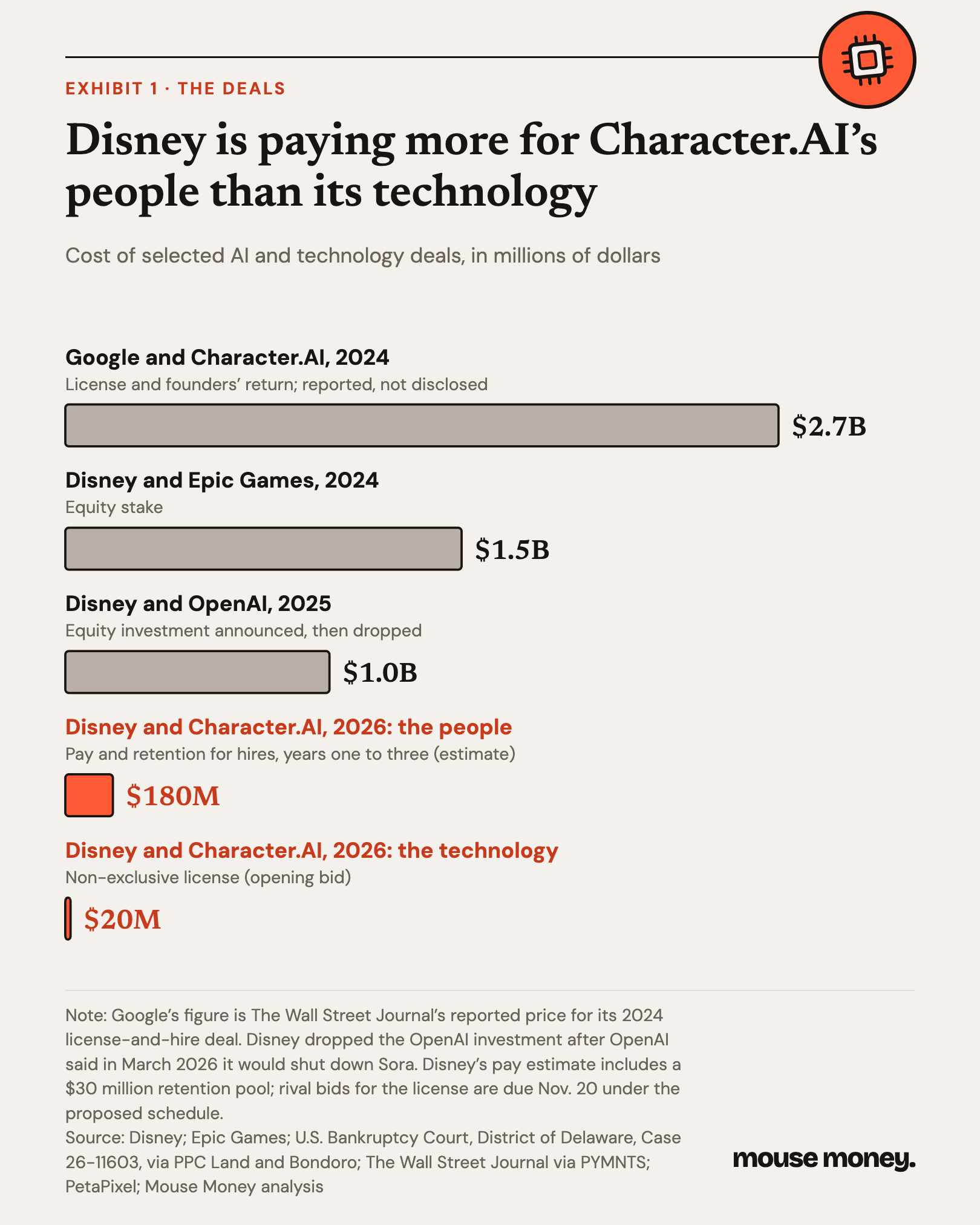
Disney hasn’t said what it will build with the technology. D’Amaro’s first memo said technology could help Disney create “more immersive, interactive, and personal ways for people to experience Disney.”
The deal is also a change of approach. In December, under Iger, Disney agreed to invest $1 billion in OpenAI and license more than 200 characters to its Sora video app. Six days after D’Amaro took over, OpenAI said it would shut Sora down, and Disney dropped the investment. In August, finance chief Hugh Johnston said Disney was expanding its stock buyback “to utilize the cash that had been set aside previously for the OpenAI deal,” along with proceeds from selling its A&E stake. Hiring Character.AI’s team suggests D’Amaro would rather build Disney’s own technology than lend its characters to someone else’s app.
Why Disney needs it
Walt Disney treated technology as part of the show: synchronized sound in Steamboat Willie in 1928, three-strip Technicolor in 1932, the first full-length cel-animated feature in 1937, the first daily monorail in the U.S. in 1959, Audio-Animatronics in 1963. At the 1964 New York World’s Fair, the Carousel of Progress showed a family’s home life getting better with each new invention.
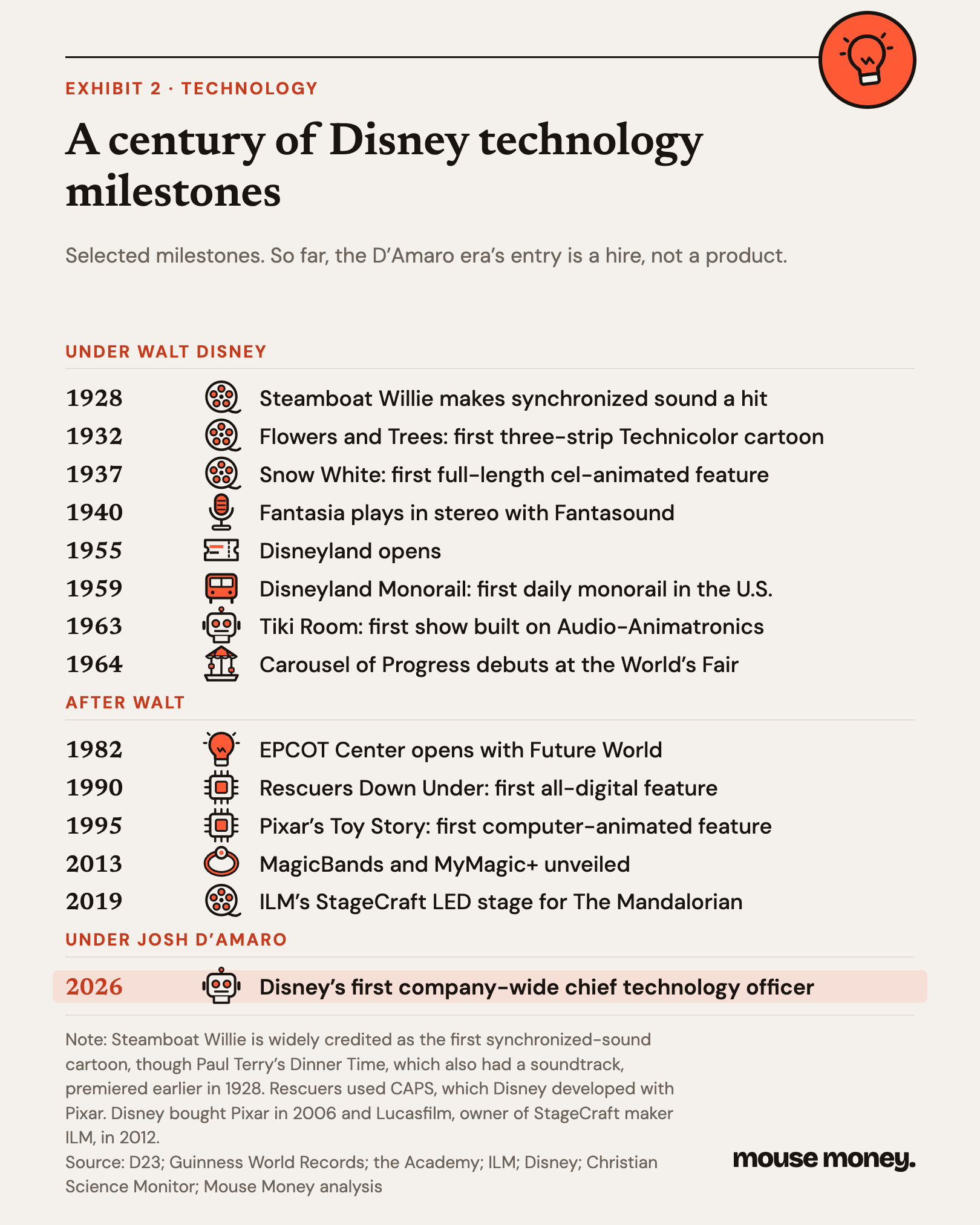
The breakthroughs kept coming after Walt died in 1966, but more of them happened behind the screen or through partners. EPCOT Center opened in 1982 with what the Christian Science Monitor counted as 450 audio-animatronic robots. The Rescuers Down Under, in 1990, was the first fully digital feature film, made on a system Disney developed with Pixar. Pixar’s Toy Story, which Disney released in 1995, was the first computer-animated feature; Disney bought Pixar in 2006. The LED stage used to film The Mandalorian came from Industrial Light & Magic, which Disney got when it bought Lucasfilm in 2012.
The bigger change was in what the parks showed guests. Epcot’s Future World was built with corporate sponsors, including General Motors, the Bell System and General Electric. As sponsors left, the pavilions about the future closed or became thrill rides. GE stopped sponsoring Horizons in 1993; Disney closed the ride in 1999 and put Mission: Space on the site. World of Motion gave way to Test Track, a thrill ride GM also sponsored. In 2021, Disney retired the Future World name.
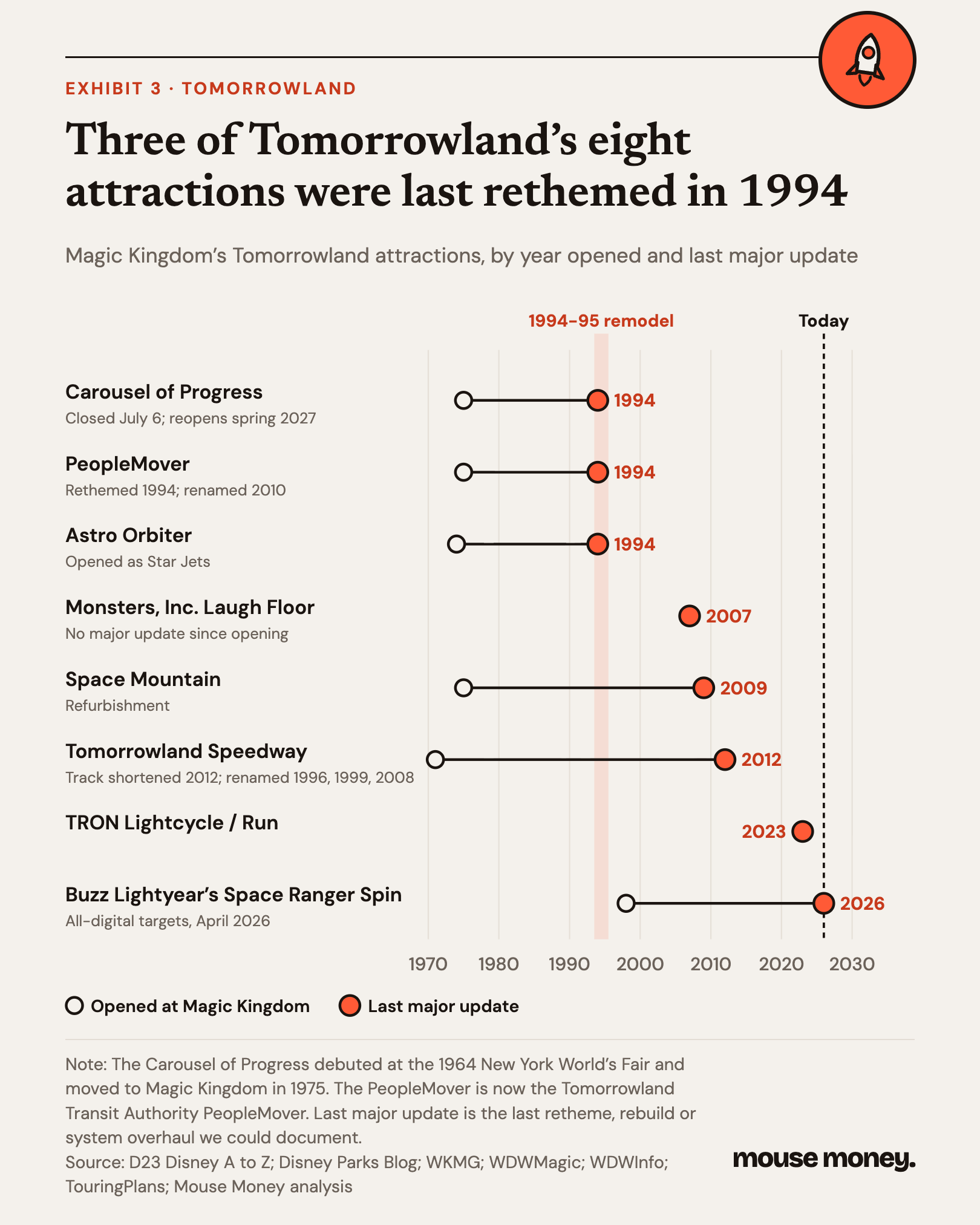
Magic Kingdom’s Tomorrowland went retro. Disney remodeled it in 1994 and 1995, giving it, in the words of D23, Disney’s official fan club, “the look of a city like those imagined by sci-fi writers and moviemakers of the 1920s and 1930s.” Three of Tomorrowland’s eight attractions, the Carousel of Progress, the PeopleMover and Astro Orbiter, were last rethemed in 1994. Disney had stopped predicting the future and started decorating with it.
Disney still builds technically ambitious rides, among them Avatar Flight of Passage in 2017, Star Wars: Rise of the Resistance in 2019 and TRON Lightcycle / Run in 2023, which opened while D’Amaro ran the parks. But they are built around films, not the future. Universal, meanwhile, made ride technology part of its pitch in Orlando. Its Harry Potter and the Forbidden Journey, which opened in 2010, carries riders on robotic arms that travel along a track. In May 2025, Universal opened Epic Universe, the first major new theme park in Florida in more than 25 years.
The stakes are large. Disney’s Experiences segment, which includes the parks, cruises and consumer products, produced $10 billion of the company’s $17.6 billion in segment operating income in fiscal 2025, or 57%, and took 80% of its capital spending. The $60 billion plan will decide what the parks look like for years. Disney shares rose about 11% from March 17, the last close before D’Amaro took over, through Oct. 30, a little less than the S&P 500’s 13% gain.
The risks
Child safety. Disney would be licensing technology from a company its own lawyers accused of running chatbots that were, in some cases, harmful to children, and it has hired the executive who ran that company. Disney’s announcement credited Anand with “making user trust and safety a priority as the platform scaled.” The states can raise some of their objections again at the sale hearing.
Fans. A Haunted Mansion photo effect at Magic Kingdom that appeared to use generative AI drew a backlash online in September. When it returned on Oct. 21 for a limited test, fan sites reported that it was “completely optional,” with a second photographer taking standard pictures.
Cost and optics. Disney’s own estimate works out to about $2.7 million per Character.AI hire over three years, in a year when it has cut more than 1,000 jobs.
Execution. Disney’s last big AI partnership, with OpenAI, unraveled in less than four months.
The test. If the technology push shows up mostly as cost cuts and chatbot features rather than in what guests can see and do in the parks, D’Amaro’s legacy will be efficiency, not invention.
What we are watching
Nov. 17: Disney’s fiscal fourth-quarter and full-year results, its first year-end report under D’Amaro. Watch for any dollar figure on technology spending or savings, the fiscal 2027 capital-spending outlook and any change to the $60 billion plan.
Nov. 20, 23 and 24: Under the proposed schedule, rival bids for Character.AI’s technology are due, then an auction if any arrive, then the sale hearing.
Dec. 17: The outside date in Disney’s agreement, after which the deal can be called off if the sale hasn’t closed.
Dec. 31: Iger retires from Disney.
Late spring 2027: The Carousel of Progress reopens.
The new Carousel’s last act is called “The Possible Future.” Seven months in, that is also the best description of D’Amaro’s technology push.
How we did this
We read Disney’s press releases, earnings-call transcripts and fiscal 2025 annual report; filings in Character.AI’s Chapter 11 case (In re Character Technologies, U.S. Bankruptcy Court for the District of Delaware, Case 26-11603); D23’s Disney A to Z and the Disney Parks Blog for attraction histories; and news coverage. The court’s docket site did not load for us, so quotations from the filings come from outlets that quote them by docket number, mainly PPC Land and Bondoro, plus the states’ notice of interest, which we read directly. Our account of the Oct. 30 hearing comes from Briefs, which links to Bloomberg’s report. The $180 million is Disney’s own estimate of pay and retention for years one to three, including the $30 million retention pool; the per-person figure divides it by the 66 employees who accepted offers. Exhibit 2 is a selection of milestones. In Exhibit 3, “last major update” is the last retheme, rebuild or system overhaul we could document. Share-price changes use Yahoo Finance closing prices and exclude dividends.
Sources
Disney, Josh D’Amaro named next chief executive (Feb. 3, 2026)
Disney, Susan Arnold named board chairman effective Dec. 31, 2021
ABC News, joint interview with D’Amaro and Iger (Feb. 3, 2026)
Disney, Disney Experiences leadership changes (March 10, 2026), and WDW News Today: 1, 2
D’Amaro’s first memo as chief executive (March 18, 2026), as published by WDW News Today
Disney, fiscal second-quarter 2026 recap and call transcript (May 6, 2026): 1, 2
Disney, fiscal third-quarter 2026 recap and call transcript (Aug. 5, 2026): 1, 2
Disney and D23, Horizons: Disney Experiences Showcase (Aug. 15, 2026): 1, 2
Disney, Karandeep Anand named chief technology officer (Sept. 18, 2026)
Variety, on Disney’s first CTO, and Fortune (2024), on an activist’s call for one: 1, 2
Axios and NBC News, Disney’s cease-and-desist letter to Character.AI (September 2025): 1, 2
States’ notice of interest in the Character.AI case (Doc. 33), via the New York attorney general
Briefs, on the Oct. 30 hearing (it links to Bloomberg’s report)
PYMNTS, on The Wall Street Journal’s report of Google’s Character.AI deal
Carousel of Progress, history and reimagining: 1, 2, 3, 4, 5
D23 Disney A to Z, Tomorrowland, Horizons, World of Motion, Tomorrowland Speedway and Tomorrowland Transit Authority: 1, 2, 3, 4, 5
WDWInfo and TouringPlans, Tomorrowland Speedway history: 1, 2
Guinness World Records, first all-talking cartoon (Dinner Time, 1928)
Christian Science Monitor, EPCOT Center opening (Oct. 4, 1982)
LaughingPlace, Epcot drops the Future World name (Sept. 27, 2021)
NBC News (whose parent, Comcast, also owns Universal), Harry Potter and the Forbidden Journey
BlogMickey and DisMornings, the Haunted Mansion Magic Shot: 1, 2
WDWMagic, Variety and Mickey Visit, 2026 layoff rounds: 1, 2, 3
AP, Disney’s $60 billion parks and cruise plan (Sept. 19, 2023)
Yahoo Finance, Disney price history, and AP, Oct. 30 market close: 1, 2