


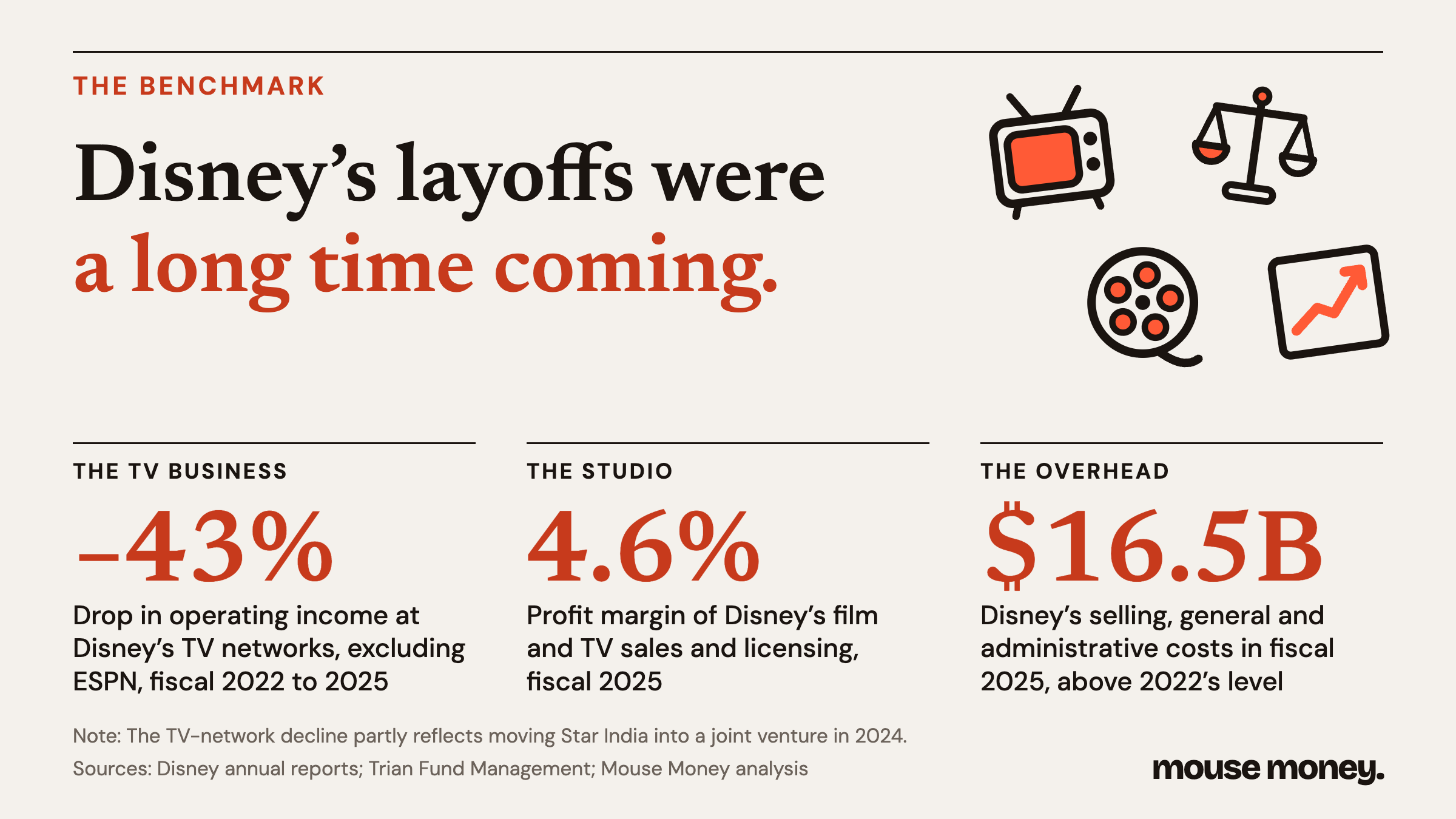
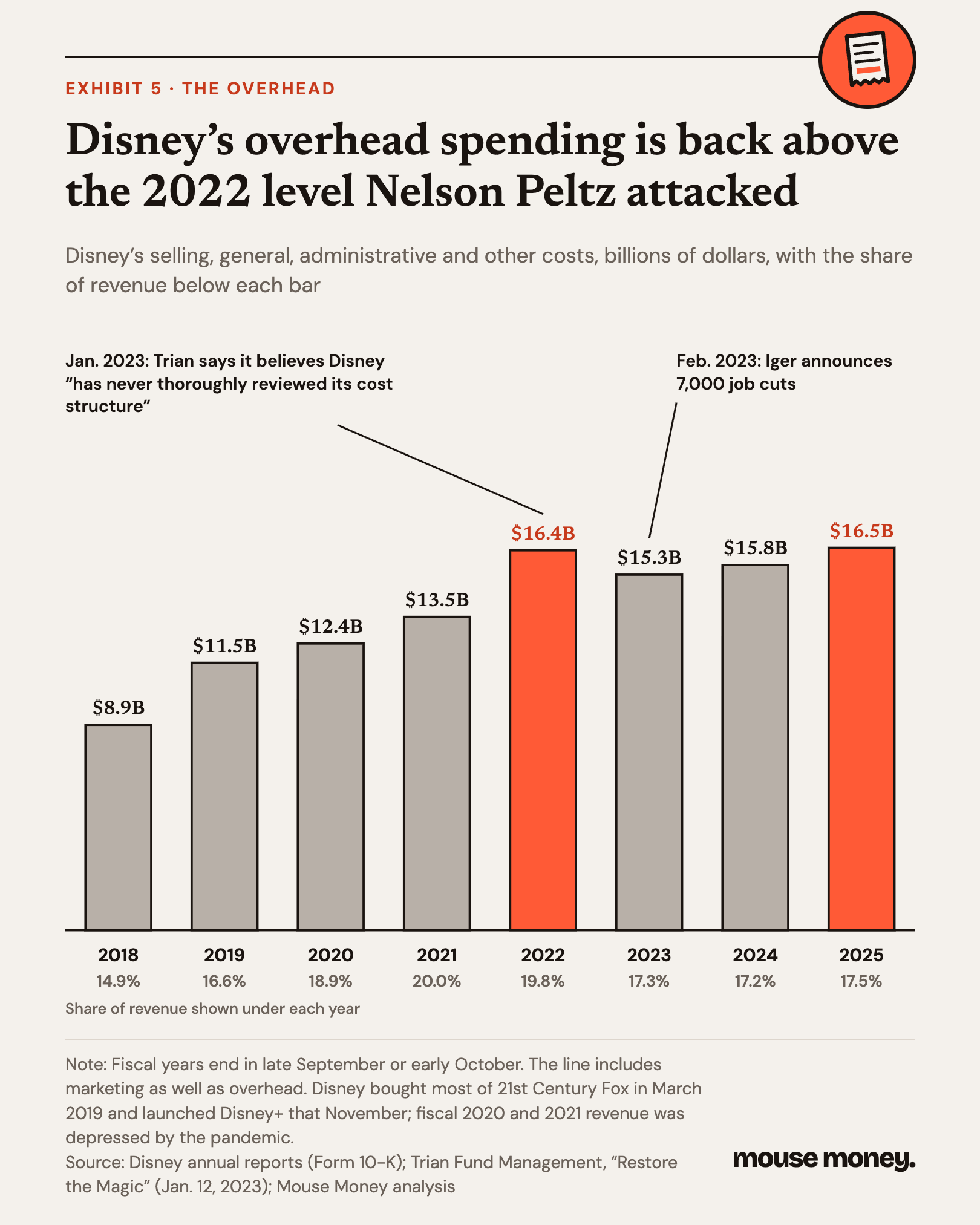
In January 2023, Nelson Peltz’s Trian Fund Management published a slide deck arguing that Disney had let its costs get away from it. Disney’s selling, general and administrative costs, which include marketing, had risen 85% in four years, to $16.4 billion in fiscal 2022, and Trian said it believed Disney “has never thoroughly reviewed its cost structure.” Four weeks later, Bob Iger announced 7,000 job cuts and a plan to save $5.5 billion a year, about $2.5 billion of it from what Disney called “non-content-related expenses (SG&A and other operating costs).” Trian called the moves “a win for all shareholders” and ended its proxy fight the next day.
Those costs are now higher than they were when Peltz complained. Disney’s selling, general and administrative costs reached $16.5 billion in fiscal 2025, and it employed about 231,000 people, more than in 2022. On Monday evening, Bloomberg reported that Disney is preparing to cut thousands of jobs and has asked some managers to target 20% in annual cost savings. Deadline and CNBC reported the plan through their own sources, and Variety called it the biggest round of cuts this year. Disney has declined to comment.
The cuts look less like a shock than a catch-up. Operating income at Disney’s TV networks, not counting ESPN, is down 43% since fiscal 2022, partly because Disney moved its Indian channels into a joint venture. Disney’s biggest cable channels have lost more than a quarter of their homes since 2019. Its studio earned a 4.6% margin last fiscal year, less than half what Comcast’s studio reports and about a quarter of Warner Bros. Discovery’s, though the companies measure profit differently. And while most of its legacy-media rivals spent the past three years shrinking, merging or splitting up, Disney grew. Paramount’s work force is down 28% since 2022, and Netflix said last month that it would cut 6% of its staff. Disney’s head count, which includes its theme parks, rose 5%.
Here is how Disney compares with its rivals, and what investors have been telling it.
What has been reported, and what hasn’t
The 20% is a savings target for some managers, not a share of the workforce, and Bloomberg says the savings could come from job eliminations as well as from other expenses. Bloomberg says some of Disney’s operations will be affected disproportionately without saying which; Deadline names the TV networks and the movie studio. No outlet has reported a number or a date. By our count this would be Disney’s fifth round of cuts this year, after about 1,000 jobs in April, several hundred in July, a few hundred in September and 100 to 200 in the parks unit in October.
TV is shrinking for everyone
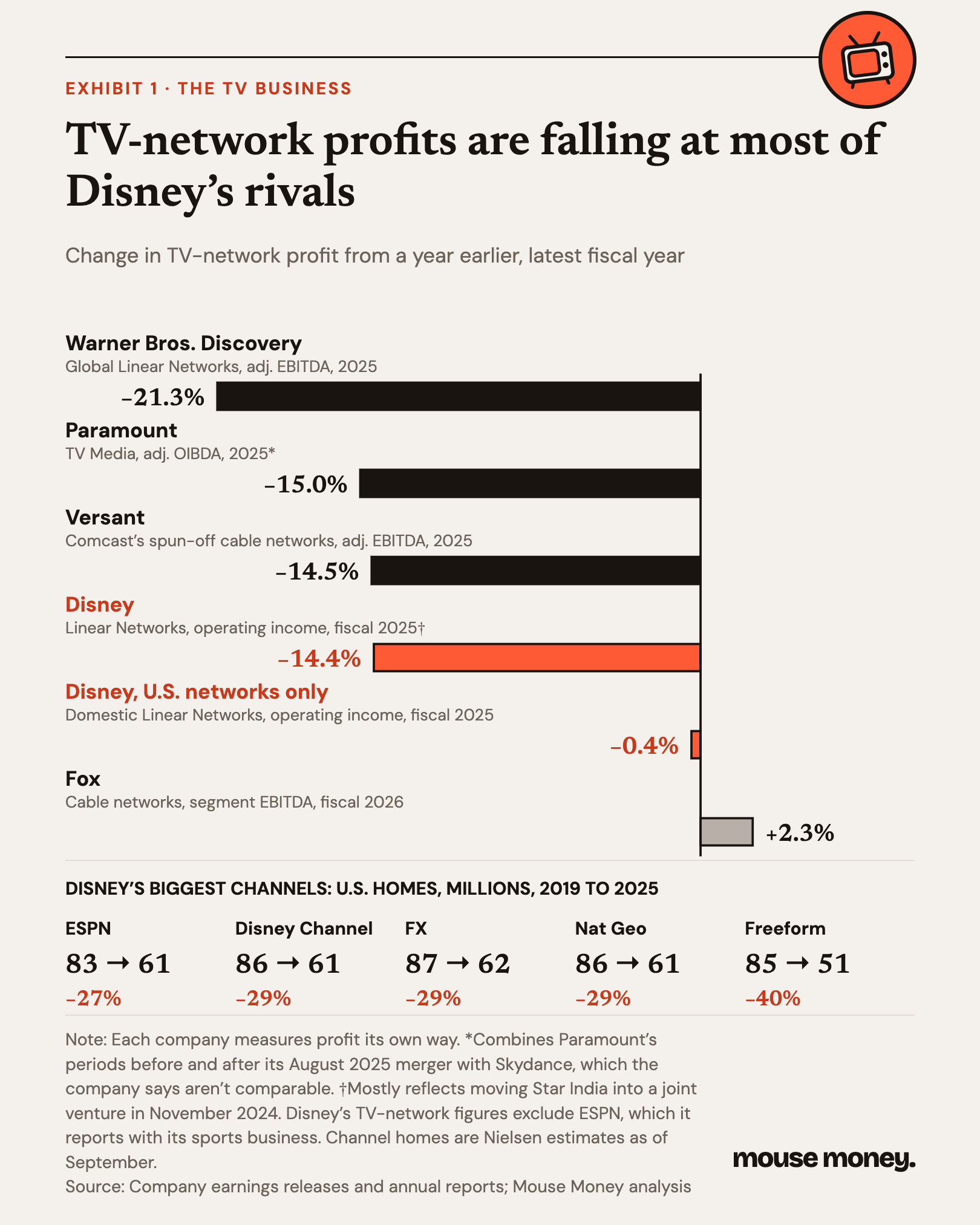
Disney’s TV problem isn’t unique, which is part of why the cuts were coming. TV-network profits fell at most of Disney’s rivals in their latest fiscal years: 21% at Warner Bros. Discovery’s networks, about 15% at Paramount’s TV Media unit and 14.5% at Versant, the cable networks Comcast spun off in January. Only Fox, whose cable networks are anchored by Fox News, grew.
Disney’s own decline last year was mostly a deal, not a slump. Operating income at its TV networks, which don’t include ESPN, fell 14% in fiscal 2025, mostly because Disney moved Star India into a joint venture; its U.S. networks earned $2.38 billion, about the same as a year earlier. The longer trend is the problem. The networks earned $3.0 billion of operating income in fiscal 2025, down from $5.2 billion in fiscal 2022, and most of that drop came before the Star India deal. ESPN, which Disney counts in a separate sports segment, reached an estimated 61 million homes in September 2025, down from 83 million in 2019, and Freeform fell to 51 million from 85 million, partly because a large distributor dropped it in 2023.
Disney’s rivals have answered by getting out or getting smaller. Comcast spun off its cable networks as Versant, plans to separate NBCUniversal into its own public company by mid-2027 and expects a restructuring charge of more than $1 billion this quarter, with job cuts focused on its broadband and cable business rather than NBCUniversal. Paramount merged with Skydance in August 2025, began cutting about 2,000 jobs that October and completed its $110 billion takeover of Warner Bros. Discovery on Oct. 6. The combined company, now called Skydance, is offering buyouts and is seeking $6 billion of cost reductions over three years, which David Ellison has said will come mainly from technology, procurement and real estate rather than job cuts.
Disney has kept its U.S. networks. Bob Iger said in 2023 that they “may not be core to Disney,” then held on to them. In March, LightShed Partners’ Rich Greenfield said D’Amaro’s arrival was a chance to split the traditional TV networks away from Disney’s streaming and other entertainment businesses, WDW News Today reported. Cutting the networks’ costs is the step in between.
The studio earns less than its brands suggest
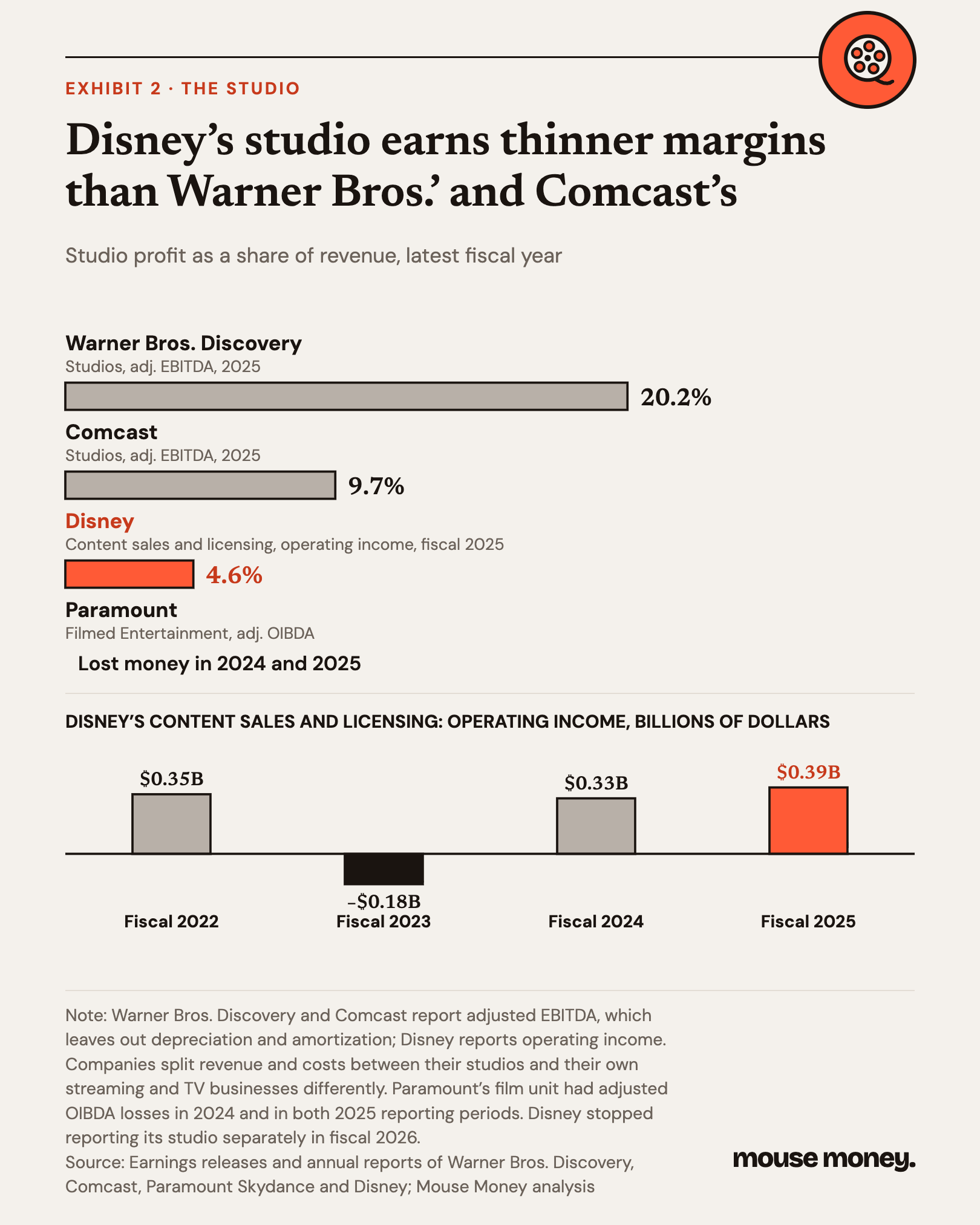
The studio should be where Disney’s brands give it the biggest edge. Its margins say otherwise. Content sales and licensing, which covers Disney’s theatrical releases, home entertainment and licensing to outside buyers, earned $392 million on $8.49 billion of revenue in fiscal 2025, a 4.6% margin, after losing money in fiscal 2023. Warner Bros. Discovery’s studios earned $2.5 billion of adjusted EBITDA on $12.6 billion of revenue in 2025, about 20%, and Comcast’s studios about 10%. Paramount’s film unit lost money in both 2024 and 2025.
The comparison is rough. The rivals report EBITDA, which leaves out depreciation and amortization, and each company splits revenue and costs between its studio and its own streaming and TV businesses differently. But the gap is wide, and Disney stopped reporting the studio’s results separately in fiscal 2026.
The studio’s results swing with its slate, and this year’s suggests the margin won’t widen quickly. Toy Story 5 grossed $1.15 billion worldwide and The Devil Wears Prada 2 $693 million, but Disney said in August that The Mandalorian and Grogu and the live-action Moana “underperformed our box office expectations.” Bank of America’s Jessica Reif Ehrlich expects “a more challenging setup” for the Entertainment segment in fiscal 2027, citing a lighter film slate, slower gains in streaming revenue per subscriber and higher content spending, Benzinga reported in September. Starting this quarter, the first of fiscal 2027, Disney is moving much of its consumer-products business into the Entertainment segment, bringing it “closer to the studios that create that IP,” D’Amaro and Hugh Johnston, Disney’s finance chief, wrote to shareholders in August. That will change how the Entertainment segment’s economics look on paper, though not the slate.
Disney’s rivals got smaller. Disney’s head count didn’t.
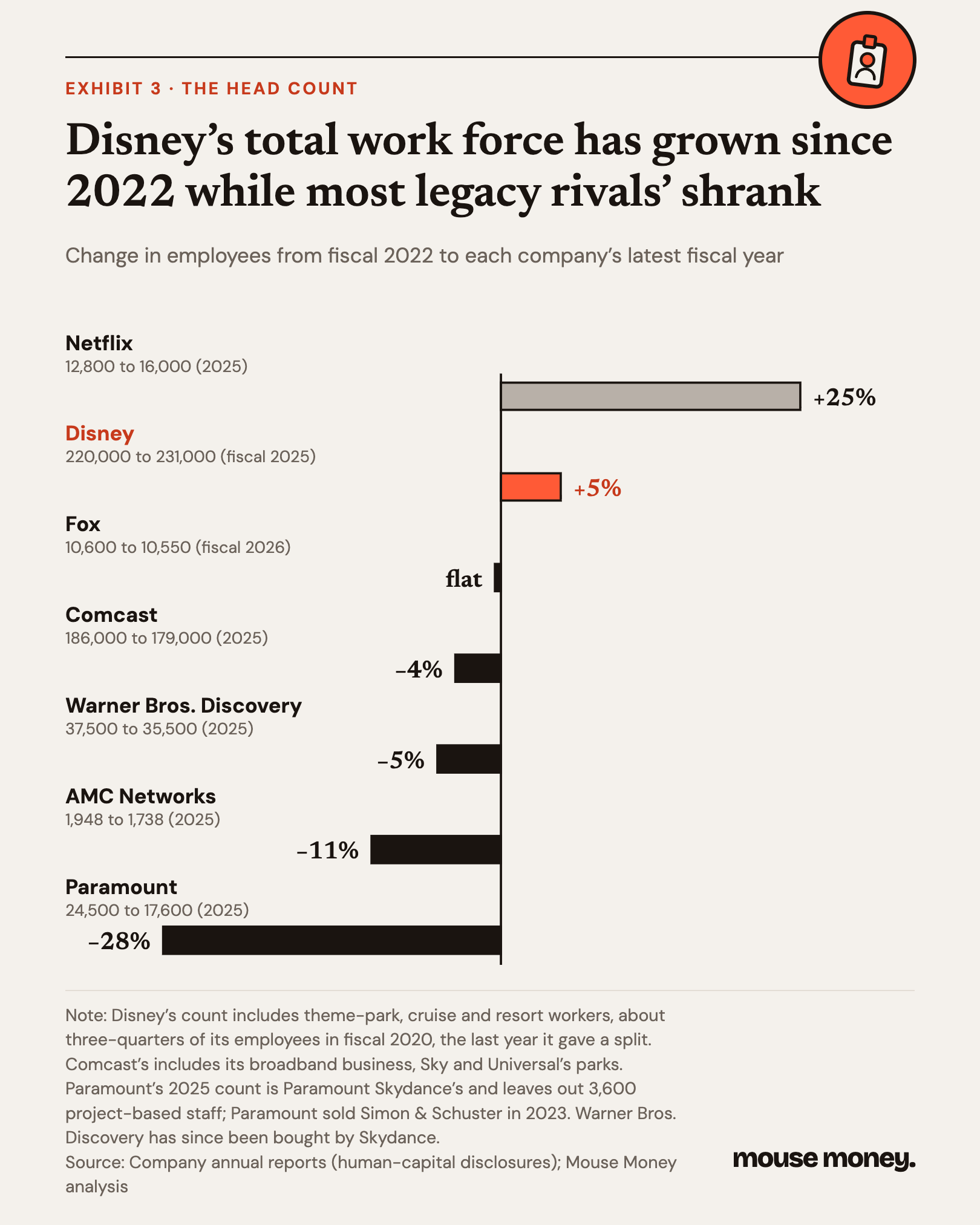
Since fiscal 2022, Paramount’s work force has fallen 28%, AMC Networks’ 11%, Warner Bros. Discovery’s 5% and Comcast’s 4%. Fox’s is flat. Netflix, still growing, added 25%, then said in October that it would cut about 1,000 jobs, or 6%. Disney’s grew 5%, to about 231,000, after peaking at 233,000 in fiscal 2024.
That comparison likely overstates Disney’s growth on the media side. In fiscal 2020, the last time Disney broke out its work force, about three-quarters of its employees worked in the parks unit, and the company doesn’t say how many people work in its media businesses now. It cut about 7,000 jobs in 2023, yet its total head count rose by about 5,000 that fiscal year, which suggests the parks kept hiring. The rivals’ counts are mixed, too: Comcast’s includes its broadband business, Sky and Universal’s theme parks, and Paramount’s decline spans its 2023 sale of Simon & Schuster. But the direction is hard to miss. Disney’s rivals spent three years cutting, while its total work force kept growing until 2024, and its cuts this year have come in rounds of a few hundred to about 1,000.
Doing less with more
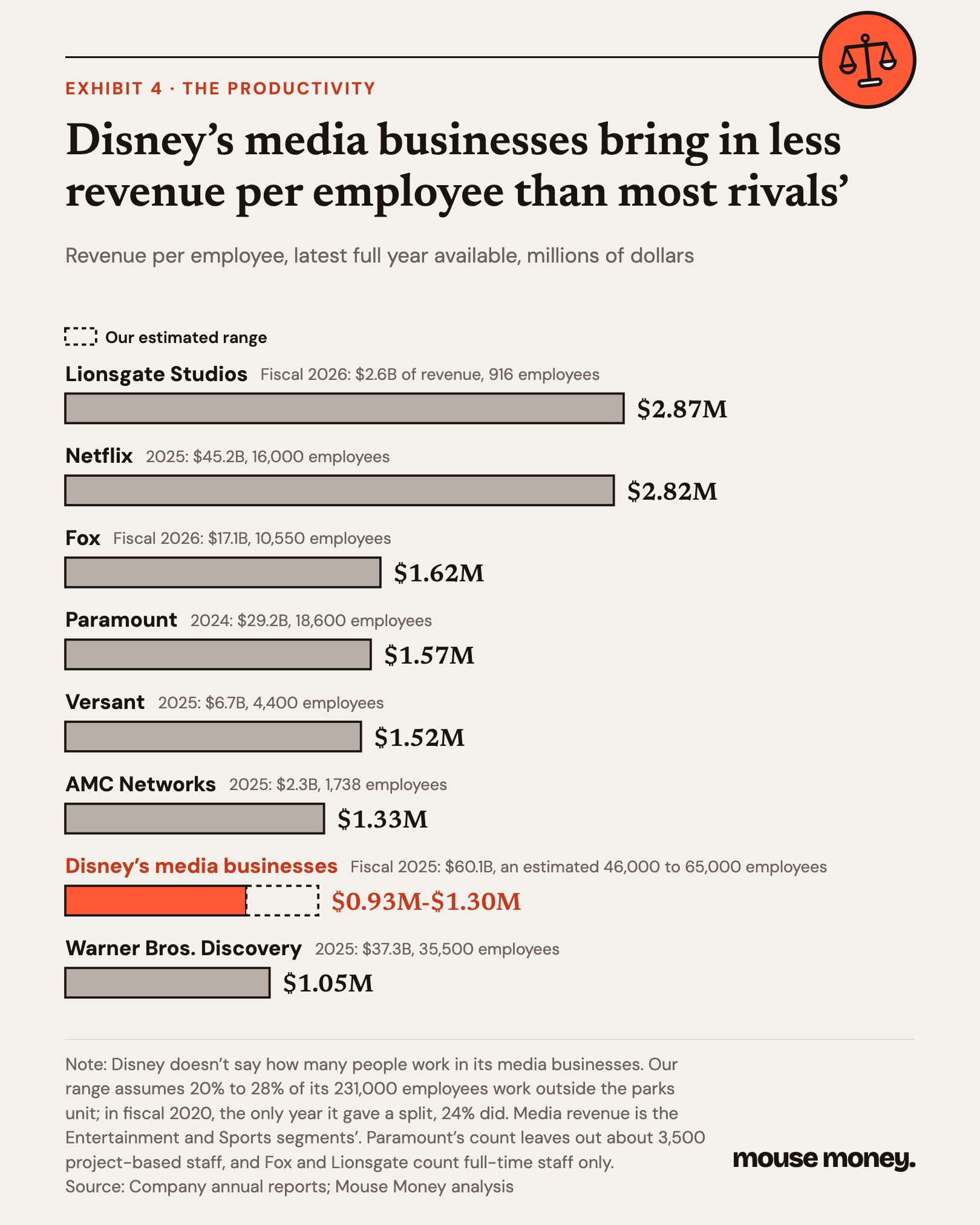
Revenue per employee is a blunt measure, but it is one way to compare companies of different sizes. By our estimate, Disney’s media businesses, its Entertainment and Sports segments, brought in $0.93 million to $1.30 million of revenue per employee in fiscal 2025. Fox brought in $1.62 million, Paramount $1.57 million in 2024, Versant $1.52 million and Netflix $2.82 million. Only Warner Bros. Discovery, at $1.05 million, fell within our range for Disney.
The estimate rests on assumptions. Disney last split its work force by business in fiscal 2020, during pandemic furloughs, when about 24% of its employees worked outside the parks unit, and we use a range around that share. The mix has surely changed since, and Disney’s media businesses include ESPN’s production crews and Disney+’s technology teams. The rivals count differently, too: Paramount’s figure leaves out about 3,500 project-based staff, and Fox and Lionsgate count only full-time employees. Even at the top of our range, Disney’s media side brings in less per employee than Fox or Versant, and about the same as Paramount once Paramount’s project-based staff are counted.
The activists said this years ago
Peltz wasn’t the first to make this argument. In August 2022, Third Point’s Daniel Loeb wrote to Bob Chapek, then Disney’s chief executive, that “Disney’s costs are among the highest in the industry, and we believe Disney significantly underearns relative to its potential,” and urged “a cost cutting program that addresses both margins and the disposal of excess underperforming assets.” He also pushed for a spinoff of ESPN, dropped that idea within a month and signed an agreement with Disney that added a director, Carolyn Everson, and capped Third Point’s stake.
Trian’s 2023 deck put numbers on the complaint. Besides the overhead figures, it said that “over the last three years costs have outpaced sales growth by ~400bps,” that Disney was “Overearning in the Parks business to subsidize streaming losses,” and that Netflix spent about 30% less than Disney’s streaming business on expenses other than programming, on more revenue. Trian also drew a line: it was “NOT seeking to cut costs that impact product quality or customer experience.” After Iger’s announcement, Peltz told CNBC, “We will be watching, we will be rooting, and the proxy fight is over.”
The 2023 program worked, for a while. Disney raised its savings target to $7.5 billion that November, and its selling, general and administrative costs fell to $15.3 billion in fiscal 2023. They have risen in each year since, by 7.6% in total against 6.2% for sales, to $16.5 billion in fiscal 2025, slightly above the 2022 level Trian criticized. As a share of revenue they are lower than in 2022, 17.5% against 19.8%, but well above the 14.9% of fiscal 2018, before Disney bought most of 21st Century Fox and launched Disney+. Disney’s work force kept growing, to a peak of 233,000 in fiscal 2024.
When Trian came back in late 2023, its complaint had moved from costs to results. “Consensus EPS estimates for fiscal years 2024 and 2025 have fallen meaningfully, even as the Company claims to be cutting billions of costs,” it said in December 2023, adding that “Studio content continues to disappoint consumers, slowing the speed of the flywheel and threatening future earnings growth.” In January 2024, it asked Disney to reach “Netflix-like margins of 15-20% by FY 2027” in streaming. Fiscal 2027 began last month; Disney’s subscription-streaming businesses earned a 13% margin in the April-June quarter. Peltz lost the April 2024 vote with about 31% support, and by late May Trian had sold its entire stake at close to $120 a share, Reuters reported, citing CNBC. ValueAct Capital, which backed Iger’s board in that fight, held no Disney shares at the end of June, its latest filing shows.
No activist has gone public since; a search of SEC filings shows no Schedule 13D or proxy-fight filing against Disney since mid-2024. The pressure now comes from D’Amaro’s own promise.
What the market thinks
Investors haven’t punished the reports. Disney shares rose about 1% on Tuesday, the first trading day after Bloomberg’s report, and kept climbing on Wednesday morning to a 52-week high above $119. At 10:35 a.m. Eastern time they were up about 4% on the day.
Wednesday’s gain wasn’t Disney’s alone. Stocks rallied broadly the day after the midterm elections, and media stocks rose even more: the S&P 500 was up 1.6%, Netflix 4.1% and Comcast 4.6%. From Monday’s close, before Bloomberg’s report, through Wednesday morning, Disney gained 5.2%, in line with Netflix’s 5.8% and Comcast’s 3.8%. So far the stock has moved with its peers, which makes it hard to credit the cuts for the gain.
What sets Disney apart is the year. Its shares are up about 5% in 2026, while Netflix’s are down about 30%, Comcast’s about 12% and Fox’s about 5%. They still trail the S&P 500, which is up about 12%. And at Wednesday’s high, Disney traded about where Trian reportedly sold its stake in 2024, at close to $120 a share.
Wall Street’s complaint hasn’t been that Disney cuts too much. It’s that the stock went nowhere for years. When D’Amaro took over in March, Guggenheim’s Michael Morris wrote that Disney shares had “underperformed the S&P 500 by 60%” since Iger returned in late 2022, according to Deadline. The shares hit their low for the year later that month and have risen 29% since. On Tuesday, MarketWatch quoted Bernstein’s Laurent Yoon: “And if DIS doesn’t invest? Then we suspect the stock remains rangebound, as it has for years, absent a more compelling growth narrative to drive investor confidence.” Analysts’ average price target is about $127, roughly 6% above Wednesday morning’s price, according to Yahoo Finance.
That is the bind the cuts could help resolve. Disney has promised double-digit growth in adjusted earnings per share in fiscal 2027, and analysts on average expect $7.47, up 7.8% from the $6.93 they expect for fiscal 2026, or roughly 12% without fiscal 2026’s extra week. Bloomberg reports that D’Amaro wants to put part of the savings back into film and TV programming, technology, and the theme parks and cruise ships. Investors will want to see how much reaches earnings.
What Disney can expect
Nov. 17: Disney’s fiscal 2026 fourth-quarter results and fiscal 2027 outlook. Watch for a savings figure (in 2023 Disney promised $5.5 billion, later raised to $7.5 billion), a restructuring charge, whether the double-digit earnings forecast holds and what Disney says about TV and the film slate.
Dec. 18: Avengers: Doomsday opens, the biggest test of Disney’s fiscal 2027 slate.
First quarter of fiscal 2027: Much of consumer products moves into the Entertainment segment, changing how that segment’s results look.
Tuesdays and Thursdays: California posts layoff notices. The state requires 60 days’ warning for larger layoffs at one site, so a cut that takes effect in January would need a notice between now and early December.
Fiscal 2026 annual report: Disney’s year-end head count, expected with or soon after the Nov. 17 results. Disney hasn’t split the figure by business since fiscal 2020.
The risks
The reports are anonymous. Bloomberg, Deadline and CNBC cite unnamed sources, and Disney hasn’t confirmed a number, a date or the teams involved.
Our benchmarks are rough. Companies measure profit differently, their fiscal years end in different months, and our revenue-per-employee figure for Disney is an estimate.
A studio’s margin depends more on hits than on head count. If the fiscal 2027 slate disappoints, cutting staff won’t fix it, and cutting marketing could make it worse.
Cuts can come back. Disney’s overhead and work force both rose after the 2023 program. Without a target that sticks, this round could follow the same path.
What would change our view. Our case that Disney’s media side is overstaffed rests on its bringing in less revenue per employee than its rivals. Disney doesn’t disclose head count by business. If it does, and the numbers show that the growth since 2022 came entirely from the parks and cruise ships and that the media side has already shrunk, that case gets weaker.
A month ago, Dana Walden, Disney’s president and chief creative officer, said that “in this exact moment” she didn’t think Disney was “the company that is going to be the tip of the spear around any kinds of efficiency targets or layoffs.” On the numbers, she was right. Disney’s rivals got there first.
How we did this
We compared Disney with the legacy media companies that report similar businesses, Warner Bros. Discovery, Paramount (now Skydance), Comcast and its spun-off cable networks (Versant), Fox, AMC Networks and Lionsgate, plus Netflix. Figures come from each company’s latest annual report or full-year earnings release. Fiscal years end in different months, so “latest fiscal year” means calendar 2025 for most rivals, the year ended Sept. 27, 2025 for Disney and the year ended June 30, 2026 for Fox. TV and studio profit use each company’s own segment measure. Disney’s TV-network figures exclude ESPN; we split its fiscal 2025 change into U.S., international and equity income using its four quarterly releases. Paramount’s 2025 figures combine the periods before and after its August 2025 merger, which the company says aren’t comparable. Comcast’s studio figures add up its four 2025 quarterly releases. Head counts come from annual reports and are year-end figures, except Lionsgate’s, which is from May 2026; Fox and Lionsgate count full-time staff only, and Paramount leaves out project-based staff. Disney doesn’t report head count by business; our revenue-per-employee range applies 20% to 28% (around the 24% it last disclosed, for fiscal 2020) to its 231,000 employees, and Disney’s media revenue is its Entertainment and Sports segments’ revenue before intersegment eliminations. Overhead is the “selling, general, administrative and other” line in Disney’s annual reports. We read Bloomberg’s report as syndicated by Yahoo Finance. Deadline’s, CNBC’s and Variety’s pages did not load for us, so we relied on Pirates & Princesses’ summary of Deadline and on CNBC’s and Variety’s headlines. The Bernstein quote comes from our research file, which read MarketWatch’s Nov. 3 report in syndication; we couldn’t open a copy ourselves. Stock prices come from Yahoo Finance; Wednesday’s figures are as of 10:35 a.m. Eastern time on Nov. 4, and year-to-date changes run from the 2025 close; Comcast’s is adjusted for its January spinoff of Versant. Activist documents come from SEC filings and the funds’ own releases.
Sources
Pirates & Princesses, summary of the Bloomberg and Deadline reports (Nov. 3, 2026)
Disney, fiscal 2025 annual report (Form 10-K), with income statement and segment table: 1, 2, 3
Disney, fiscal 2022 and fiscal 2019 annual reports (Form 10-K), for channel homes, head count and overhead: 1, 2, 3, 4
Disney, fiscal 2020 and fiscal 2024 annual reports (Form 10-K), for head count: 1, 2
Disney, fiscal 2025 quarterly earnings releases (first through fourth quarters) and fiscal 2023 fourth-quarter release, for segment results: 1, 2, 3, 4, 5
Disney, fiscal 2023 annual report (Form 10-K), for head count and Freeform’s distribution
Disney, fiscal 2026 third-quarter earnings release and shareholder letter (Aug. 5, 2026)
Stocktwits, on Disney’s plan to move consumer products into Entertainment (Aug. 5, 2026)
Warner Bros. Discovery, fourth-quarter and full-year 2025 earnings release (Feb. 26, 2026)
Paramount Skydance, fourth-quarter 2025 earnings release (Feb. 25, 2026)
Fox Corp., fiscal 2026 fourth-quarter earnings release (Aug. 6, 2026)
Comcast, 2025 quarterly earnings releases, for Studios results: 1, 2, 3, 4
Front Office Sports, on Comcast’s planned split and restructuring charge (Oct. 22, 2026)
NewscastStudio, on the completion of Versant’s spinoff (Jan. 5, 2026)
NBC Los Angeles, on Skydance’s buyouts and cost targets (Oct. 26, 2026)
AP via Shoot, on Paramount Skydance’s 2025 layoffs (Oct. 29, 2025)
Benzinga, on Bank of America’s Jessica Reif Ehrlich (Sept. 29, 2026), as syndicated by Longbridge
Trian Fund Management, “Restore the Magic” (Jan. 12, 2023), filed with the SEC
Third Point (Daniel Loeb), letter to Bob Chapek (Aug. 15, 2022)
Disney, Form 8-K on its agreement with Third Point (Sept. 30, 2022)
Trian Fund Management, press release nominating Nelson Peltz (Jan. 11, 2023), filed with the SEC
Disney, fiscal 2023 first-quarter earnings presentation (Feb. 8, 2023), filed with the SEC
Trian, “Trian Applauds Recent Initiatives Announced by Disney” (Feb. 9, 2023), filed with the SEC
Trian, press release nominating Peltz and Jay Rasulo (Dec. 14, 2023), filed with the SEC
Trian, preliminary proxy announcement with “Trian’s plan” (Jan. 18, 2024), filed with the SEC
Disney, Form 8-K/A with final 2024 annual meeting votes (Apr. 17, 2024)
Reuters, citing CNBC, on Trian’s sale of its Disney stake (May 2024), via Business Standard
Disney and ValueAct Capital, information-sharing agreement (Jan. 3, 2024)
SEC EDGAR full-text search for Schedule 13D filings on Disney, June 2024 to Nov. 4, 2026
MarketWatch, Nov. 3, 2026 report quoting Bernstein’s Laurent Yoon (read in syndication; not opened by us)
Yahoo Finance price data, price history and analysts’ average price target (Nov. 2-4, 2026; Wednesday figures as of 10:35 a.m. ET Nov. 4): 1, 2
AP via Spectrum News, “U.S. stocks rally, and the Dow soars more than 1,000 points” (Nov. 4, 2026)
Company annual reports (Form 10-K) of Netflix, Warner Bros. Discovery, Paramount Global and Paramount Skydance, Comcast, Fox, AMC Networks, Lionsgate Studios and Versant, for head count and revenue