


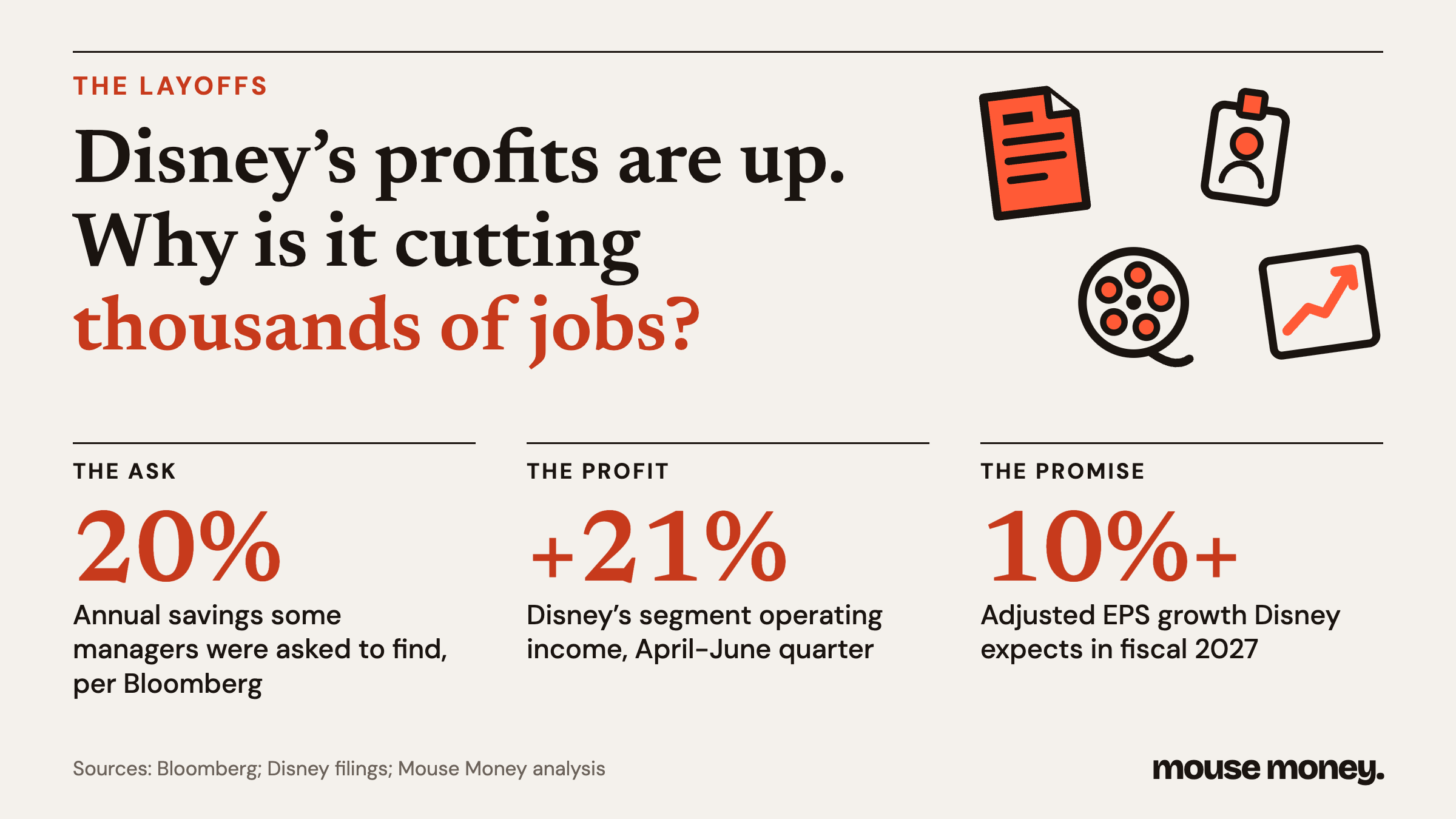
Disney is preparing to cut thousands of jobs and has asked some managers to target 20% in annual cost savings, Bloomberg reported Monday evening. Deadline reported the plan through its own sources, and CNBC followed on Tuesday. Disney declined to comment to Bloomberg. No outlet has reported a number, a date or exactly which teams.
The cuts aren’t a response to a bad quarter. Disney’s segment operating income rose 21% in the April-June quarter, and its parks unit earned more than half of the company’s profit in fiscal 2025. Disney planned to buy back at least $9 billion of its own stock in the fiscal year that ended in early October. What it has promised Wall Street is harder: double-digit growth in adjusted earnings per share in fiscal 2027, which began in October, while analysts expect its sales to grow only about half that fast. Earnings per share can outrun sales only if margins widen, the share count shrinks, or both. Cutting costs is the most direct lever, and Bloomberg reports that D’Amaro wants to put part of the savings back into film and TV programming, technology, and the theme parks and cruise ships.
Wall Street has been asking about this all year, though not about how many jobs. Analysts on Disney’s earnings calls have asked whether its savings will go to the bottom line or back into the business, and how much artificial intelligence can save. None, as far as we could find, has published an estimate of how many jobs Disney could cut. Disney’s finance chief, Hugh Johnston, has been more direct than the analysts. He told them in May that Disney was working toward “right-sizing our organization,” and he has listed managing park staff and making back-office workers “more effective and more efficient” among the ways AI could raise revenue or cut costs.
What has been reported, and what hasn’t
The 20% is a savings target for some managers, not a share of the workforce. Bloomberg says the savings could come from eliminating jobs as well as from other expenses, and that some of Disney’s operations, which it says range from the theme parks to the TV networks and the film studio, will be affected disproportionately. It doesn’t say which. Deadline names the TV networks and the studio. CNBC, which reported “several thousand” cuts, says the target is up to 20%. Deadline also reported that more managers than expected had taken an early-retirement offer Disney made in August.
The cuts have been coming in rounds all year. In April, Disney eliminated about 1,000 jobs, mostly in the marketing division it had combined in January. Several hundred followed in July, including 108 at Pixar. In late August, Disney offered early retirement to some longtime U.S. executives, from director to executive vice president, in its entertainment, ESPN and corporate units, and its chief people officer, Sonia Coleman, wrote that “involuntary staff reductions that have already begun in some areas” would “continue into next year.” A few hundred human-resources and technology jobs went in September, and 100 to 200 at Disney Experiences, including at Imagineering, in October. The Wall Street Journal reported in October that a restructuring of the TV group under Debra O’Connell could eliminate hundreds of jobs.
What Wall Street expects
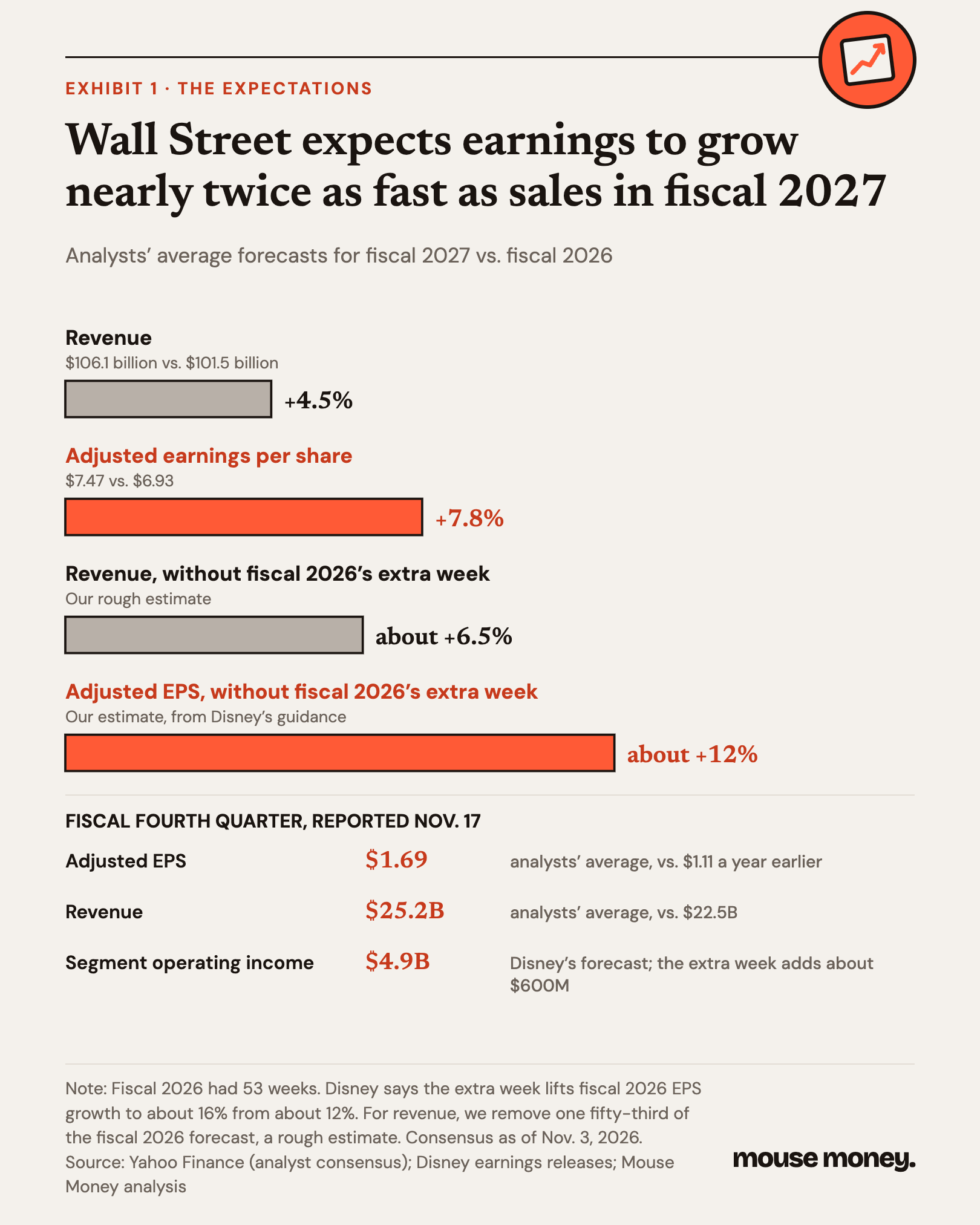
Disney reports its fiscal fourth quarter, which ended Oct. 3, before the market opens on Nov. 17. Analysts expect adjusted earnings of $1.69 a share, according to Yahoo Finance, up from $1.11 a year earlier, partly because the quarter had an extra week. Disney itself has forecast about $4.9 billion of segment operating income for the quarter, including about $600 million from that 53rd week.
The bigger number is fiscal 2027. Analysts on average expect adjusted earnings per share of $7.47, up 7.8% from the $6.93 they expect for fiscal 2026, on revenue up about 4.5%. Both figures are held down by fiscal 2026’s extra week. Disney says that week lifts fiscal 2026 EPS growth to about 16% from about 12%. Take it out, and the fiscal 2027 forecast works out to EPS growth of roughly 12% on sales growth of roughly 6% to 7%, by our rough estimate. Wall Street, in other words, has already written Disney’s double-digit promise into its numbers, and it expects earnings to grow nearly twice as fast as sales.
Analysts have pressed Disney on what the cuts are for. On the May earnings call, Wells Fargo’s Steven Cahall pointed to “some recently announced workforce reductions” and asked whether “efficiency gains” would fall “to the bottom line” or be “reinvested into areas of growth like content or technology spend.” Johnston said Disney was working toward “right-sizing our organization for the state of the business today and where we want to go over time,” that it wouldn’t “size the opportunity,” and that it wanted “to fund growth opportunities from within the existing expense base.” In August, answering a question about stock buybacks, he said Disney was looking at “meaningful reductions to cost, including labor and SG&A,” the accounting line for selling, general and administrative costs, which includes marketing and overhead. Bank of America’s Jessica Reif Ehrlich wrote in late September that savings from cost cuts were likely to be largely reinvested in streaming and that the Entertainment segment faced a harder year in fiscal 2027, Benzinga reported.
The stock is where the pressure shows. Disney shares are roughly flat for 2026, while the S&P 500 is up about 11%. When D’Amaro took over in March, Guggenheim’s Michael Morris wrote that the shares had “underperformed the S&P 500 by 60%” since Bob Iger returned in late 2022, according to Deadline. The layoff reports barely moved the stock on Tuesday morning.
The parks make the money
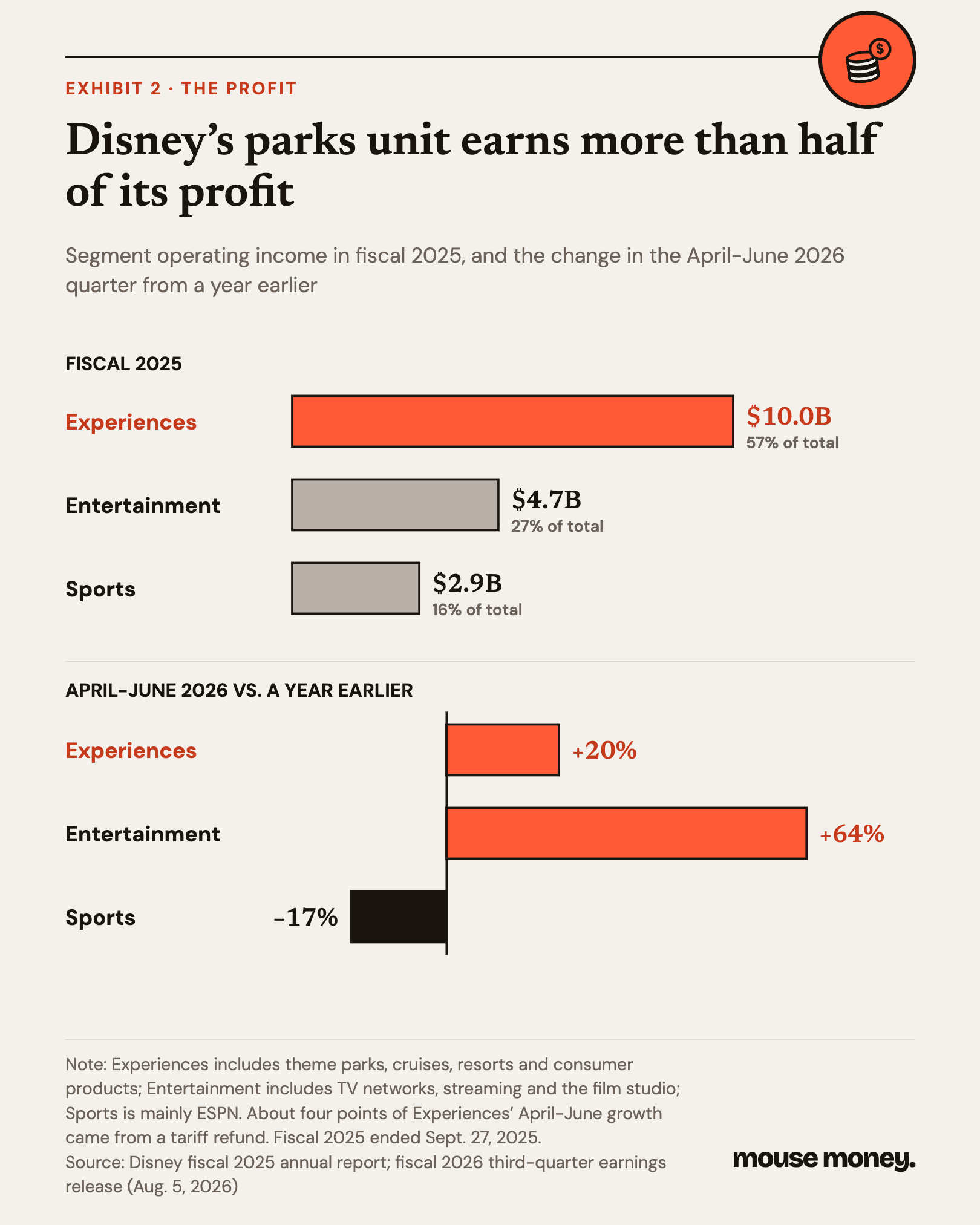
Disney’s Experiences segment, which includes the parks, cruises, resorts and consumer products, earned $10 billion of operating income in fiscal 2025, 57% of the total. It grew 20% in the April-June quarter, about four points of it from a tariff refund, and Disney expected its full-year growth to come in at the high end of its high-single-digit forecast.
Whether the parks are part of this round is unclear. Bloomberg mentions them among the businesses Disney runs and among those D’Amaro wants to reinvest in, and Pirates & Princesses noted that neither Bloomberg nor Deadline said whether front-line cast members would be affected. The parks unit’s October cuts reached Imagineering, its design and engineering arm: 159 layoffs Disney listed in a California notice for Imagineering’s Glendale campus take effect Dec. 29.
The studio and TV are the pressure points
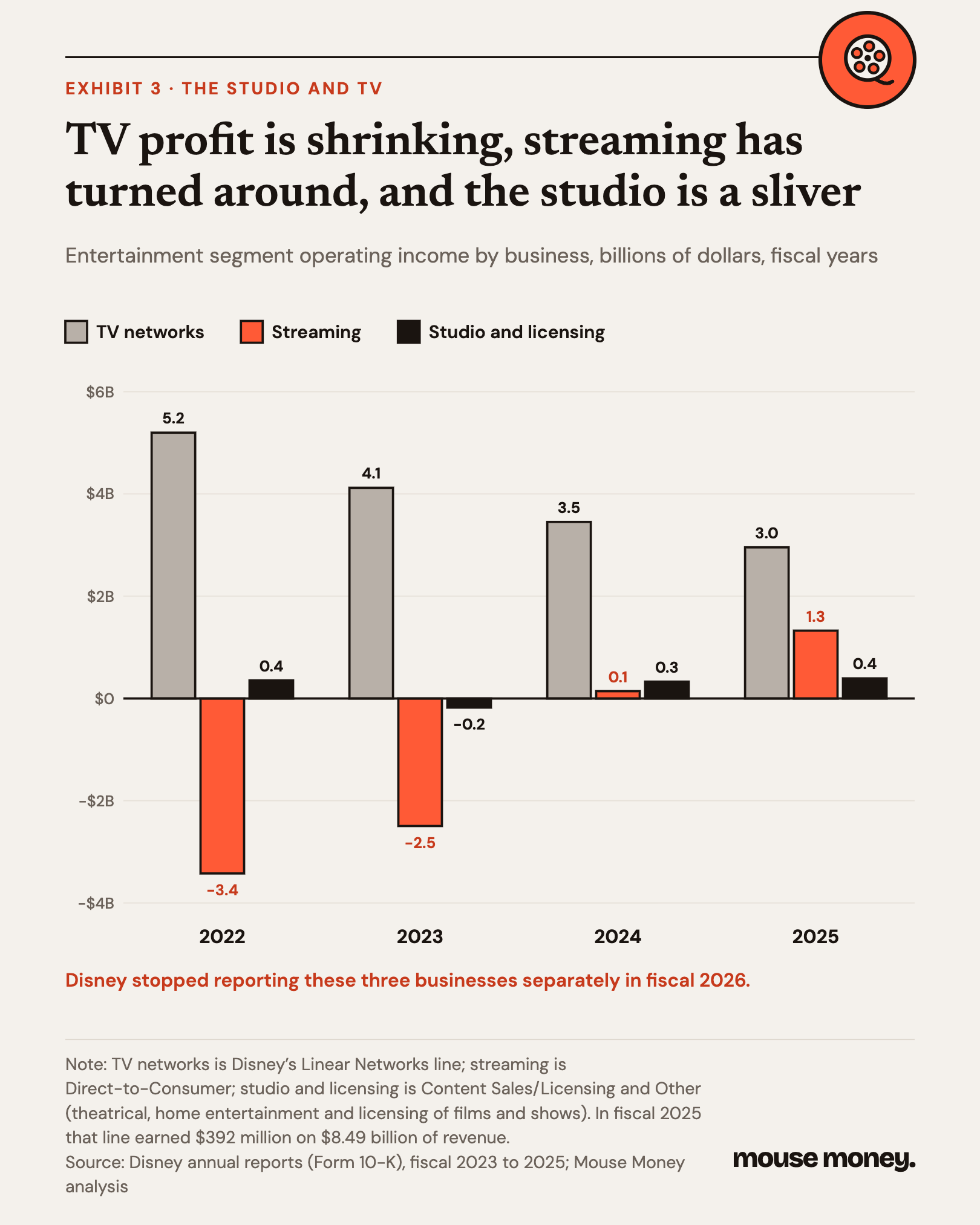
The Entertainment segment is where the numbers argue for cuts. Operating income from Disney’s TV networks fell from $5.2 billion in fiscal 2022 to $3.0 billion in fiscal 2025, down 43%, as cable subscribers kept leaving, advertising weakened and Disney moved its Indian TV business into a joint venture. Streaming moved the other way, from a $3.4 billion loss to a $1.3 billion profit, and Disney’s subscription-streaming businesses earned $712 million in the April-June quarter, a 13% margin.
The studio is the thinnest line. Content sales and licensing, which covers theatrical releases, home entertainment and licensing of films and shows, earned $392 million on $8.49 billion of revenue in fiscal 2025, a 4.6% margin, after losing money in fiscal 2023. This year Disney stopped reporting it separately.
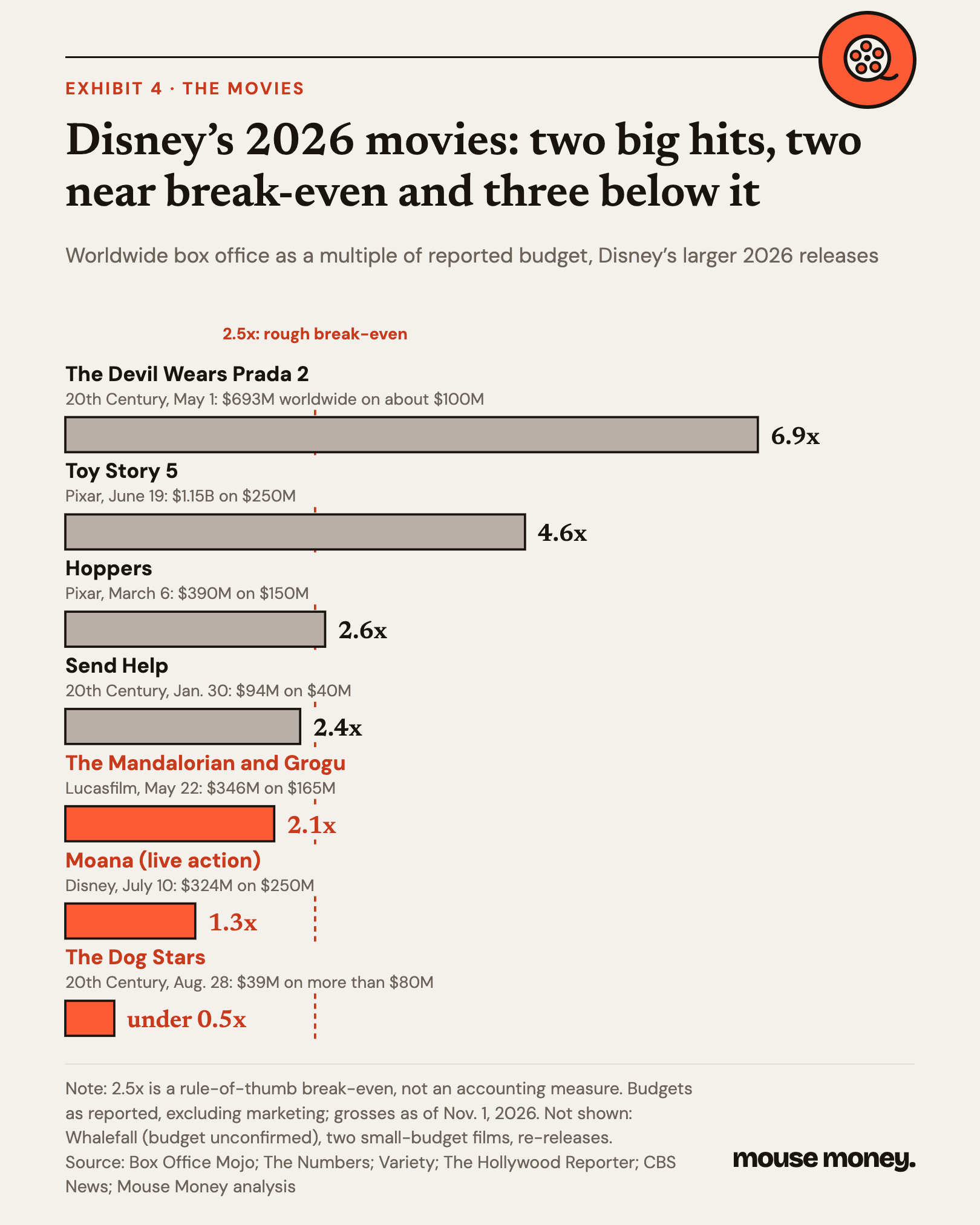
The 2026 slate shows why. Toy Story 5 has grossed $1.15 billion worldwide on a reported $250 million budget, and The Devil Wears Prada 2 $693 million on about $100 million. But Disney said in August that The Mandalorian and Grogu and the live-action Moana “underperformed our box office expectations,” and that its fourth-quarter Entertainment results would “reflect the impact of Moana’s box office performance.” Moana has grossed $324 million on a reported $250 million budget.
Is the studio inefficient? Disney no longer reports enough to say. What is clear is that a studio’s costs don’t shrink when its films disappoint, because production and marketing money is spent before a movie opens. When Disney last made big cuts, in 2023, about half of the $2.5 billion it set out to save outside of content was to come from marketing and about 30% from labor, its finance chief said at the time. Lower marketing costs are already showing up: the Entertainment segment’s selling, general and administrative costs fell $187 million in the April-June quarter from a year earlier, to $2.3 billion, which Disney attributed to lower marketing costs. It didn’t say how much came from this year’s marketing cuts. Hits don’t protect jobs, either: in July, a month after Toy Story 5 opened, Pixar filed notice that it would lay off 108 people in Emeryville, Calif.
Is it AI?
D’Amaro’s April layoff memo said Disney had to “constantly assess how to foster a more agile and technologically-enabled workforce.” In public, though, Disney says AI is about more than cost. “With AI, it isn’t simply about efficiency,” its August letter to shareholders said, adding that Disney uses AI “first and foremost to enhance a creative process” and had given an AI tool called J.A.R.V.I.S. to its more than 2,000 Imagineers earlier this year. In September it hired Character.AI’s chief executive, Karandeep Anand, as its first company-wide chief technology officer.
Its finance chief has been plainer with investors. Asked at a Morgan Stanley conference in March what generative AI could mean for Disney, Johnston listed five areas, including “managing the large cast that we have running the parks” and “making our back-office people more effective and more efficient.” All five, he said, “have the potential to either drive a lot of revenue for the company or alternatively to reduce costs for the company.” In May, when Needham’s Laura Martin asked where Disney was integrating generative AI “to lower costs and/or accelerate revenue growth,” Johnston pointed to “precision labor demand forecasting across our theme parks,” which he said could create “a better guest experience, a better employment experience, and also better cost management for the company.” And at a Goldman Sachs conference in September, he described “that virtuous circle of reducing costs, reinvestment in the business, driving growth, creating operating leverage, and then reducing cost again.” If Disney could keep that up, “leveraging both our cost management as well as artificial intelligence,” he said, it would be “an earnings compounder for many, many, many years to come.”
The clearest link between AI and jobs is in the legal department. In a Sept. 18 memo first reported by Deadline, Disney’s top lawyer, Horacio Gutierrez, told the fewer than 1,000 people in Legal and Global Affairs that the group “will be a much smaller organization than it is today.” The memo also mentioned “automating certain workflows.” Six days later, Disney posted an opening for a director of “AI Enablement & Legal Engineering.”
Analysts are asking the same question about the studio. On the August call, Morgan Stanley’s Sean Diffley asked how to think about AI “cost savings across different film types.” D’Amaro answered that Disney was using AI across the company “to gain efficiency, to be faster, to accelerate velocity, and unleash creativity.”
What no outlet has reported is that AI is replacing the jobs being cut now. The rounds so far look like older moves: combining marketing and back-office teams, restructuring TV and trimming a studio whose results swing between hits and misses. The parks are where Johnston has been most specific about AI and labor, but no outlet has reported that park jobs are part of this round, let alone tied them to AI. AI is part of Disney’s plan to spend less over time. Disney hasn’t said it is the reason for this round.
The head count
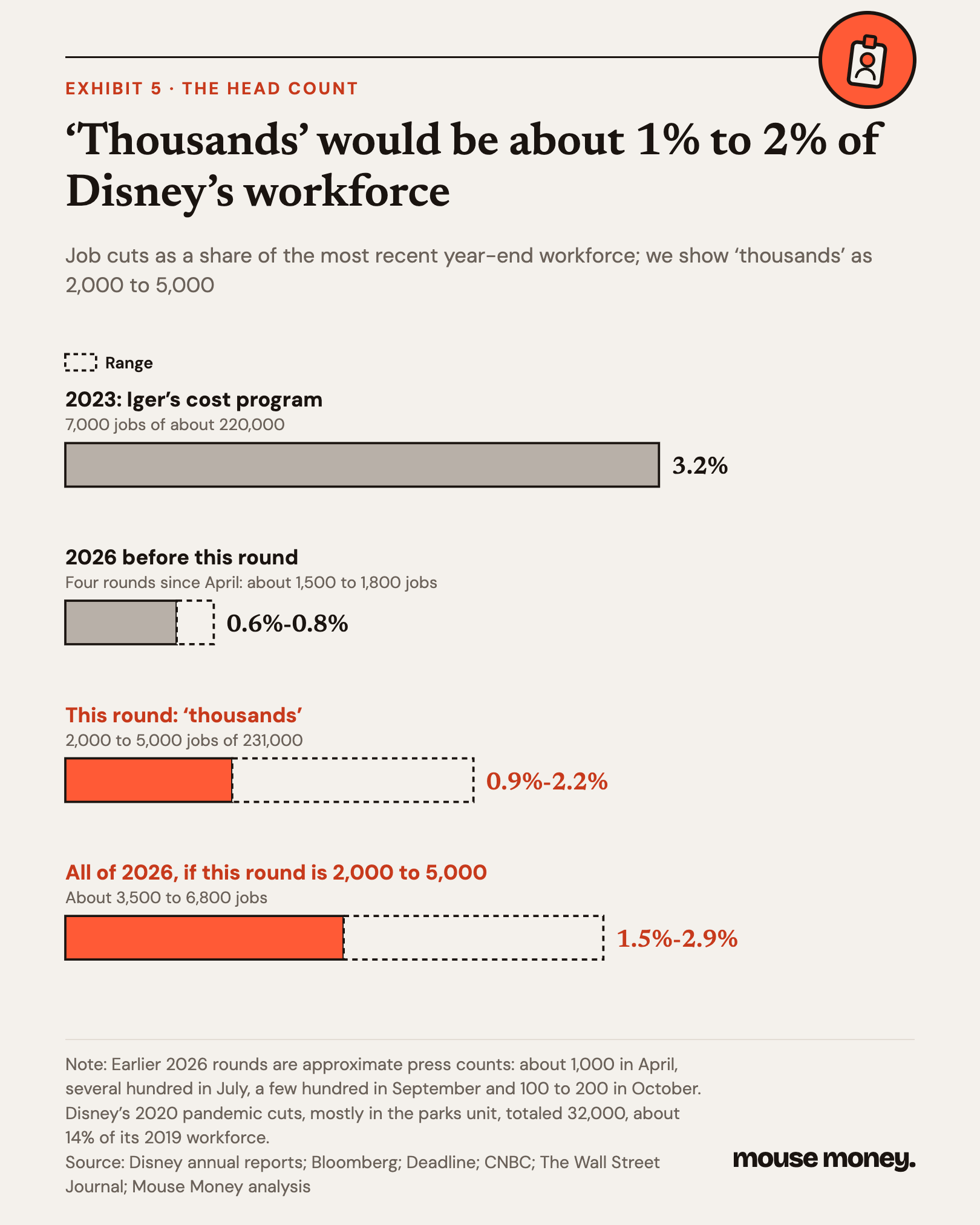
Disney employed about 231,000 people at the end of fiscal 2025: 172,000 in the U.S. and 59,000 abroad, about three-quarters of them full-time. That is up from 133,000 in fiscal 2006, and it kept growing after the 2023 cuts, from about 220,000 in fiscal 2022 to a peak of 233,000 in fiscal 2024. Read as 2,000 to 5,000 jobs, “thousands” would be 0.9% to 2.2% of the workforce, a smaller share than the 7,000 cuts of 2023 and far smaller than the 32,000 of 2020, most of them in the parks unit during the pandemic closures.
Analysts have said little about that number. We found no Wall Street estimate of how many jobs Disney could cut, what the 20% ask would save or how big Disney’s workforce should be, and on Disney’s August earnings call, no analyst asked about head count. Their questions have been mostly about money, not people.
The most detailed outside critique of Disney’s overhead is nearly four years old. In January 2023, Nelson Peltz’s Trian Fund Management told shareholders that Disney’s selling, general and administrative costs had risen 85% in four years, to $16.4 billion in fiscal 2022, a stretch that included Disney’s purchase of most of 21st Century Fox and the launch of Disney+. Trian said it believed “Disney has never thoroughly reviewed its cost structure.” In fiscal 2023, the year of the last big cuts, those costs fell to $15.3 billion. They have grown faster than sales since, reaching $16.5 billion in fiscal 2025, slightly above the 2022 level Trian criticized. Head count and overhead both drifted back up after the last round of cuts. Johnston has said Disney wants to “build a culture of efficiency” and that the work is “an ongoing exercise.”
Inside Disney, the plainest talk about head count has come from Dana Walden, its president and chief creative officer. Explaining the TV reorganization at a Bloomberg conference on Oct. 1, she said Disney had to “evaluate how many people do we need, how many people are so many that it’s actually keeping us from being agile, speed of decision making.”
What we are watching
Nov. 17: Disney’s fiscal 2026 fourth-quarter results and fiscal 2027 outlook. Watch for a savings figure (in 2023 Disney promised $5.5 billion, later raised to $7.5 billion), a restructuring charge, whether the double-digit EPS forecast holds, and how much of the savings Disney says will reach earnings.
Tuesdays and Thursdays: California’s posted layoff notices. The state requires 60 days’ warning for larger layoffs at one site, and Disney has filed 63 to 67 days ahead this year, so a cut that takes effect in January would need a notice between now and early December.
Dec. 29: The 159 Imagineering layoffs take effect.
Fiscal 2026 annual report: Disney’s year-end head count, expected with or soon after the Nov. 17 results.
The risks
The reports are anonymous. Bloomberg, Deadline and CNBC all cite unnamed sources, and Disney hasn’t confirmed a number, a date or the teams involved.
”Thousands” is vague. Our 2,000-to-5,000 range is an illustration, not a forecast.
Early retirements may shrink the layoffs. Deadline says more managers took the August offer than expected, which could mean fewer layoffs than “thousands” suggests.
Reinvestment cuts both ways. If most of the savings go back into content, technology and the parks, the cuts will show up in Disney’s spending more than in its earnings.
What would change our view. If Disney lowers its fiscal 2027 forecast on Nov. 17, these cuts are about protecting earnings, not paying for growth. If it reaffirms double-digit growth and names a savings figure it plans to reinvest, the cuts are what D’Amaro has said they are.
Disney isn’t cutting because it is losing money. It says it is cutting to pay for growth, while promising Wall Street earnings growth that sales growth alone won’t deliver. Nov. 17 will show how it plans to do both.
How we did this
We read Bloomberg’s report as syndicated by Yahoo Finance. Deadline’s, CNBC’s and Variety’s pages did not load for us, so we relied on Pirates & Princesses’ summary of Deadline’s report and on CNBC’s headline; we couldn’t see whether Variety had its own sources. Analysts’ questions and executives’ answers come from Disney’s official transcripts of its May 6 and Aug. 5 earnings calls and of Johnston’s March 2 and Sept. 9 conference appearances. We searched coverage of the Nov. 2-3 reports through Tuesday afternoon for analysts’ comments and found none. Financial figures come from Disney’s annual reports and its fiscal 2026 quarterly releases; the fiscal 2022 overhead figure, which Trian cited, is from Disney’s fiscal 2022 annual report. Analysts’ forecasts are Yahoo Finance’s consensus as of Nov. 3. To compare fiscal 2027 with fiscal 2026 on a like-for-like basis, we used Disney’s guidance that fiscal 2026 adjusted EPS will grow about 12% without the 53rd week, which puts the base at about $6.64 ($5.93 times 1.12); for revenue, we took one fifty-third of analysts’ fiscal 2026 forecast out of the base, a rough cut that treats every week alike. Box office grosses are as of Nov. 1, from Box Office Mojo, checked against The Numbers; budgets are as reported by trade publications and other outlets and exclude marketing. “Thousands” is shown as 2,000 to 5,000, and earlier 2026 rounds are approximate press counts. Layoff-notice dates come from California’s Employment Development Department.
Sources
Pirates & Princesses, summary of the Bloomberg and Deadline reports (Nov. 3, 2026)
Reuters, on Bloomberg’s report (Nov. 2, 2026), as syndicated by Investing.com
Disney, official transcript of the fiscal 2026 second-quarter earnings call (May 6, 2026)
Disney, official transcript of the fiscal 2026 third-quarter earnings call (Aug. 5, 2026)
Disney, fiscal 2026 third-quarter earnings release and shareholder letter (Aug. 5, 2026)
Disney, fiscal 2025 fourth-quarter earnings release (Nov. 13, 2025)
Disney, fiscal 2025 annual report (Form 10-K), with its income statement and segment table: 1, 2, 3
Disney, fiscal 2022 annual report (Form 10-K), for head count and overhead: 1, 2
Disney annual reports (Form 10-K) for head count in fiscal 2006, 2020 and 2024: 1, 2, 3
Disney, fiscal 2026 fourth-quarter results date (Oct. 12, 2026)
Disney, Karandeep Anand named chief technology officer (Sept. 18, 2026)
Benzinga, on Bank of America’s Jessica Reif Ehrlich (Sept. 29, 2026), as syndicated by Longbridge
WDW News Today, on Guggenheim’s Michael Morris as quoted by Deadline (Mar. 19, 2026)
Trian Fund Management, “Restore the Magic” (Jan. 12, 2023), filed with the SEC
SFist, July 2026 layoffs at Pixar and elsewhere (July 21, 2026)
Fox Business, early-retirement offer and eligibility (Aug. 25, 2026)
TheWrap, early-retirement offer and Sonia Coleman’s memo (Aug. 24, 2026)
Variety, September layoffs in human resources and technology (Sept. 29, 2026), Australian edition
BlogMickey, California filing for 159 layoffs at Imagineering (October 2026)
Laughing Place and IBTimes UK, Horacio Gutierrez’s memo to Legal and Global Affairs (September 2026): 1, 2
Disney Careers, “Director, AI Enablement & Legal Engineering”
California Employment Development Department, WARN notices and posting schedule: 1, 2
Box Office Mojo and The Numbers, 2026 grosses (as of Nov. 1, 2026): 1, 2
Production budgets: Variety on Toy Story 5, The Devil Wears Prada 2, Moana and The Dog Stars; Deseret News citing The Hollywood Reporter on The Mandalorian and Grogu; The Numbers on Hoppers; CBS News on Send Help: 1, 2, 3, 4, 5, 6, 7