


On Wednesday, the Los Angeles Times reported that Disney’s theme parks division was laying off 100 to 200 people. Disney declined to comment. Fan sites reported that Walt Disney Imagineering, the unit that designs its rides and lands, was among the teams hit. It was the third round of Disney job cuts this year to begin two to three weeks before an earnings report, and the company had told investors to expect more. “We remain highly focused on reducing costs across the enterprise,” Josh D’Amaro, the chief executive, and Hugh Johnston, the finance chief, wrote in the company’s August earnings release, adding that they were “evaluating a variety of levers, including reductions in labor and SG&A.”
This is a company watching its money. D’Amaro, who took over in March, says Disney creates long-term value when it operates with “speed, discipline, and efficiency.” Disney expected to spend about $9 billion on capital projects in the fiscal year that ended Oct. 3, much of it on new attractions and cruise ships, under a plan announced in 2023 to put about $60 billion into its parks and cruises over roughly a decade. It also planned to spend at least $9 billion buying back its own stock. And the parks are thriving: operating income in the Experiences segment rose 20% in the quarter ended June 27, to $3.02 billion, about four points of it from a tariff refund.
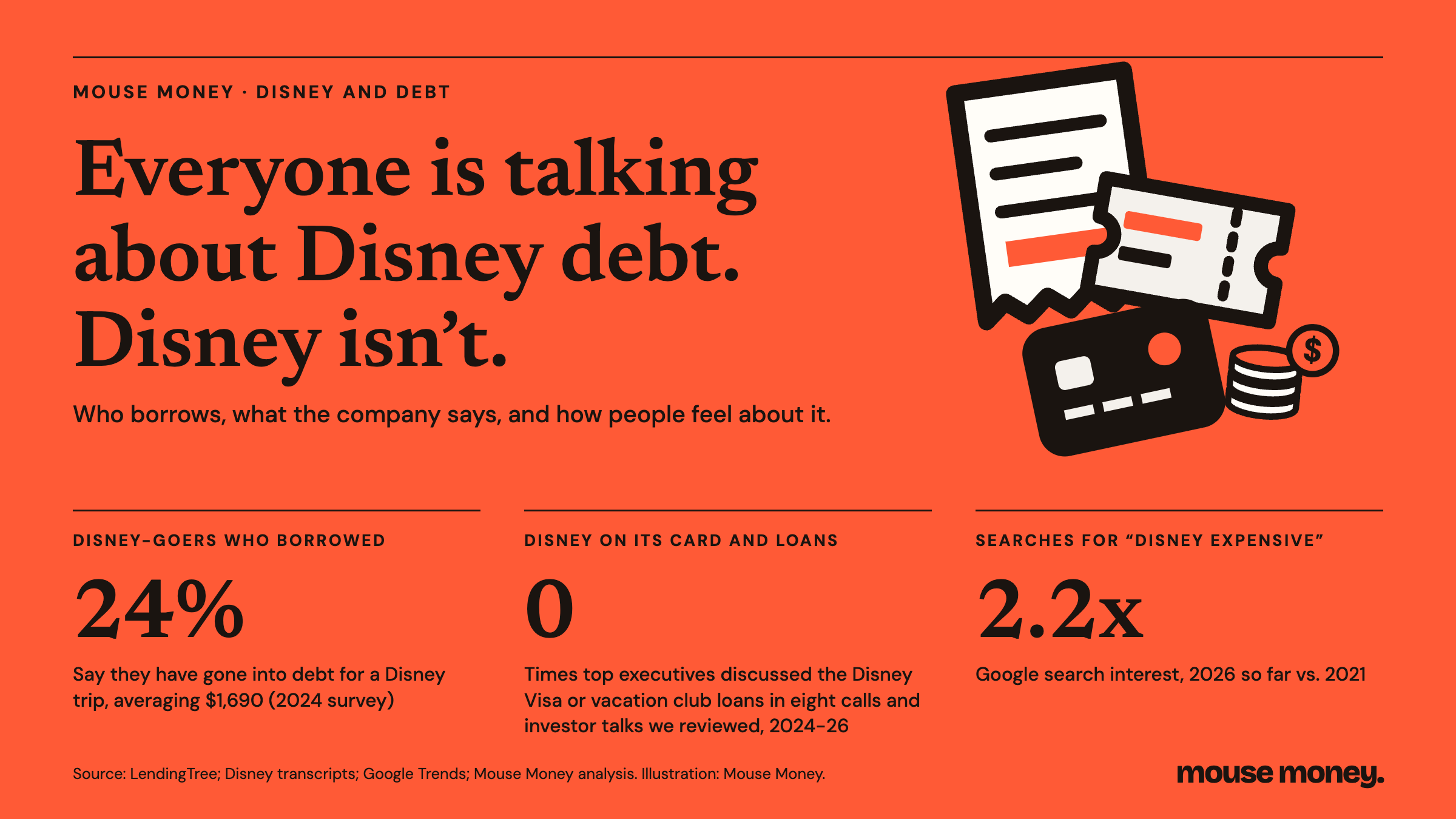
Many of its customers are stretching. A quarter of Disney-goers told LendingTree, an online loan marketplace, in 2024 that they had gone into debt for a Disney trip, and those who did borrowed an average of $1,690. Google searches for “Disney expensive” are at a record, more than twice their 2021 level. Fans even have a T-shirt for it: “Most Expensive Day Ever,” a fan-made twist on “Best Day Ever,” a slogan Disney has printed on shirts sold on Main Street, U.S.A. Disney, which offers guests several ways to pay later, says almost nothing about the borrowing.
The stakes are large. Experiences, the segment that includes the parks, produced 57% of Disney’s segment operating income in fiscal 2025. And Disney is mostly paid up front. A vacation package has to be paid in full 30 days before arrival, so Disney has the money before the family gets there. When that money is borrowed, it is borrowed from Chase, from PayPal and its partner bank, or from another card issuer or lender, and they and their investors, not Disney, carry the risk of not being repaid. The main exception is Disney Vacation Club, the company’s timeshare business, where Disney lends to buyers. The risk for Disney is not that its customers default. It is that they stop saying yes.
The customers
Who borrows, and how much
LendingTree, which is paid by lenders when it passes along consumers’ loan requests, surveyed Disney-goers about debt in 2022 and 2024. In the 2024 survey, 24% of adults who had been to a Disney park said they had gone into debt for a Disney trip, up from 18% in 2022. Among Disney-going parents of children under 18, the share rose to 45% from 30%. Both were online opt-in polls run by different vendors, so the increase is a signal rather than a measured trend. The question also counts any trip ever taken: fewer than a third of the 2024 borrowers said they had done it in the past year.
The sums are modest by the standards of household debt. Borrowers reported an average of $1,690, and parents $1,983. Three in four said it would take, or took, six months or less to repay, and 64% said they had no regrets. At 22.36%, the average rate on bank credit card accounts assessed interest in August 2026, repaying $1,690 in six equal monthly payments would cost about $112 in interest.
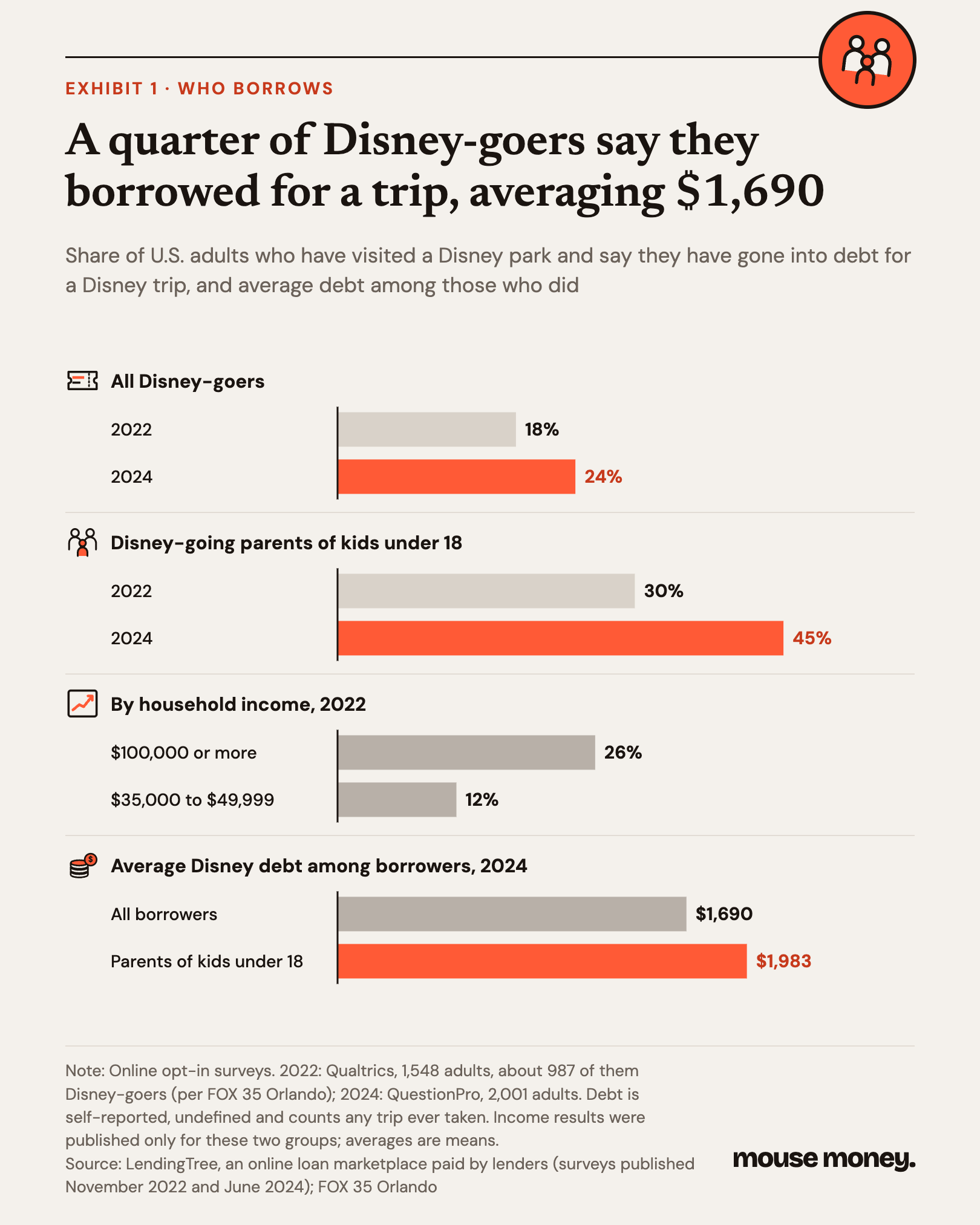
It is not only a story about stretched budgets. In the 2022 survey, 26% of Disney-goers earning $100,000 or more said they had borrowed for a trip, against 12% of those earning $35,000 to $49,999, the only two income groups LendingTree published. Disney has described the same divide. In August 2024, Johnston told investors that “the lower-income consumer is feeling a little bit of stress. The high-income consumer is traveling internationally a bit more.” Card data showed it the next summer: spending at U.S. theme parks fell 5% from a year earlier, with the weakness among visitors earning under $100,000, Forbes reported, citing Consumer Edge, while Bloomberg Second Measure data put spending by Disney park visitors up 8% from May through July.
In 2024, The New York Times profiled Alyssa Leach, whose household earns about $250,000. For a 2022 trip, she charged about $6,000 to her Disney-branded credit card, paid the minimum for two months and ran up about $382 in interest. “I’ll make more money,” she told the paper. “But he’ll never be that young again,” she said of her son.
The extreme cases are the ones that spread. Accounts of a New Yorker article in May describe AJ Wolfe, the author of a book about Disney adults, who ran up about $17,000 of Disney debt in the early 2000s, and a Columbus high school teacher who owes $3,000 for her next trip. On Caleb Hammer’s YouTube show “Financial Audit,” a 26-year-old Orlando barista with $50,000 of consumer debt, bragging about a planned trip to Disneyland, said of her splurges: “I could die tomorrow, so I’m spending money today.” One Instagram user joked, “My retirement plan is just vibes and pixie dust,” Moneywise reported. None of that is typical. The average borrower in LendingTree’s survey took on $1,690, and three in four said they had repaid, or expected to repay, within six months.
Borrowing for a big occasion is common. In LendingTree surveys, 67% of newlyweds said they took on debt for their weddings, and 37% of consumers said they took on holiday debt in 2025, averaging $1,223. In a Bankrate poll, 29% of Americans planning summer trips in 2025 said they would take on debt for them, down from 36% the year before. Buy now, pay later has become ordinary too: 16% of adults had used it in the previous 12 months when the Federal Reserve surveyed households in October 2025, one of the few probability samples on the subject.
What the trip costs
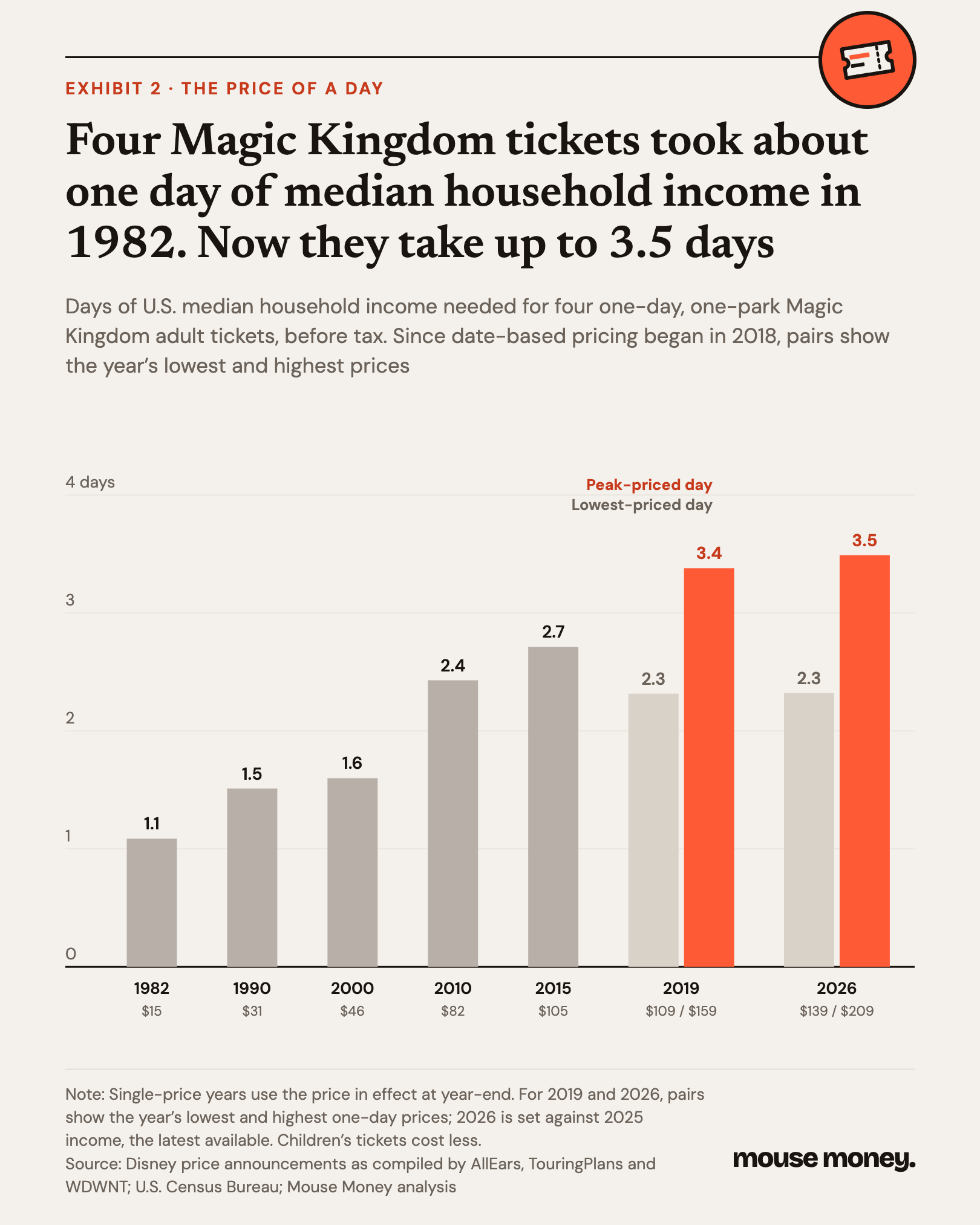
The price of the trip has climbed. By the fall of 1982, a one-day ticket to the Magic Kingdom cost $15, and four of them took about one day of the median American household’s income. On the most expensive days of 2026, four cost $836 before tax, about three and a half days of income. Even on the cheapest days, they take more than two. Disney has already set the Magic Kingdom price for Christmas Day and New Year’s Eve 2027 at $229 a ticket.
The extras add up faster than the tickets. A four-day Walt Disney World trip for a family of four, staying at a value resort, cost about $4,266 in 2024, against $3,230 for the same trip five years earlier in inflation-adjusted dollars, according to a TouringPlans analysis for The Wall Street Journal. Nearly 80% of the increase came from charges for services that used to be free, such as skipping lines. Files leaked in 2024 and reported by the Journal showed that Genie+, Disney’s paid line-skipping service, brought in more than $724 million of revenue at Disney World between October 2021 and June 2024.
The company
What Disney says, and what it doesn’t
Disney has not addressed guests’ borrowing directly. For a 2024 New York Times article about families going into debt for Disney vacations, a Disney spokesperson said the company offered vacation options at multiple price points; Disney representatives did not respond to Business Insider on the same subject that year. In eight earnings calls and investor appearances from 2024 through 2026 whose transcripts we reviewed, Disney’s top executives never discussed the Disney Visa or vacation club loans.
The annual report is nearly as quiet. Disney’s report for fiscal 2025 does not mention a credit card, Visa or Chase. It reports revenue from “sponsorships and co-branding opportunities” in a line called parks licensing and other, along with real estate rent and sales and royalties from Tokyo Disney Resort. That line brought in $2.36 billion in fiscal 2025, about 6.5% of the Experiences segment’s $36.2 billion of revenue, and Disney does not say how much of it comes from the card. The lending gets a sentence: Disney had $1.0 billion of receivables with original maturities of more than a year at the end of fiscal 2025, “primarily related to the sale of vacation club properties,” and it called credit losses on them “not material.” In a filing for the first quarter of fiscal 2025, it said $0.7 billion of the prior year-end balance was vacation club receivables.
What Disney does talk about is price and choice. “We intentionally offer a wide variety of ticket, hotel, and dining options to welcome as many families as possible, whatever their budget,” D’Amaro, then the chairman of Disney Experiences, said in a company article in February 2025. In the same article, Johnston said Disney had “worked hard to make a Disney vacation accessible to guests of all income levels.” At the annual meeting in March, on his first day as chief executive, D’Amaro told shareholders, “I know that a Disney Park visit, it’s a meaningful investment for families that visit us,” and added, “we want this experience to be the best day of a guest’s life,” according to WDW News Today, a fan news site.
With investors, executives have been more candid. “I’ve always believed that Disney was a brand that needed to be accessible,” Bob Iger, then Disney’s chief executive, told an investor conference in March 2023. “And I think that in our zeal to grow profits, we may have been a little bit too aggressive about some of our pricing.” In November 2025, at another conference, Johnston said that “our consumer, as you know, tends to be at the higher income deciles, and those consumers continue to do well,” adding, “we certainly, broadly feel good about where the consumer is.”
Taken away, given back
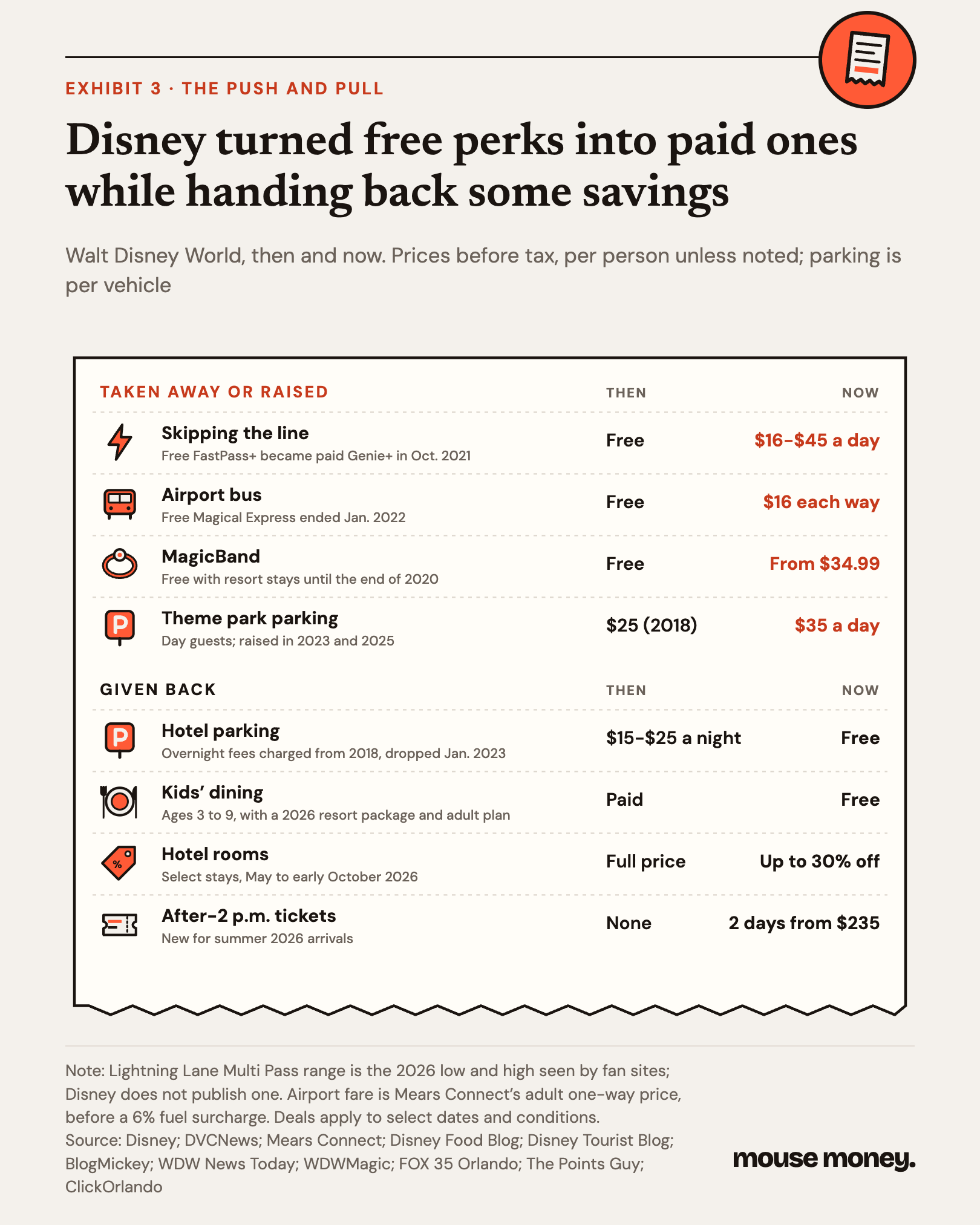
Disney has cut some prices and raised others. The company says “it’s important to us to offer a variety of ticket, hotel, and promotional offers during the year,” and the deals are real. Walt Disney World’s new after-2 p.m. tickets for the summer of 2026 started at $235 for two days. A four-day ticket covering one visit to each of the four parks, for visits from late May to early October, started at $109 a day. Hotel rooms were up to 30% off for much of the summer and early fall, Florida residents could get up to 35% off, and children 3 to 9 ate free with a resort package and an adult dining plan. In California, Disneyland sold kids’ summer tickets from $50 and offered Anaheim residents one-day tickets for $71.
So are the fees. Line-skipping, free under the old FastPass+ system, became Genie+ at $15 a person a day in October 2021. Its successor, Lightning Lane Multi Pass, has cost $16 to $45 a person a day in 2026, depending on the park and date, according to fan sites that track it. The top tier, Lightning Lane Premier Pass, runs as high as $449 a person at Magic Kingdom. The free Magical Express bus from Orlando’s airport ended on Jan. 1, 2022; Mears Connect, run by the company that operated it, now charges adults $16 each way plus a fuel surcharge. MagicBands, the wristbands that work as park tickets and room keys, were once free for resort guests and now cost $34.99 and up. Parking at the theme parks for day guests has gone from $25 in 2018 to $35. One change went the other way: in January 2023, Disney dropped the overnight parking fees it had begun charging hotel guests in 2018.
D’Amaro has made clear that the deals are targeted. The value offers are “designed to reach a specific guest,” he said on the company’s August earnings call, and with spending per guest up 4%, “we’re certainly not discounting our way to volume growth.” In the quarter ended June 27, attendance at Disney’s domestic parks rose 3%, and per capita guest spending rose 4%.
The checkout
Disney’s payment page invites guests to “pay a deposit at the time of booking then pay the remaining balance in customizable installments.” Its package terms set the deposit at $200 for trips booked more than 30 days out and require payment in full 30 days before arrival. PayPal’s Pay in 4 covers purchases of $30 to $1,500, with 25% down. Pay Monthly covers $49 to $10,000; Disney’s payment page lists fixed annual rates of 9.99% to 26%, and PayPal’s own terms run as high as 35.99%.
The free periods are short. Pay in 4 runs six weeks. The Disney Visa’s 0% offer, on select Disney vacation packages and cruises, lasts six months from the purchase, so a package balance charged a month before the trip stays interest-free for about five months after it. After that, the card charges new accounts 18.49% to 27.99%, a range that brackets the 22.36% average.
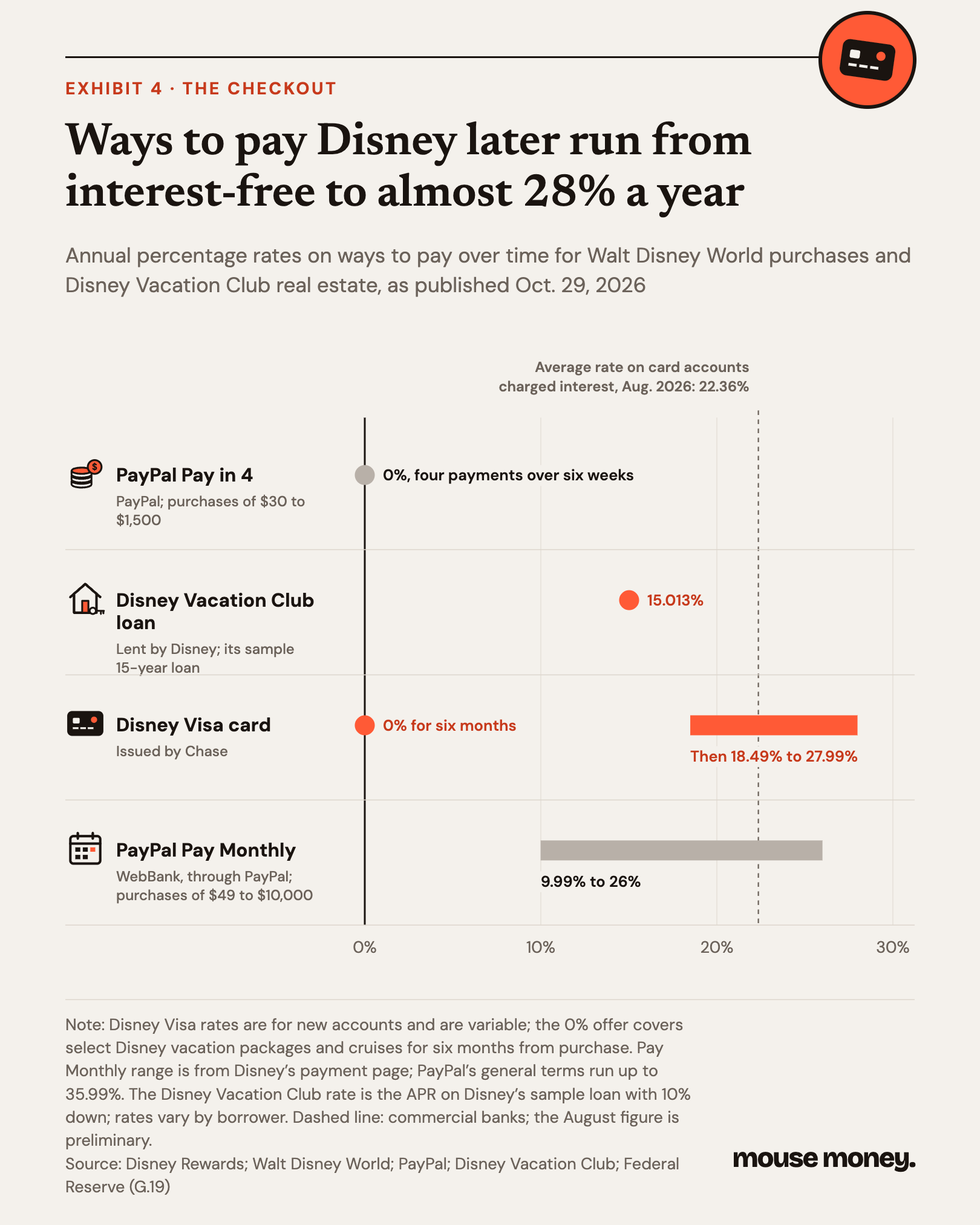
The card has carried Disney’s name since 2003 and now comes in three versions. The newest, the Disney Inspire Visa, launched in February with a $149 annual fee. Chase, which called itself the largest co-brand card issuer in the U.S. when it renewed the program in 2022, did not disclose how long the renewal runs or its terms. At the Inspire launch, Cathy Cline, Disney’s senior vice president of corporate alliances and consumer financial services, said the card “is sure to be a Disney fan’s go-to card in their wallet.” The card’s vacation financing page carries the tagline “Make your Disney vacation magic happen.” The most recent cardholder figure we could find is from 2008: “over 2 million Cardmembers joining since its launch in 2003.”
Disney as lender
Disney Vacation Club has sold ownership interests in 17 resort properties, priced in points that members trade for stays. Disney will lend buyers the money. In April 2025 it began offering 15-year loans on direct purchases, up from a standard 10 years. Its current sample, on the vacation club’s website, is 100 points at Polynesian Villas & Bungalows, priced at $24,300. With 10% down, the buyer borrows $22,603, including closing costs, and pays $316 a month for 15 years, an annual percentage rate of 15.013%. Over 180 payments that comes to $56,880, of which about $34,300 is interest, more than the price of the points. Annual dues on those 100 points, $69.42 a month in 2026 and “subject to increase,” come on top. Membership at the resort ends on Jan. 31, 2066.
Disney’s pitch is that ownership pays for itself. Compared with renting the same rooms, “savings can begin approximately 6 to 14 years after purchase,” the site says. That illustration assumes a cash purchase.
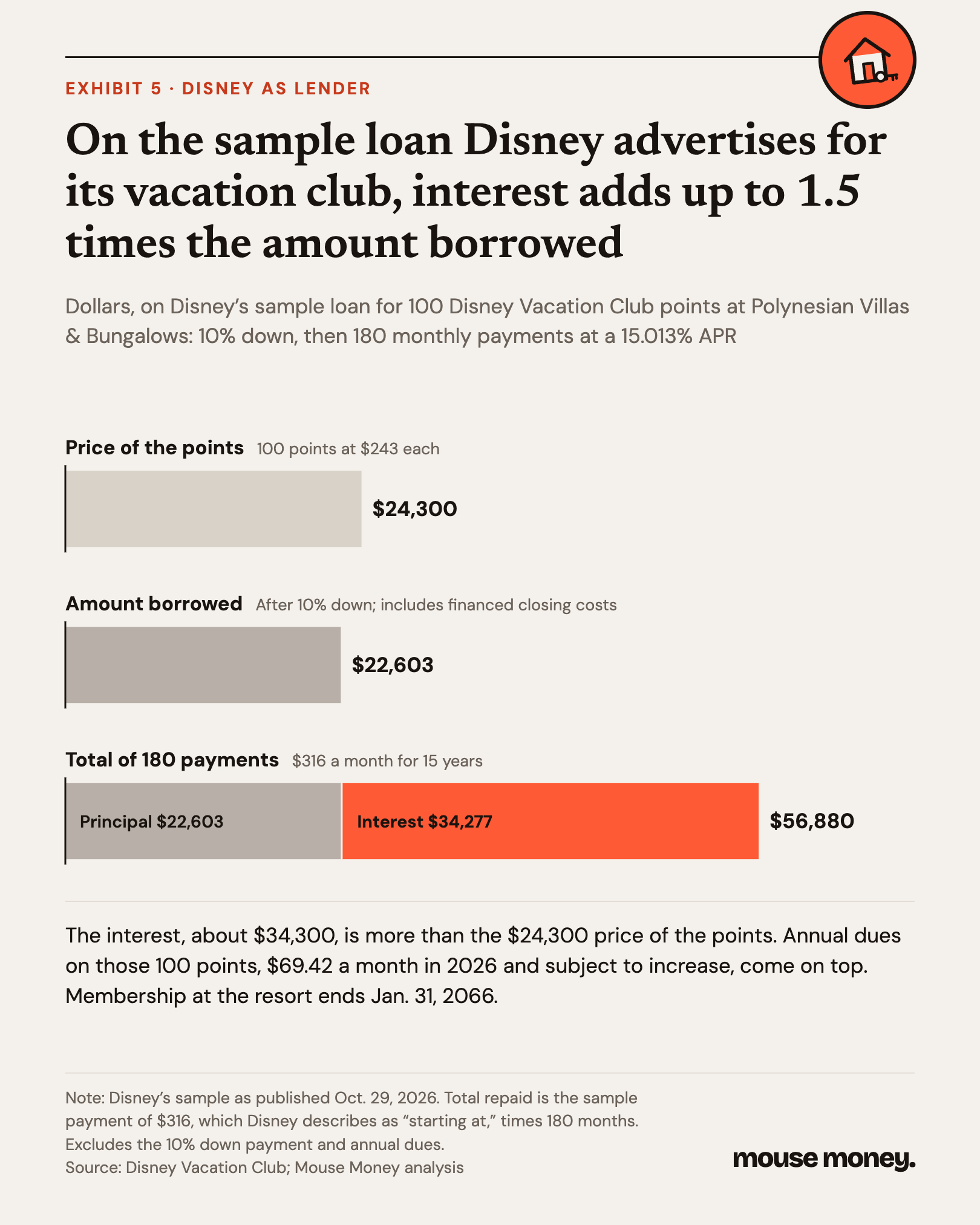
When owners fall behind, Disney’s side of the loan has teeth. Palm Financial Services, the Disney affiliate that handles foreclosures on vacation club interests that Disney financed, handled 928 of them in Orange County, Fla., in 2014 and more than 900 in 2015, according to county records reported by the Orlando Sentinel. In 2019, Disney filed 2,406 liens with the Orange County comptroller, according to DVCNews, which tied them to owners behind on loan payments or annual dues. The vacation club also moves Disney’s results: the company cited “lower sales of Disney Vacation Club units” in the fourth quarter of fiscal 2024 and higher unit sales in the second quarter of fiscal 2025.
How people feel
When Disney became “expensive”
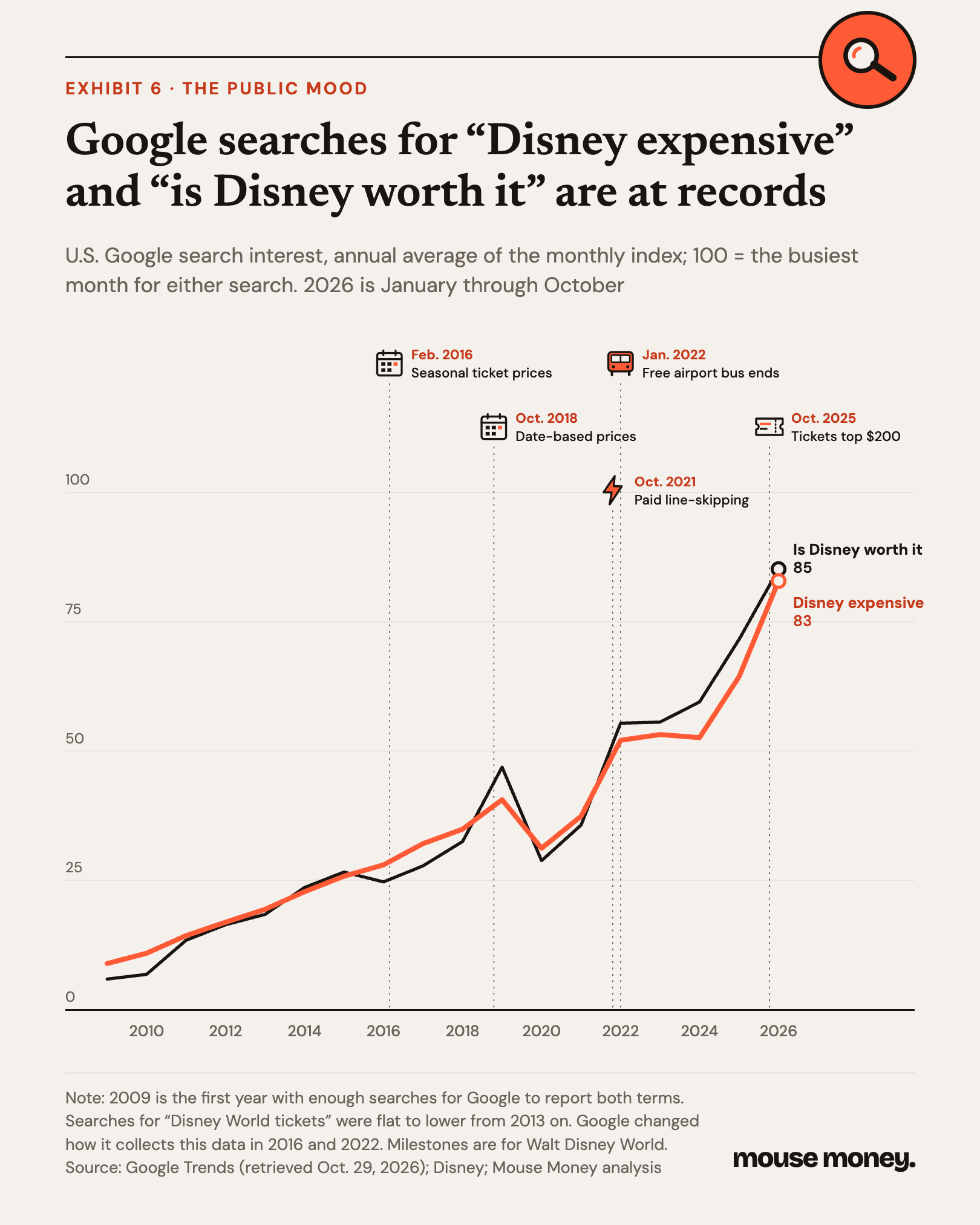
Search data shows when the idea that Disney is expensive took hold. U.S. Google searches for “Disney expensive” and “is Disney worth it” have climbed almost every year since 2009. One big step came in 2022, the first full year after Disney began charging for line-skipping and ended its free airport bus, when searches for “Disney expensive” rose about 40%, though Google also changed how it collects the data that January. This year both searches are at records, with “Disney expensive” running 34% above the same months of 2025. Searches for “Disney World tickets” were flat to lower over the same period, so the rise is not simply more people searching for Disney.
The worry is older than the searches. In 2015, the year a one-day Magic Kingdom ticket first passed $100, The Washington Post described how theme parks “left the middle class behind.” Robert Niles, the editor of Theme Park Insider, told the Post that parks would “set their prices at the top 10 percent of family incomes and make their money where the money is.” By 2025, Len Testa of TouringPlans had concluded that “Disney prices its theme parks for the top 20% of American households by income.”
Debt goes public
Debt has also moved into public view, and Disney’s marketing runs through the same feeds. The company worked with about 6,000 creators in 2026, 30% more than the year before, and their posts drew nearly 12 billion impressions, the Los Angeles Times reported this month. The same feeds that sell the trip carry posts about paying for it. “Disney adults,” grown fans who visit without children, became a favorite target online around 2020; Rolling Stone called them the internet’s most hated group. The New Yorker asked in May whether they are “the happiest debtors on Earth.” George Kamel, a personality at Ramsey Solutions, the debt-free advice company, posted a video last November of himself asking tourists at Disney Springs how much debt they carry. Most of what they described was car loans, student loans and card balances, not Disney trips.
Seeing other people’s vacations does move money. In a 2023 Credit Karma poll, 38% of Gen Z adults and 28% of millennials said they had spent money they didn’t have on travel after seeing other people’s vacations on social media, compared with 15% of Gen X and 7% of baby boomers and older adults. A 2013 study in the Journal of Consumer Research linked heavier social network use with higher credit card debt among people with strong ties to their online network. The pull has limits: in a December 2025 LendingTree poll, travel and experiences made up just 3% of the purchases people said they made after seeing them on social media.
Younger adults are more open about money than their elders. More than half of Gen Z adults told Bankrate in 2024 that they were comfortable talking about money with the people closest to them, against fewer than 30% of baby boomers. Debt itself still carries shame. In a 2018 Credit Karma survey, 73% of millennials who had gone into debt to keep up with friends said they had kept it a secret.
The happiest place, the most stressful bill
Money is among the heaviest worries Americans carry. In the American Psychological Association’s 2026 Stress in America survey, 77% of adults named the cost of living as a significant source of stress. In its 2023 survey, 58% of parents said money caused fights in their family, against 30% of other adults. Researchers who followed 4,574 couples found that disagreements about money predicted divorce more strongly than other common disagreements. “It’s not children, sex, in-laws or anything else. It’s money,” Sonya Britt, one of the authors, said in a 2013 release.
How families pay may matter as much as how much. In a classic study of mental accounting, Drazen Prelec and George Loewenstein found that most people would rather pay for a vacation before they take it, so it can be enjoyed “without thinking about the need to pay.” Disney’s deposit plan, with the balance due before arrival, works with that instinct. A card balance that lingers after the trip works against it. Paying later also tends to mean spending more. In auctions with real money, Prelec and Duncan Simester at MIT found that telling people to pay by credit card could raise what they were willing to pay by as much as 100%. A 2022 National Bureau of Economic Research working paper found that when shoppers gained access to buy now, pay later, their total spending rose and stayed higher.
The memories may be thinner than the bill. Research going back to a 2003 study by Leaf Van Boven and Thomas Gilovich finds that experiences tend to make people happier than possessions. But a 2010 Dutch study of 1,530 people found vacationers were happier than non-vacationers before their trips, and generally no happier afterward. And a trip with a toddler may not last in the child’s memory. Children asked at 8 and 9 about events they had discussed at age 3 remembered fewer than 40% of them, though researchers in 1991 found that children who had visited Disney World at 3 or 4 still recounted a great deal of it six or 18 months later.
Put together, the research describes the best Disney trip as one paid off before the gate opens: months of looking forward to it, the stretch when the Dutch study found vacationers happier than people staying home, and no bill afterward. Disney’s deposit plan is built for that kind of trip. The card that carries its name is built for the other kind.
What would change our view
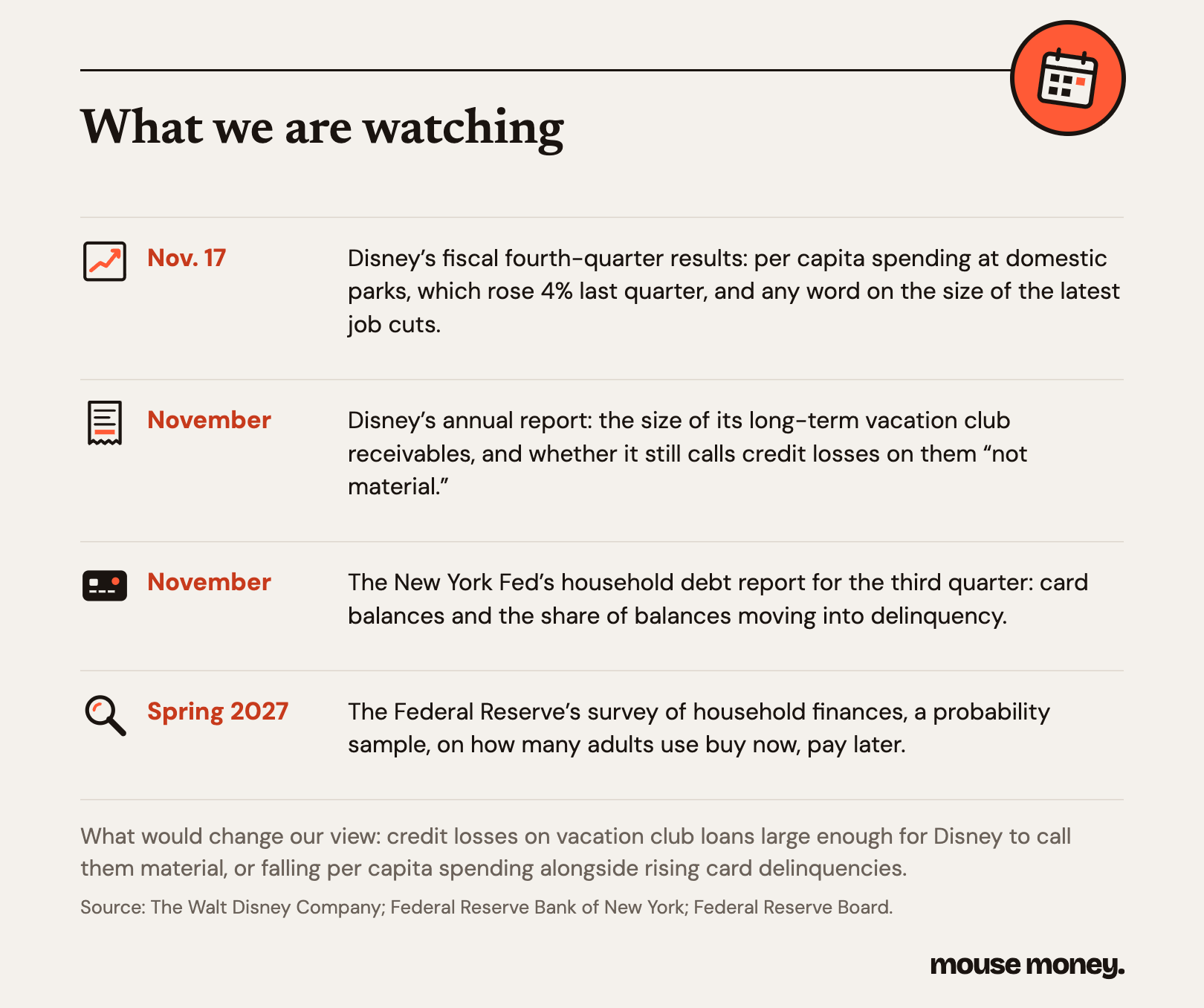
Our read is that Disney’s exposure to its customers’ debt is mostly indirect. It is paid up front, and the risk sits with lenders and families, except for about $1 billion of long-term receivables tied mostly to the vacation club. That would change if Disney began calling credit losses on those loans material, or if per capita spending at its domestic parks fell while card delinquencies rose. The next test comes on Nov. 17, when Disney reports results for its fiscal fourth quarter and may say how big the latest job cuts were.
How we did this
Days of income are four times the one-day, one-park adult Magic Kingdom ticket price before tax, divided by U.S. median household income for that year over 365 days. Single-price years use the price in effect at year-end: from the fall in 1982, February in 1990 and 2015, January in 2000 and August in 2010. For 2019 and 2026 we used the year’s lowest and highest prices; 2026 prices are compared with 2025 income, the latest Census figure. Search interest comes from Google Trends for the U.S., retrieved Oct. 29, 2026, as annual averages of the monthly index, with 2026 covering January through October; comparisons with earlier years use the same months. The interest example assumes $1,690 repaid in six equal monthly payments at 22.36%, the Federal Reserve’s preliminary August 2026 rate on bank credit card accounts assessed interest. The vacation club figures are Disney’s published sample as of Oct. 29, 2026, with total repayment calculated as $316 times 180. The LendingTree, Bankrate and Credit Karma polls are online opt-in samples; the Federal Reserve survey is a probability sample. D’Amaro’s remarks at the 2026 annual meeting are as reported by WDW News Today; Disney’s official transcript of the meeting covers only its business portion. Social posts quoted here were reported by the outlets named and could not be independently verified. Web pages were checked on Oct. 29, 2026.
Sources
The Walt Disney Company, third-quarter fiscal 2026 earnings release and letter
The Walt Disney Company, fourth-quarter and full-year fiscal 2025 results
The Walt Disney Company, Form 8-K on Experiences investment, Sept. 19, 2023
WDW News Today on Josh D’Amaro’s remarks at Disney’s 2026 annual meeting, March 18, 2026
WDWMagic on D’Amaro’s first day as chief executive, March 18, 2026
Federal Reserve, Economic Well-Being of U.S. Households in 2025, May 2026
U.S. Census Bureau, Income in the United States: 2025 (P60-289)
Google Trends, “Disney expensive” and “is Disney worth it,” United States, 2004 to present
TouringPlans, “Every Regular Disney World Ticket Price in 2026”
The Washington Post (via HeraldNet), “Disney parks price out the middle class,” June 12, 2015
Spectrum News 13 on the end of Magical Express, Jan. 11, 2021
Disney Food Blog on Lightning Lane Multi Pass prices, April 2026
Disney Tourist Blog on Lightning Lane Single Pass and Premier Pass prices, October 2026
Daily Ridge on The Wall Street Journal’s trip-cost analysis, Feb. 27, 2025
TouringPlans, Len Testa, “How Much Disney Can America’s Middle Class Afford in 2025?”
The New York Times, Jessica Fu, “Families Are Going Into Debt for Disney Vacations,” Aug. 20, 2024
The New Yorker, Amelia Tait, “Are Disney Adults the Happiest Debtors on Earth?,” May 2026
Rolling Stone, “How ’Disney Adults’ Became the Most Hated Group on the Internet,” 2022
George Kamel, “I Asked People at Disney How Much Debt They Have,” Nov. 17, 2025
Wilcox and Stephen, “Are Close Friends the Enemy?,” Journal of Consumer Research, 2013
The National News Desk on Bankrate’s 2024 money-talk survey, Oct. 7, 2024
WDW News Today on Disney’s “Best Day Ever” shirt, July 28, 2021
Disney Vacation Club, Polynesian Villas & Bungalows 2026 point chart
The Real Deal on Disney timeshare foreclosures, Jan. 2, 2016
The Walt Disney Company, Form 10-Q for the quarter ended Dec. 28, 2024
The Walt Disney Company, earnings release, fourth quarter of fiscal 2024
The Walt Disney Company, earnings release, second quarter of fiscal 2025
Transcript, Bob Iger at the Morgan Stanley conference, March 9, 2023
Transcript, Hugh Johnston at the Wells Fargo conference, Nov. 19, 2025
HealthDay on the APA’s 2026 Stress in America survey, Oct. 23, 2026
American Psychological Association, Stress in America 2023 release
Kansas State University release on money arguments and divorce, July 2013
Prelec and Loewenstein, “The Red and the Black,” Marketing Science, 1998
MIT Technology Review on the prepaid vacation study, July 1, 1997
Prelec and Simester, “Always Leave Home Without It,” Marketing Letters, 2001
Di Maggio, Williams and Katz, “Buy Now, Pay Later Credit,” NBER Working Paper 30508, 2022
Hamond and Fivush, “Memories of Mickey Mouse,” Cognitive Development, 1991
Bauer and Larkina, “The onset of childhood amnesia in childhood,” Memory, 2014