


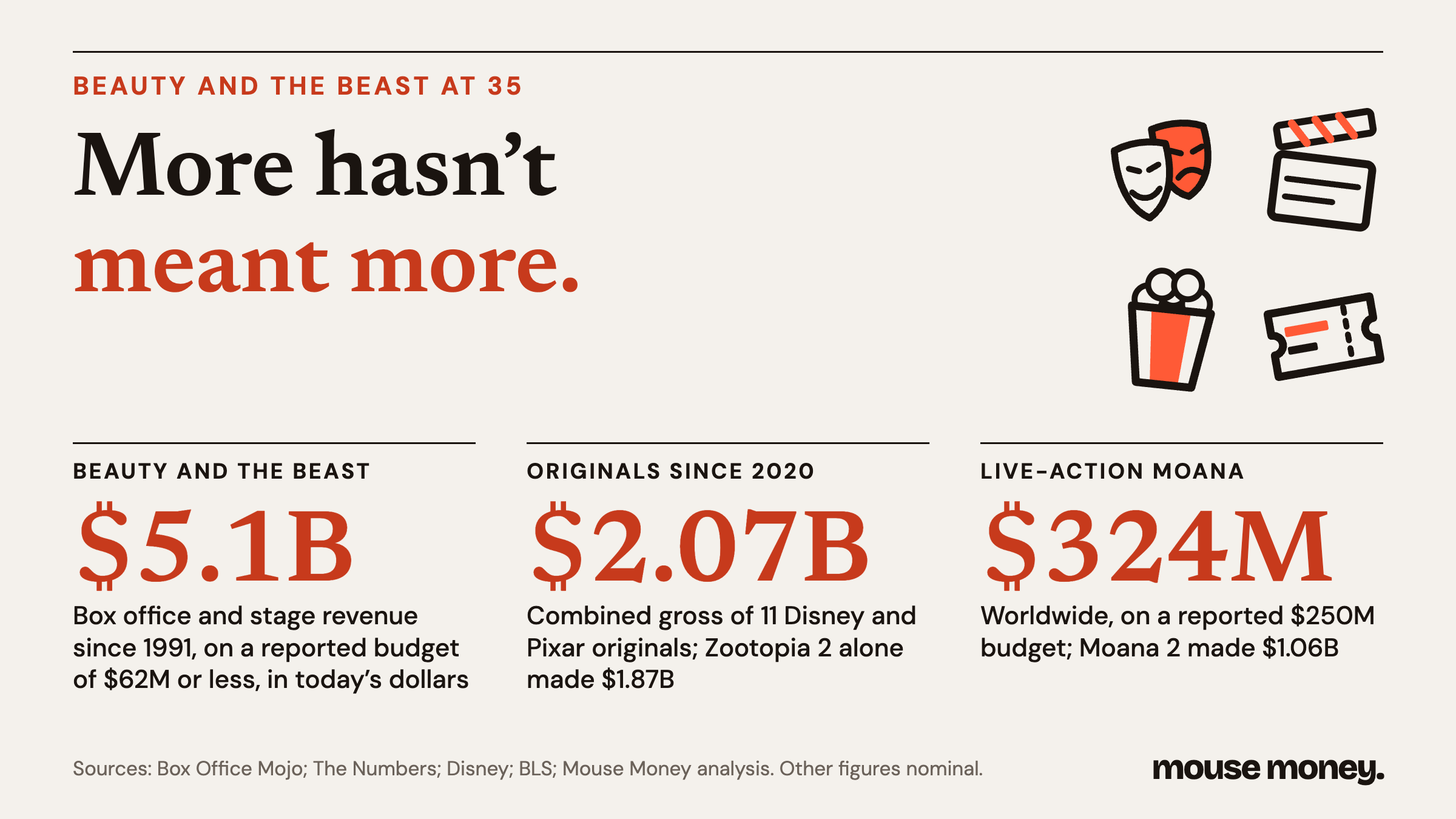
Disney released Beauty and the Beast 35 years ago this month. It has been finding new ways to sell it ever since.
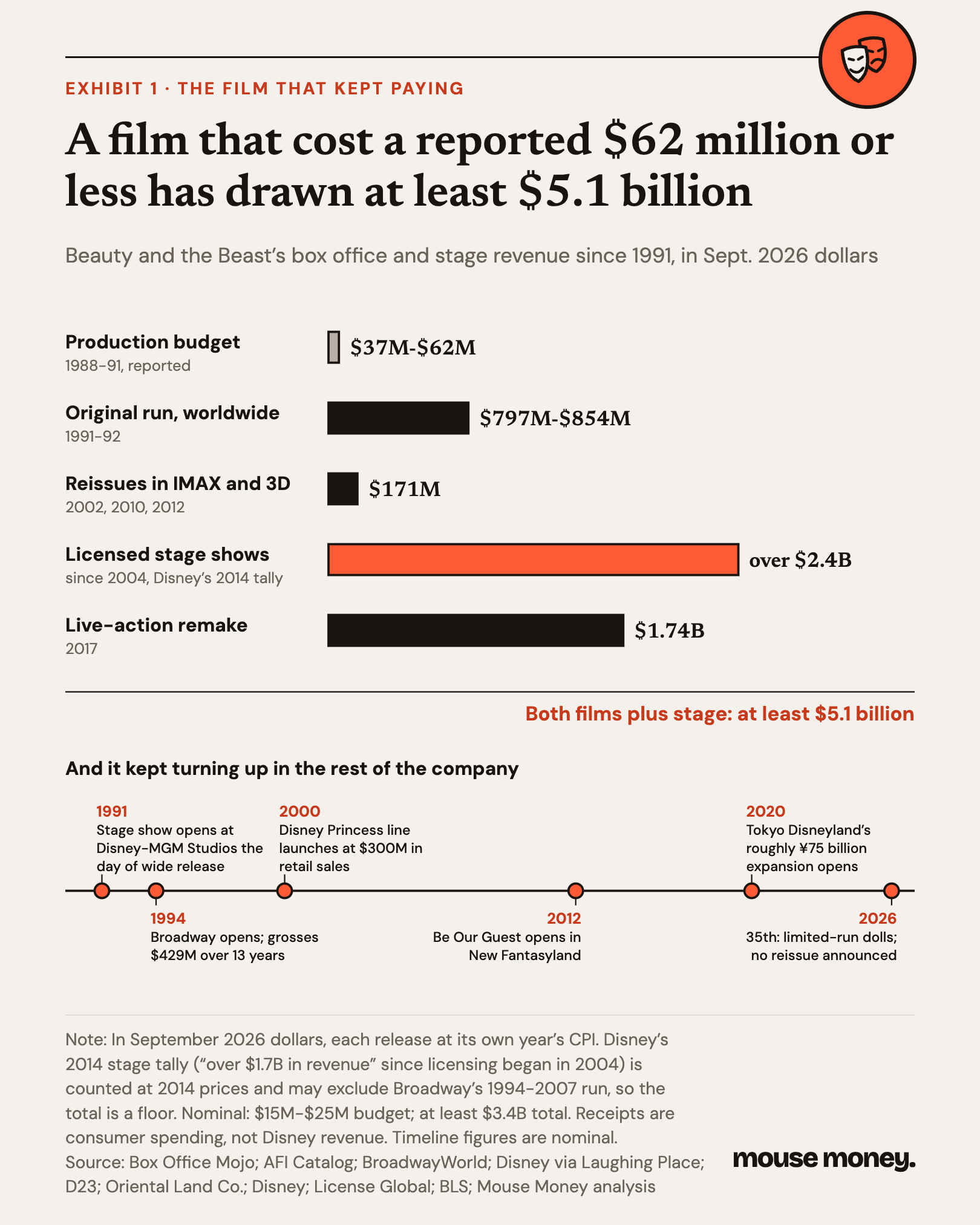
In today’s dollars, the animated film cost about $37 million to $62 million to make, based on a reported budget of $15 million to $25 million, and has taken in about $1 billion at the box office worldwide, counting rereleases. It was the first animated feature nominated for the best-picture Oscar. A stage version opened at a Disney theme park the day the film went into wide release, and the Broadway production that followed ran 13 years. The 2017 live-action remake grossed $1.74 billion in today’s dollars. Disney Theatrical and its touring partners said in 2014 that licensed stage productions had generated more than $1.7 billion, at least $2.4 billion today. All told, the story has drawn at least $5.1 billion in today’s dollars at the box office and on stage. Disney is still selling it: a limited run of 4,600 Belle dolls goes on sale Nov. 13.
Beauty and the Beast came out of a studio that released one animated feature a year at most, and many of the films from that stretch are still earning. Disney now makes far more: more animated features, more live-action remakes and, during the streaming push, a flood of series for Disney+. The record since has been spotty. Sequels to older hits are carrying the box office, while new originals and remakes mostly are not. Disney has already told investors that its live-action Moana, which grossed $324 million on a reported $250 million budget, will weigh on the Entertainment results it reports Nov. 17.
At 35, Beauty and the Beast is a reminder that more hasn’t meant more.
One film at a time
Walt Disney Animation Studios’ official filmography lists five features in the 1980s and nine in the 1990s, never more than one in a year. From The Little Mermaid in 1989 through Tarzan in 1999, the studio released about one film a year.
Each film got the company’s full attention, including a willingness to start over. In 1989, Jeffrey Katzenberg, then chairman of Disney’s film studio, watched the early storyboard reels for Beauty and the Beast, ordered the film scrapped and had it started again from scratch. First-time feature directors Kirk Wise and Gary Trousdale took over. Lyricist Howard Ashman, who had been developing Aladdin with composer Alan Menken, reluctantly joined to write the songs.
That decision to absorb the cost of a restart is still paying off.
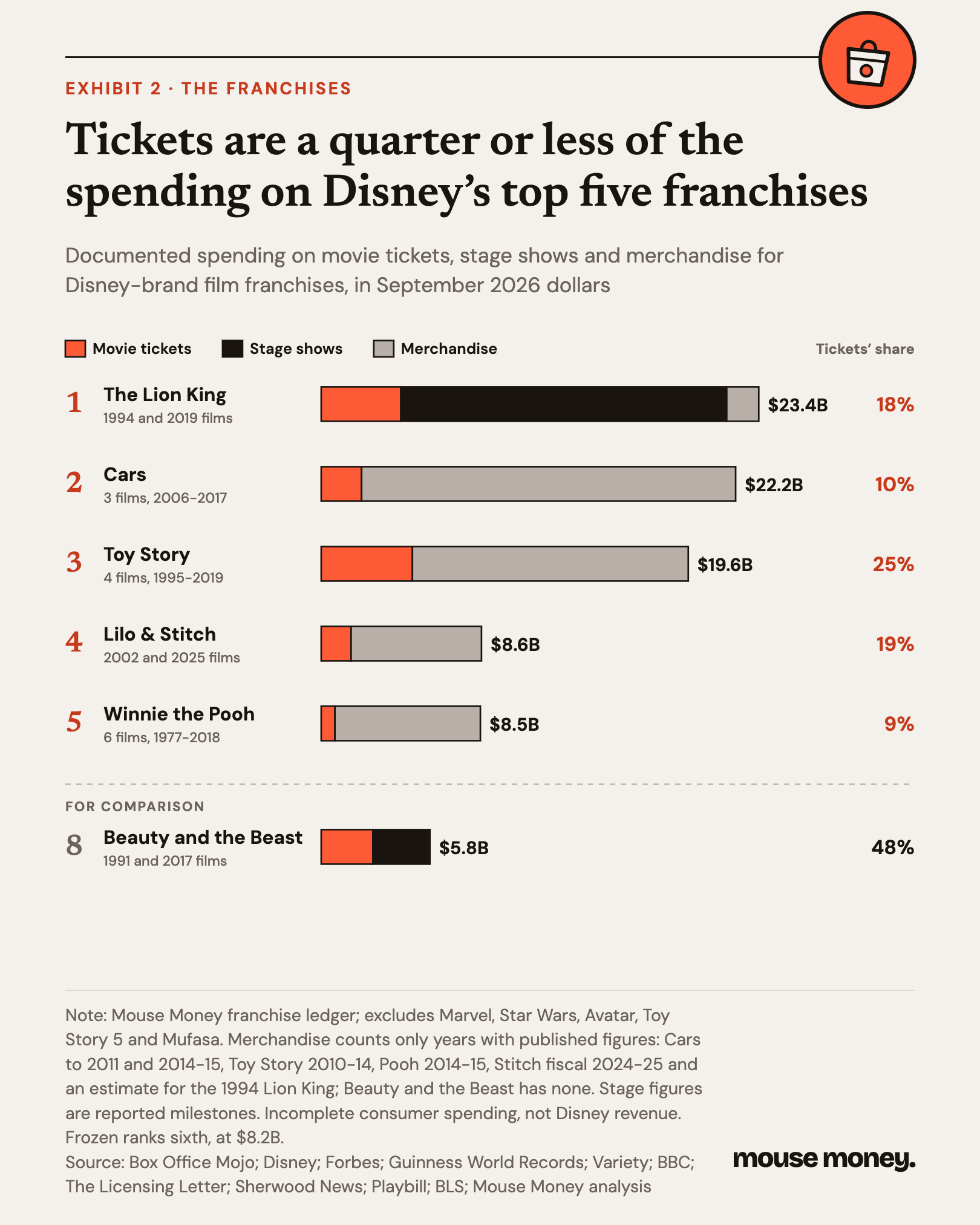
The rest of the decade did the same. Five of its films, Beauty and the Beast, The Lion King, The Little Mermaid, Tarzan and Aladdin, became Broadway musicals that have grossed $3.58 billion on Broadway alone, close to the $3.88 billion that the 10 films of the period known as the Disney Renaissance took in at the box office. Four of those five came back as live-action remakes; The Lion King’s grossed $1.66 billion in 2019. Not every film worked: The Rescuers Down Under made $47 million. But the hits kept paying long after release. By Mouse Money’s count of ticket sales, stage grosses and published merchandise figures, The Lion King is Disney’s biggest film franchise, at $23.4 billion in today’s dollars, and about three-quarters of that has come from the stage.
A spotty record since
The biggest films of recent years have gone back to worlds audiences already knew. Inside Out 2 grossed $1.70 billion, Zootopia 2 $1.87 billion, Toy Story 5 $1.15 billion and Moana 2 $1.06 billion. After inflation, three of the five biggest Disney-brand films ever are a remake or a sequel, and the top two both belong to The Lion King, a story Disney first told in 1994.
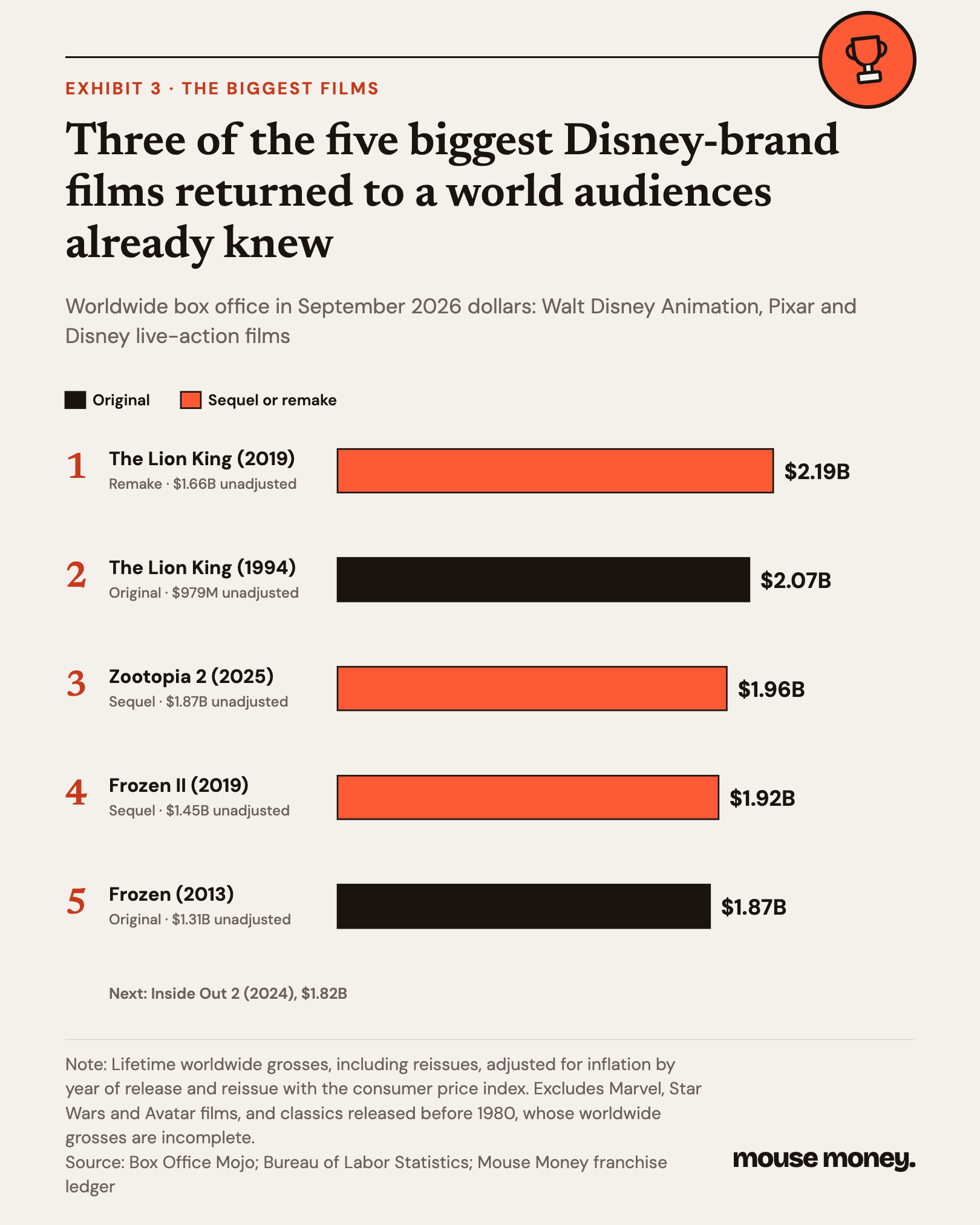
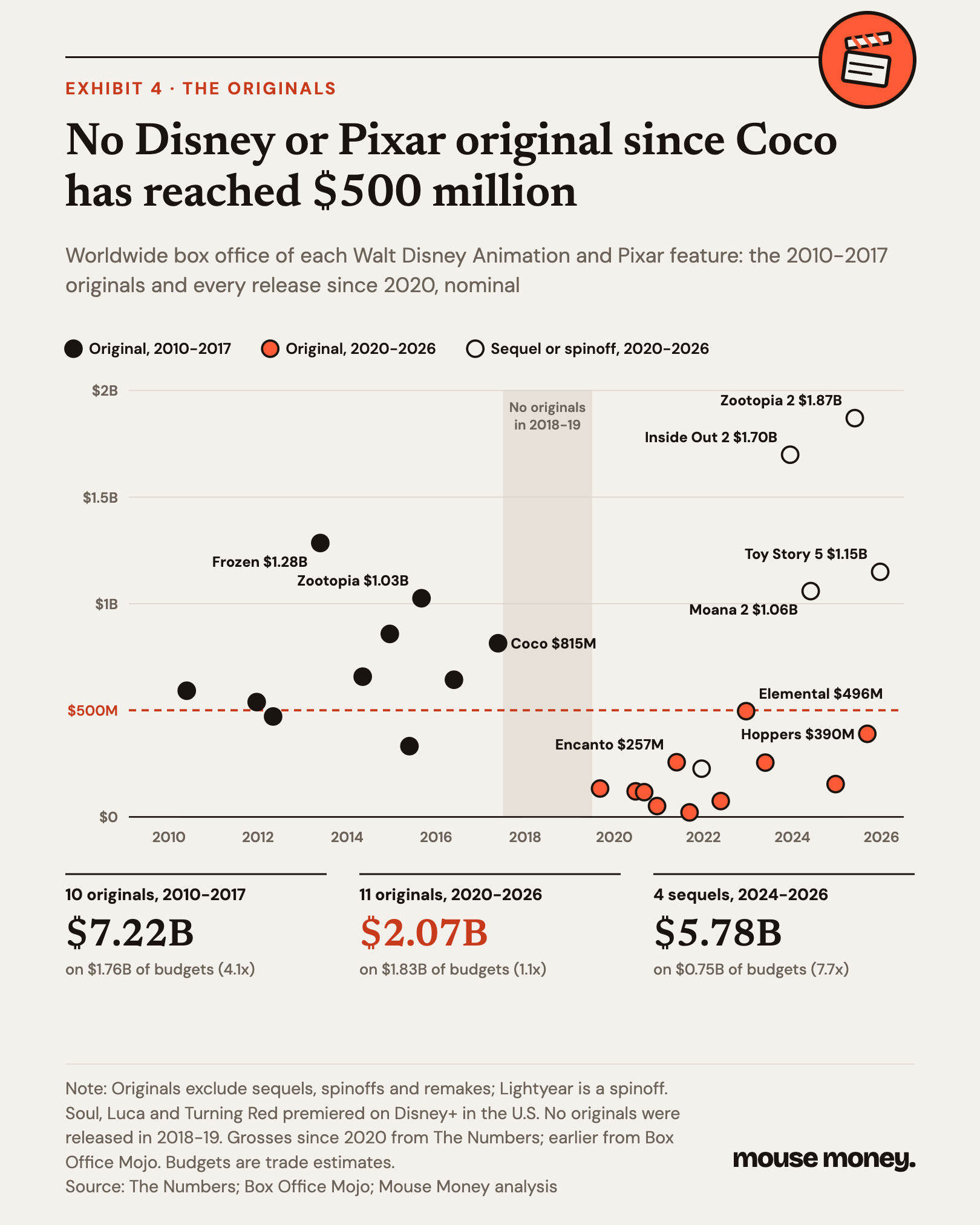
New stories have had a much harder time. The 11 original features that Walt Disney Animation and Pixar have released since 2020 grossed $2.07 billion worldwide combined, barely more than Zootopia 2 made by itself. None has reached $500 million. Pixar’s Elemental came closest at $496 million, and last year’s Elio made about $154 million.
The financial swings are large. Deadline’s annual estimates of film profits, which count production, marketing and later revenue, put Strange World’s loss at $197 million, Wish’s at $131 million and the Toy Story spinoff Lightyear’s at $106 million. Those three losses, $434 million in all, equal two-thirds of the $650 million profit Deadline estimated for Inside Out 2 in 2024. These are outside estimates for selected films, not Disney’s accounts, but they show how much expensive misses take back from the best films.
There are bright spots. Encanto found a big audience on Disney+ and is getting an Animal Kingdom attraction. Hoppers, Pixar’s March release, has made $390 million on a $150 million budget. And it is early: Beauty and the Beast took three years to reach Broadway.
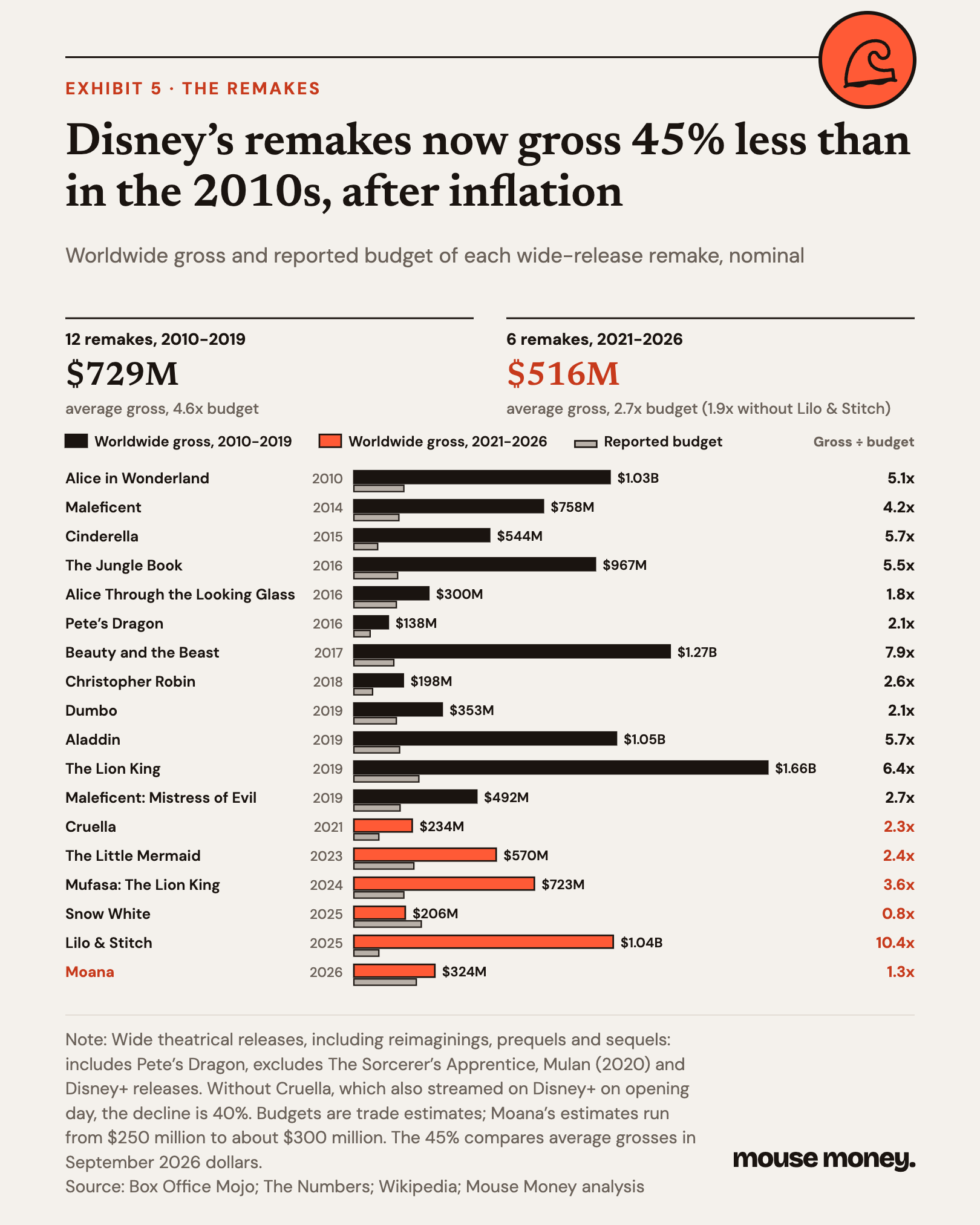
The remakes, which turned the 1990s classics into a second round of billion-dollar hits, are losing steam. The six wide releases since 2021 have averaged $516 million worldwide, against $729 million for the 12 released from 2010 through 2019, a 45% drop after inflation. This summer’s live-action Moana opened about 19 months after the animated sequel and took in about $324 million on a reported $250 million budget; Moana 2 had made $1.06 billion on a reported $150 million. In its August shareholder letter, Disney said the remake fell short of its box-office expectations and would weigh on fourth-quarter Entertainment results.
Disney made more
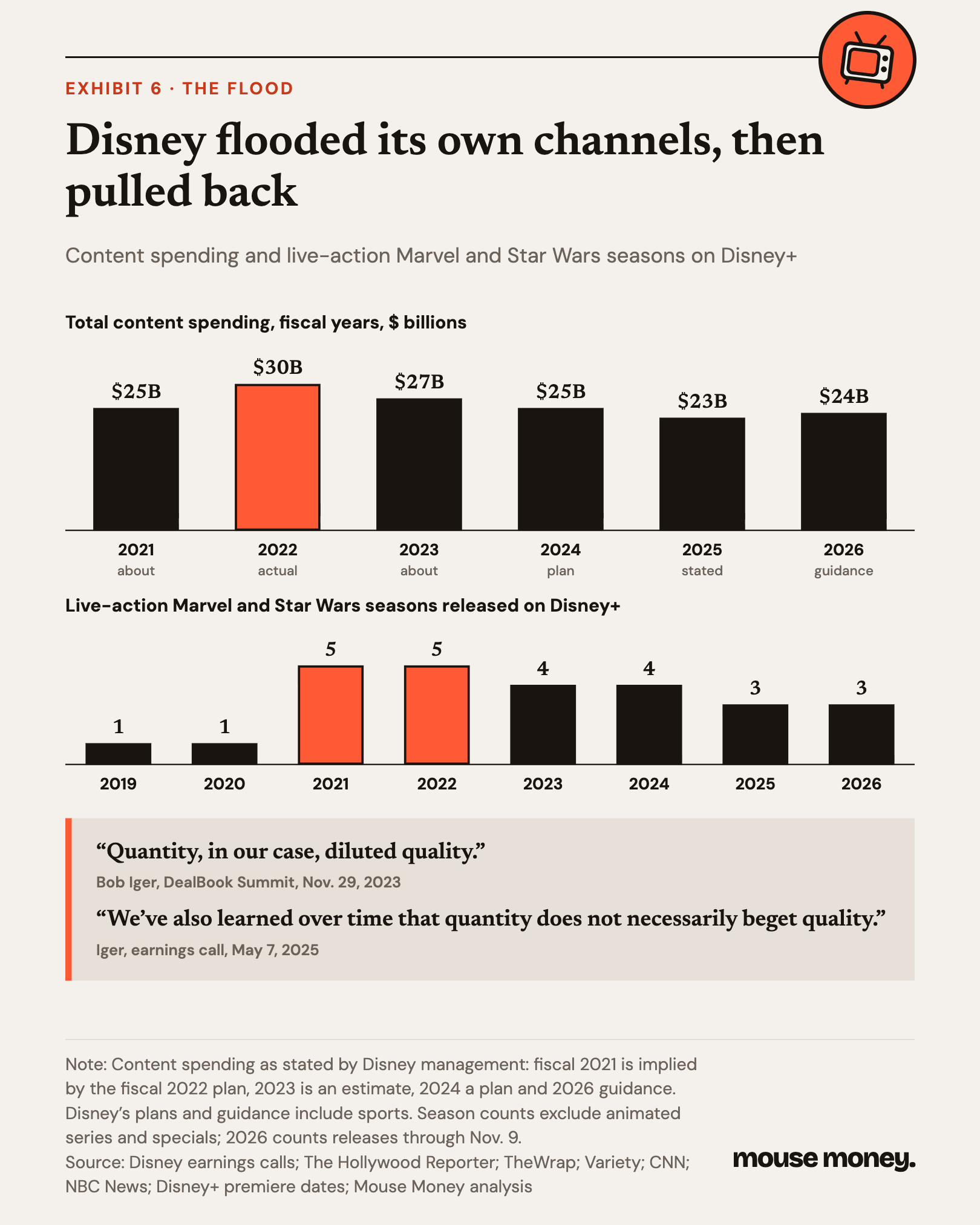
The bigger change is how much Disney asks of itself at once. In the 1990s, Walt Disney Animation released nine features and Pixar three. From 2020 through this year, the two studios have released 16, and Disney has added nine live-action remakes and spinoffs of its animated films. During the streaming push, Marvel and Star Wars put five live-action series seasons a year on Disney+ in 2021 and 2022, and cash spending on content reached $30 billion in fiscal 2022.
Bob Iger, back as chief executive at the time, delivered a verdict at the New York Times DealBook Summit in November 2023: “Quantity, in our case, diluted quality.” He was discussing Marvel. On the May 2025 earnings call, he went further: “We’ve also learned over time that quantity does not necessarily beget quality,” he said, describing Disney’s “zeal to flood our streaming platform with more content.”
The argument has limits. Walt Disney Animation itself still releases about one feature a year; the crowding is across Disney’s studios, its remake slate and its streaming service. The pandemic sent several films straight to Disney+, and U.S. and Canadian theaters sold 37% fewer tickets in 2025 than in 2019, by The Numbers’ count, which makes it harder for any unfamiliar title to break out. Iger’s admission does not explain why any single film failed.
Give the next classic room
Protecting quality pays more at Disney than at most studios, because one film can feed so many other businesses. The audience that falls in love with a story is the start of the stage shows, toys and rides that follow. A release date has no such earning power.
That should shape decisions long before a film reaches theaters. A story that isn’t working may need a rewrite, a new team, a smaller budget or more time. A sequel or remake that isn’t convincing should be canceled even when the franchise is popular. And Disney needs room for originals, because today’s profitable sequels depend on characters someone once took a chance on creating.
The next tests come quickly. Walt Disney Animation’s Hexed, its first original since Wish, opens Nov. 25, and Pixar’s Gatto follows in March.
What we’re watching
Nov. 17: Disney’s fiscal fourth-quarter results, including how much Moana weighed on Entertainment, and any guidance on next year’s content spending.
Nov. 22: The 35th anniversary of Beauty and the Beast’s wide release.
Nov. 25: Hexed opens in U.S. theaters.
March 5, 2027: Pixar’s Gatto opens.
Nov. 24, 2027: Frozen III, the next sequel to a hit from the 2010s.
What would change our view
If Hexed or Gatto breaks out and starts a franchise while Disney keeps its current pace, volume wasn’t the problem, and Disney can make more without getting less.
Thirty-five years on, Disney is still selling a story its filmmakers were willing to start over. That is the standard its next release should meet, even if meeting it means waiting.
A note on the numbers
Figures were checked Nov. 9, 2026. Release counts come from Walt Disney Animation Studios’ official filmography and Pixar’s film list; the 2020-2026 count runs through Toy Story 5 and includes films released straight to Disney+. Box-office figures are worldwide ticket sales in nominal dollars unless noted; they are not Disney revenue or profit. The Numbers supplies most film grosses and reported production budgets, which exclude marketing; Box Office Mojo supplies the 2017 Beauty and the Beast gross. Profit and loss figures are Deadline’s estimates, not Disney’s accounts. Inflation adjustments use the Bureau of Labor Statistics’ consumer price index, in September 2026 dollars, with each release at its own year’s prices. Beauty and the Beast’s $5.1 billion counts Disney’s 2014 stage figure at 2014 prices, so it is a floor; the franchise ledger, which spreads that figure over 1994 through 2014, puts the film’s tickets and stage revenue at $5.8 billion. Franchise totals and the inflation-adjusted film ranking come from Mouse Money’s franchise ledger, in September 2026 dollars; its merchandise figures cover only years with published data, so those totals are incomplete. Remake averages cover wide theatrical releases. Selected examples illustrate the economics but do not prove that releasing fewer films causes better ones.
Sources
Wikipedia, Beauty and the Beast (1991 film), for its development history
Box Office Mojo, Beauty and the Beast (1991) and (2017): 1, 2
Academy of Motion Picture Arts and Sciences, 64th Academy Awards
BroadwayWorld grosses for Beauty and the Beast, The Lion King and Aladdin: 1, 2, 3
Laughing Place, Disney’s 2014 stage tally for Beauty and the Beast (April 9, 2014)
The Numbers, title pages for Elemental, Inside Out 2, Moana 2, Zootopia 2, Hoppers, Toy Story 5, Snow White and Moana (2026): 1, 2, 3, 4, 5, 6, 7, 8
Wikipedia, the Disney Renaissance and lists of Pixar films, Disney live-action remakes, Marvel Cinematic Universe television series and Star Wars television series: 1, 2, 3, 4, 5
Disney fiscal fourth-quarter 2022 earnings call transcript (Nov. 8, 2022), via MarketBeat
CNN, via ABC17, and NBC News on Iger at the DealBook Summit (Nov. 29, 2023): 1, 2
Disney fiscal second-quarter 2025 earnings call (May 7, 2025), transcript via Bullfincher, and A.V. Club: 1, 2
Cartoon Brew and Deadline, via Yahoo, on Deadline’s estimated losses for Strange World, Wish and Lightyear: 1, 2
Forbes and Deadline on the most profitable films of 2024: 1, 2
Disney fiscal third-quarter 2026 shareholder letter (Aug. 5, 2026)