


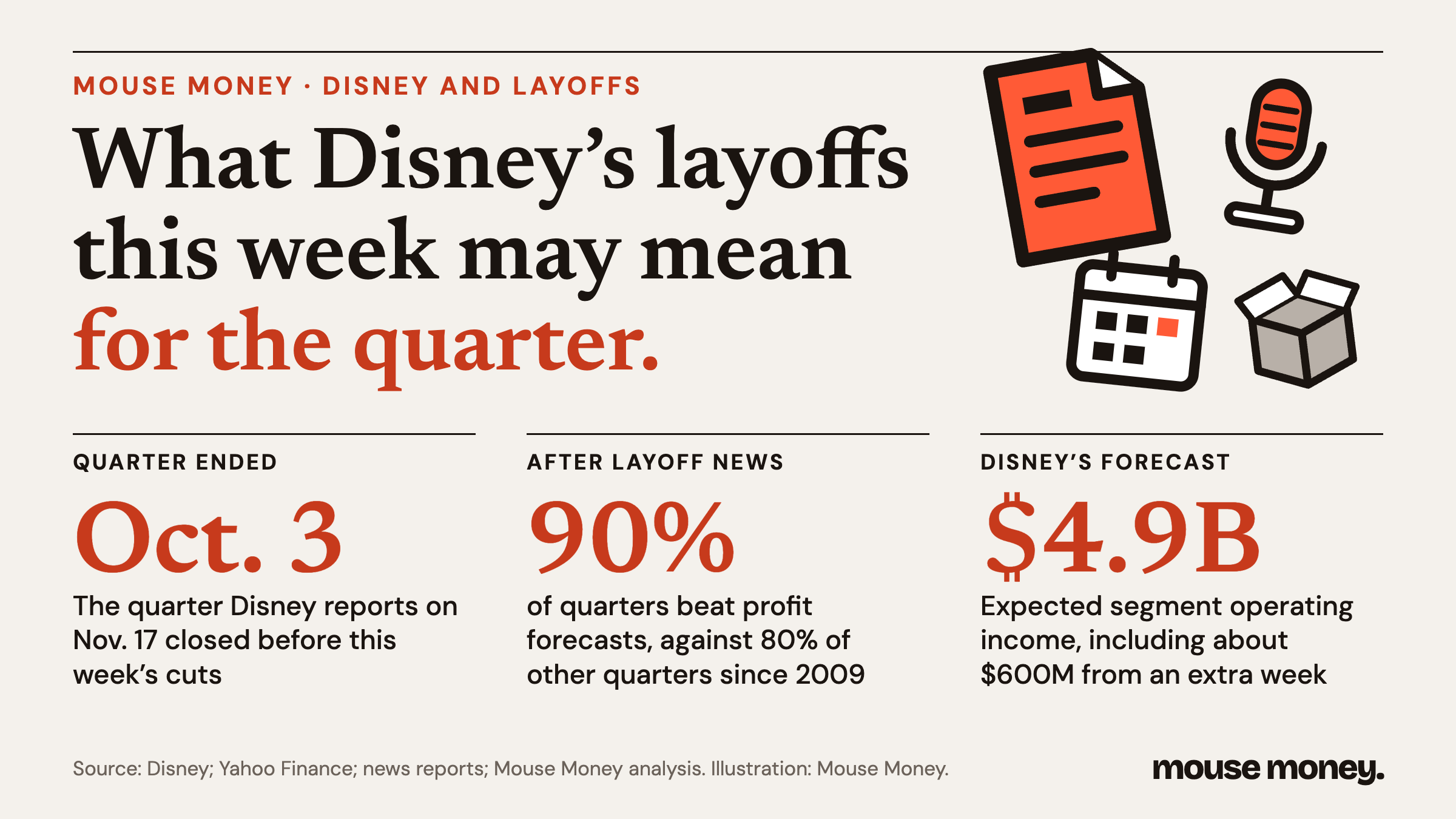
Disney’s latest job cuts arrive three weeks before its next earnings report, raising a familiar question: Are they a warning about business conditions or an effort to improve profits?
Mouse Money’s review of Disney’s job cuts since 2009 offers little evidence that their timing reliably answers either question. The more useful clues may be what executives have already told investors about costs, and what they say next about the year ahead.
Start with the record on earnings. Disney topped analysts’ profit forecasts in 19 of the 21 quarters that followed layoff news since 2009, according to Yahoo Finance’s data. It topped them in 39 of its 49 other quarters over the same period, or 80%. The difference amounts to about two quarters, and a sample this small cannot show that layoffs predict a beat.
The latest cuts are in Disney’s parks division, including Walt Disney Imagineering. On Oct. 27, Disney’s parks division notified California regulators that it would lay off 159 people at Imagineering’s headquarters in Glendale, effective Dec. 29. The next day, the Los Angeles Times reported that the division was cutting 100 to 200 jobs. Disney declined to comment. It was the fourth round of cuts since Josh D’Amaro became chief executive in March, after about 1,000 jobs in April, several hundred at Pixar, National Geographic and other units in July, and a few hundred in human resources and technology at the end of September.
The quarter has already closed
The fiscal fourth quarter that Disney reports on Nov. 17 ended on Oct. 3. The September cuts came in its final week, and this week’s came after it closed. The Imagineering layoffs take effect Dec. 29, so their payroll savings begin well into Disney’s 2027 fiscal year. Announcing cuts before an earnings report does not mean the savings helped the quarter being reported.
Severance runs on its own schedule. Disney records it in restructuring charges, which it leaves out of adjusted earnings per share, the figure analysts forecast. In its fiscal third quarter, Disney left $900 million of restructuring and impairment charges out of adjusted earnings: an $812 million write-down of its stake in A+E and $88 million of severance. It recorded $180 million of severance in the first nine months of the fiscal year.
Disney’s own forecast
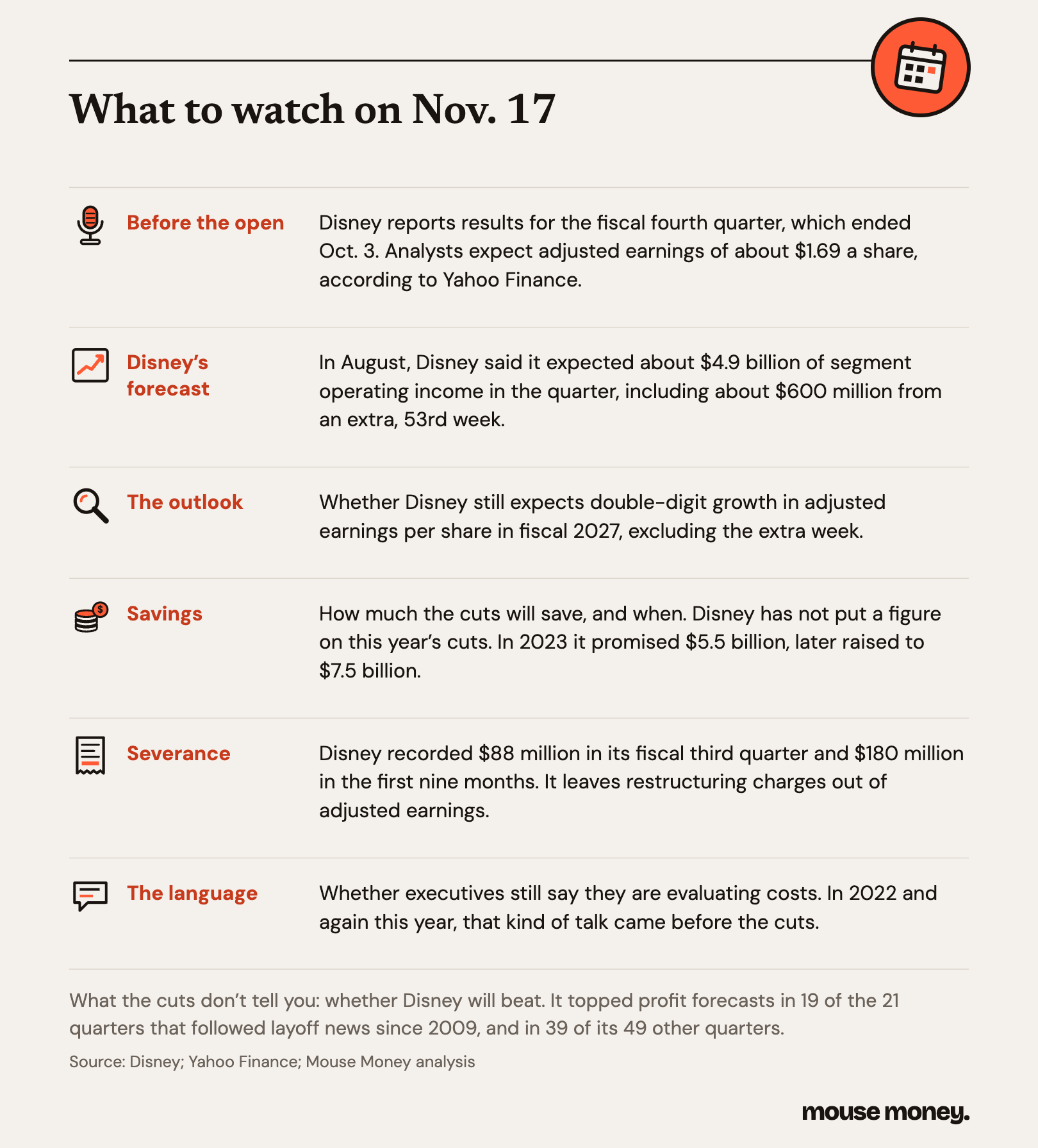
Analysts expect adjusted earnings of about $1.69 a share, according to Yahoo Finance. Disney has given its own benchmark. In August, it said it expected about $4.9 billion of segment operating income in the fourth quarter, including about $600 million from a 53rd week. Disney’s fiscal year usually has 52 weeks; this year’s extra week falls in the fourth quarter and will flatter comparisons with a year earlier.
Disney also said it expected double-digit growth in adjusted earnings per share in fiscal 2027, excluding the extra week. Whether it keeps that outlook will say more about the year ahead than the layoffs do.
The calendar
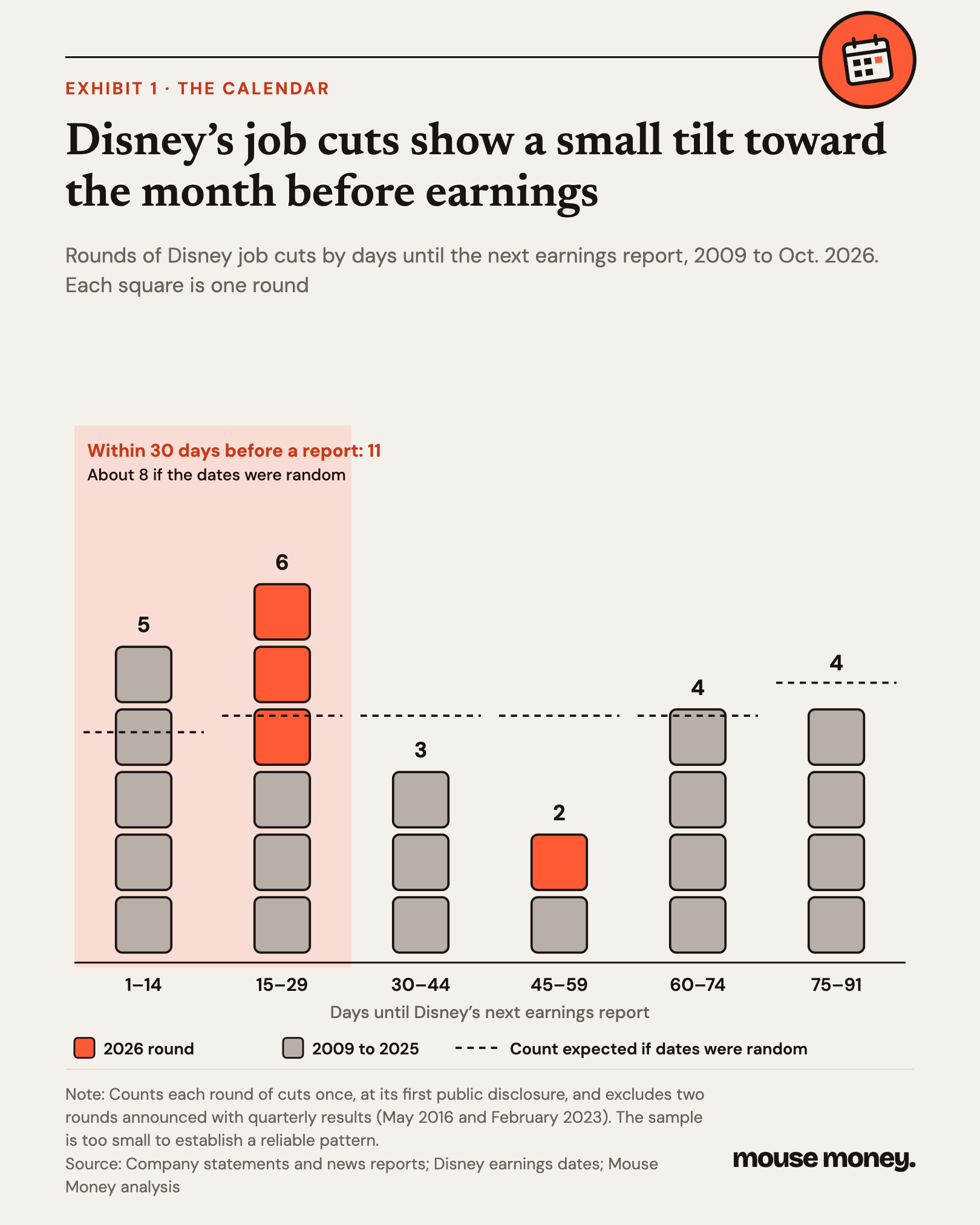
This year’s timing invites a theory: cut before the call, and the cost story is ready when investors listen in. Three of Disney’s four rounds of cuts this year were first disclosed two to four weeks before an earnings report.
The longer record is less tidy. Mouse Money counted 26 distinct rounds of Disney job cuts since 2009, treating a news report and a memo about the same cuts as one round. Two were announced along with quarterly results. Of the other 24, 11 were first disclosed in the 30 days before an earnings report, against about 8 if the dates were random, and 8 in the 30 days after one. The sample does not establish a reliable pattern of layoffs clustering before earnings reports.
The stock
Share-price moves around most rounds were within Disney’s usual range of market-relative fluctuations. One standard deviation of Disney’s two-day move against the S&P 500 is about 1.75 percentage points. Over the first two sessions after each round was first disclosed, the gap was smaller than that 21 times out of 24, and Disney trailed the index by an average of 0.13 percentage point.
Three of the four rounds of about 1,000 jobs or more that were not announced with results were followed by two-day declines against the market, the largest after the 28,000 pandemic layoffs at the parks in September 2020, at 3.0 percentage points. Four rounds are too few to draw a conclusion, and the count depends on how two of them are dated.
This week’s reaction is hard to read. The Times story appeared shortly before the market closed on Oct. 28, so most of that day’s trading came before it. On Oct. 29, the first full session after the report, Disney rose 1.7% while the S&P 500 fell 0.3%.
Talk first, cut later
In two cost pushes, Disney signaled cost reductions in earnings communications before employees received layoff notices. The first ran from late 2022 into 2023. On its November 2022 earnings call, Christine McCarthy, then Disney’s finance chief, told analysts, “We are actively evaluating our cost base currently, and we’re looking for meaningful efficiencies.” Three days later, Bob Chapek, then the chief executive, sent a memo saying Disney was “limiting headcount additions through a targeted hiring freeze” and that “we do anticipate some staff reductions as part of this review.” Bob Iger, who replaced Chapek later that month, announced 7,000 job cuts on the February 2023 earnings call, and the layoffs came in three waves starting in late March.
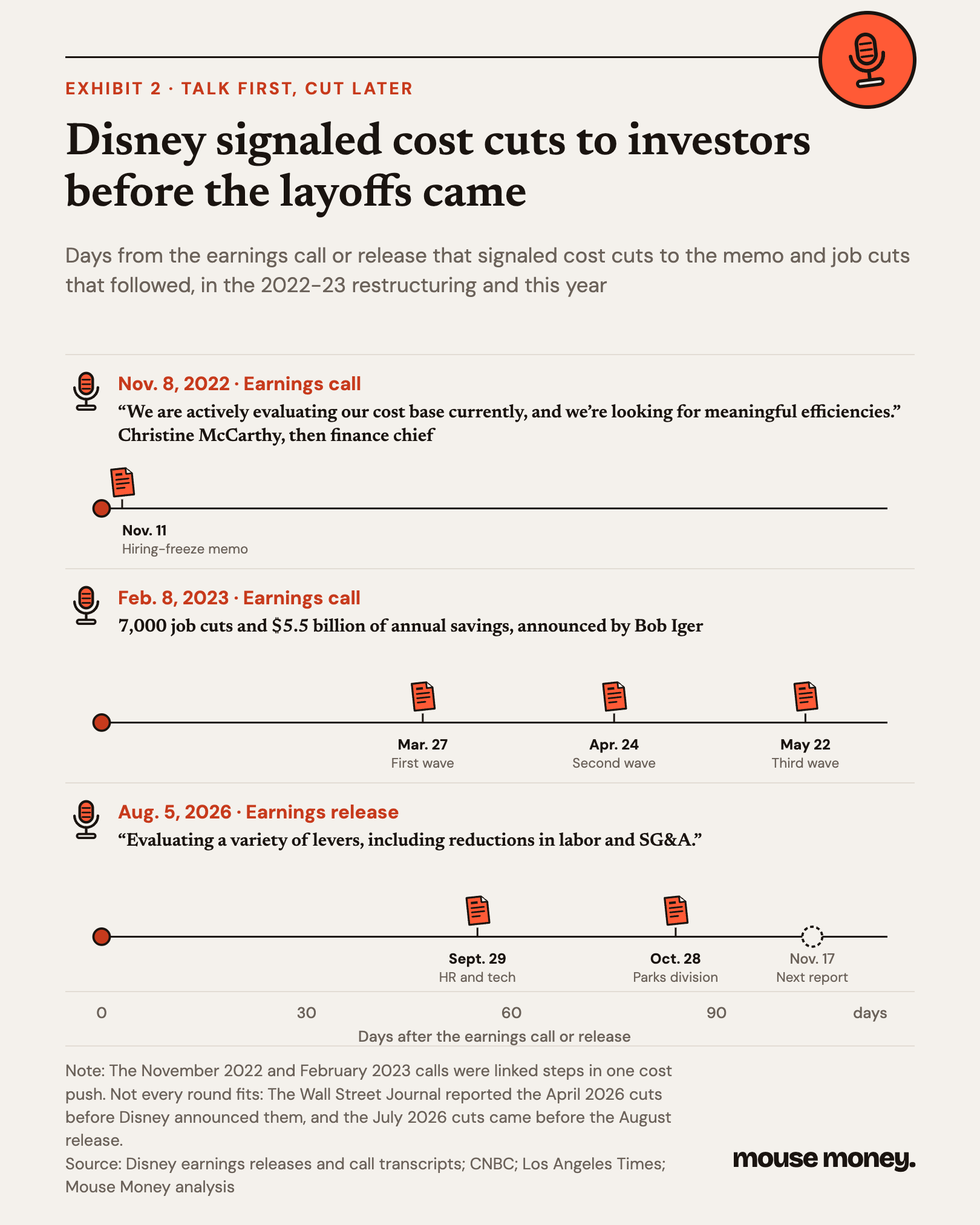
This year the signal came in writing. On Aug. 5, Disney’s earnings release said the company was “evaluating a variety of levers, including reductions in labor and SG&A,” and that it was “mid-stream in this work.” The human resources and technology cuts came 55 days later, and the parks division cuts 84 days later.
Not every round fits. The Wall Street Journal reported April’s cuts before Disney announced them, July’s cuts came before the August release, and the 2020 parks layoffs, announced in a memo from D’Amaro, then the parks chairman, were forced by closures during the pandemic. Two cost pushes cannot establish a rule, but they suggest where to look.
The headcount question
Critics have long argued that Disney costs too much to run, and its workforce grew 74% from fiscal 2006 to fiscal 2025, to about 231,000. Headcount alone does not establish excess overhead. Disney’s workforce rose by about 22,000 in fiscal 2019, the year it acquired most of 21st Century Fox. Its fiscal 2020 annual report, which broke out employees by segment, showed about three-quarters working in parks, experiences and products, where hotels and rides need staff in a way that streaming does not. The activist complaints centered on overhead: Trian Fund Management said Disney’s selling, general and administrative expenses rose 85% from fiscal 2018 to fiscal 2022.
What Disney needs to answer on Nov. 17
The layoffs alone offer little basis for predicting an earnings beat or miss. The more consequential questions are how much Disney expects to save, when those savings will arrive and whether its outlook has changed. Disney has not put a figure on savings from this year’s cuts; in 2023, it promised $5.5 billion, later raising the target to $7.5 billion. Listen, too, for whether executives still say they are evaluating costs. In 2022 and again this year, that kind of language came before the layoffs.
Mouse Money will break down Disney’s results after the Nov. 17 report, including what the company says about costs.
How we did this
We counted a round of job cuts when a company statement, memo, filing or credible news report first disclosed it, from January 2009 through Oct. 28, 2026. Later reports that carried out, enlarged or confirmed a round already disclosed were folded into it: the April 2026 news report and memo are one round, as are the February 2023 announcement and its three waves, the February 2009 parks reorganization and the 1,900 parks job cuts that followed in April, and the 2020 parks layoffs and their later increase. ESPN’s June 2023 on-air cuts count as a separate round because CNBC reported they were separate from the 2023 restructuring. That leaves 26 rounds from 32 announcements. Two of the rounds were not layoffs as such: the January 2009 buyout offer to parks executives and the November 2022 hiring-freeze memo, which said Disney anticipated staff reductions. Grouping is a judgment. Folding the November 2022 memo into the 2023 restructuring, or the January 2009 buyouts into that year’s parks reorganization, leaves the result at 11 of 23 or 24 rounds in the 30 days before a report. A one-sided binomial test gives p between 0.10 and 0.13, which we treat as a rough guide, not a definitive test.
Sizes are as reported, often by unnamed sources; “several hundred” is counted as 300, and a round’s size is the largest figure reported for it. Day 0 is the first trading session that could react: the day of the news if it broke before the 3 p.m. Central close or the time is unknown, and otherwise the next session. We dated The Wall Street Journal’s April 8, 2026 report to April 9 because the earliest follow-up reports we found appeared that morning; dated to April 8, the April round would show a gain against the market. The stock measure is Disney’s daily change, using dividend-adjusted prices from Yahoo Finance, minus the S&P 500’s, over two sessions; its standard deviation since 2006 is about 1.75 percentage points.
Earnings forecasts and results are Yahoo Finance’s adjusted figures; other providers may differ slightly. The 21 quarters that followed layoff news are the first reports after each disclosure of cuts. They include February 2023, which followed the November 2022 memo, and exclude May 2016, when Disney announced the cuts with its results. The 49 other quarters are the rest of Disney’s reports from February 2009 to August 2026. Counting only the quarters that followed a new round gives 19 of 20, against 39 of 50 for the rest. Headcount comes from Disney’s annual reports. Prices were checked through Oct. 29, 2026.
This article was updated on Oct. 30, 2026, after it was first sent by email. The revision counts distinct rounds of job cuts rather than separate announcements, which changed the timing and stock figures; adds Disney’s own fourth-quarter forecast and when the quarter ended; and shortens the article, removing comparisons of revenue per employee over time and with other media companies, a comparison with other companies’ 2026 layoffs and a passage on Disney’s hiring from Character.AI.
Sources
Yahoo Finance on Josh D’Amaro’s appointment as chief executive, Feb. 3, 2026
Reuters via Yahoo Finance on The Wall Street Journal’s April 8, 2026 report
Associated Press on the April 14, 2026 layoffs and D’Amaro’s memo
CNBC on Disney’s reorganization and 7,000 job cuts, Feb. 8, 2023
The Walt Disney Company, fourth-quarter fiscal 2023 earnings release, Nov. 8, 2023
Trian Fund Management, “Restore the Magic,” SEC filing, January 2023
Orlando Sentinel via Hotel Online on parks executive buyouts, January 2009
Los Angeles Times on Disney Entertainment Television cuts, July 2024